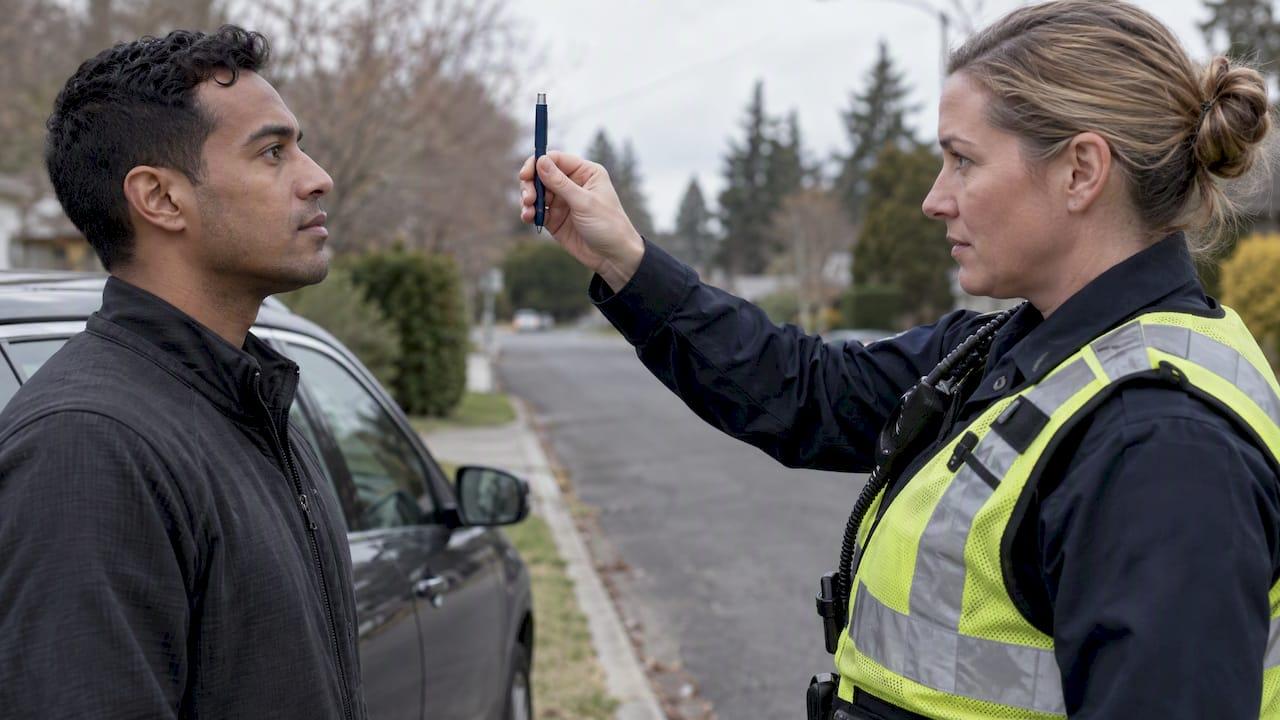
The HGN (horizontal gaze nystagmus) test is not as accurate as the numbers prosecutors quote make it sound. The best-known figure, about 77%, comes from a 1980s laboratory study that measured how often the test sorted people above or below a set blood alcohol level. It did not measure whether you were too impaired to drive, and it assumed a properly trained officer following the procedure exactly. In a real roadside stop, with a flashing light bar, a tired driver and an officer who may have rushed the test, results can be much less reliable.
Below, we walk through what the studies found, where they fall short, what else makes eyes jerk, and what that means if you were arrested for DUI in San Diego.
TL;DR
- NHTSA's original study reported about 77% correct classification for HGN at the 0.10% BAC threshold, higher than the walk-and-turn (68%) and one-leg stand (65%).
- That percentage measures how well the test sorted people by BAC under study conditions. It says nothing about driving impairment, and field results depend on the officer.
- Age, medical conditions, medications and testing conditions can all affect nystagmus, and independent reviewers call the supporting science limited.
- Courts generally let officers describe HGN observations, but not use them to put a number on your BAC. A properly challenged HGN result is often a weak point in the prosecution's case.
- Field sobriety tests are voluntary in California for most drivers. How you handle them matters, and so does what you do after an arrest.
Table of Contents
- What the HGN test is and why officers use it
- Where the 77% figure comes from
- The 1998 San Diego validation study
- Other research that supports HGN
- What independent reviewers say about the limits
- What else causes nystagmus besides alcohol
- How courts treat HGN results
- HGN versus the other field sobriety tests
- Our perspective
- Talk to a San Diego DUI defense lawyer
- What to do after an HGN test and arrest
- FAQ
- Sources
What the HGN test is and why officers use it
Nystagmus is an involuntary jerking of the eyes. Alcohol and some other depressant drugs make the jerking appear earlier and more clearly when the eyes move to the side. In the HGN test, an officer holds a pen or fingertip about a foot or so from your face and moves it side to side while you follow it with your eyes only. The officer watches for three things in each eye: whether the eye tracks smoothly, whether it jerks distinctly when held at the far edge, and whether the jerking starts before the eye reaches about 45 degrees. A California appellate court described this last sign, onset of nystagmus before a 45 degree gaze angle, in People v. Joehnk.
Officers like the test because it takes about a minute, needs no equipment, and feels objective. You cannot easily fake or hide the result. But the same features that make it appealing also make it hard to challenge on the roadside: the officer is the only one who sees your eyes, and unless the stop was recorded in a way that captures your face, the jury is relying on the officer's account.
Where the 77% figure comes from
The number you see on nearly every website traces back to a federally funded study. In NHTSA's original laboratory study, Improved Sobriety Testing, gaze nystagmus correctly classified about 77% of subjects as above or below 0.10% BAC. In the same study, the walk-and-turn classified 68% correctly and the one-leg stand 65%.
Three details matter before you rely on that number:
- It is a classification rate, not a guarantee. A 77% rate means roughly one in four people was misclassified. Some of those errors are sober or under-the-limit people who appear impaired.
- The threshold was 0.10%. California's per se limit for most adult drivers is 0.08%. The study was not built around the limit in your case.
- It was a controlled study. Trained testers, planned conditions and known BACs are very different from a roadside at night.
The 1998 San Diego validation study
Because it was conducted locally, San Diego drivers hear about the 1998 field study more than most. NHTSA's 1998 validation study looked at 297 motorists stopped by San Diego officers. HGN was the most predictive single component of the field sobriety battery, with a correlation of r=0.65 against BAC. The three-test battery together correlated at r=0.69. Officers' decisions on whether a driver was above or below 0.08% were right in 91% of cases, or 94% if explanations for some false positives are accepted.
Those are real numbers, and we do not pretend otherwise. But the same study had features that limit how far it can be stretched:
- It used only seven trained San Diego officers, so it says little about the average officer.
- It used modified scoring rather than the standard scoring used elsewhere.
- It involved officers who were deciding whether to arrest, and a breath test followed. The study evaluated the battery as a tool to help officers make arrest decisions and to discriminate BAC at specific thresholds, not as proof of impairment.
- The officers knew they were part of a study of this exact question.
A 91% accuracy rate on an arrest decision also means roughly one in eleven calls was wrong, and when thousands of people are stopped, that is a lot of people.
Other research that supports HGN
Fairness requires saying that the science is not empty. Several studies found HGN to be a useful indicator of alcohol:
- A study of low BACs found that standardized HGN, using alternative scoring criteria, was the only reliably useful index for distinguishing a BAC below versus above 0.04% in the 0.00% to 0.08% range.
- A study of 96 volunteer drinkers found HGN signs increased with BAC and that HGN given standing, seated or lying down discriminated impairment at criterion BACs of 0.08% and 0.10%.
- NHTSA's 2007 robustness experiments varied stimulus speed, elevation, distance, posture and vision in one eye, and the report concluded those variations did not change whether HGN occurred or was observed.
A good defense attorney knows this research and does not pretend it away. The job is to show where it stops applying to your case.
What independent reviewers say about the limits
The harshest criticism comes from scientists outside law enforcement. A peer-reviewed review of the standardized field sobriety tests in Law and Human Behavior concluded that the supporting research was limited, that important confounding factors had not been studied thoroughly, and that reliability was mediocre. It also argued the tests had been oversold in prosecution-oriented materials.
A separate review of the vision science behind HGN in the Journal of Forensic Sciences concluded that the test is limited by substantial variation in normal responses, poorly controlled methods and testing environments, and a lack of rigorous laboratory validation.
Steven Rubenzer's review adds two points that matter in court. First, officer-to-officer differences in giving and scoring the test are a substantial source of error. Second, every SFST study used BAC as the yardstick, and none had used mental, behavioral or driving impairment as the criterion. In other words, nobody has shown that a given HGN score means you could not safely drive.

What else causes nystagmus besides alcohol
Police training materials often treat nystagmus as a nearly alcohol-specific sign. The vision science literature is less tidy. According to the forensic vision science review, possible influences include:
- Age
- Stimulus and background conditions, such as moving or flashing lights behind the officer
- Medical conditions
- Prescription medications
- Psychiatric disorders
The same review notes that onset nystagmus may appear in some sober people at 45 degrees or less. That matters because onset before 45 degrees is one of the three clues officers count.
The posture study is also worth knowing. It reported that positional alcohol nystagmus was most often seen at BACs of 0.08% or higher, but was not confused with HGN or vertical gaze nystagmus regardless of posture. So not every challenge works. A defense built on "you tested me lying down" needs more than posture.
Questions a defense attorney asks about the test itself
When we review an HGN claim, we look at specifics rather than the label:
- Was the officer trained and current? Training and certification records are discoverable.
- Was the test given correctly? Stimulus distance, speed, holding time at the edge, and whether the officer checked for equal pupil size and tracking all matter.
- What was behind you? Patrol car light bars, headlights and passing traffic can cause or hide eye movement.
- Is there video? Body-worn camera or dash video often shows how long the officer really held the stimulus, and whether the officer's report matches the footage.
- Do you have a medical or vision condition? Records can explain what the officer attributed to alcohol.
- How did the officer record it? Vague report language such as "HGN present" without clue counts is a weakness.
How courts treat HGN results
Courts across the country have settled on a middle position: HGN can show signs consistent with alcohol, but it cannot stand in for a chemical test.
- In California, the Supreme Court held in Leahy that HGN results come in only if the technique passes the Kelly test for scientific evidence. In People v. Joehnk, the Court of Appeal concluded that HGN testing was admissible as a basis for an officer's opinion that the driver was under the influence of alcohol.
- A Washington appellate opinion held HGN can indicate physical signs consistent with alcohol consumption but cannot establish impairment by itself, and testimony asserting impairment solely from HGN was improper.
- In State v. Ruthardt, Delaware's Superior Court admitted HGN for probable cause and, with an expert foundation, as circumstantial evidence of being under the influence, but barred using it to quantify BAC.
- Oregon's State v. O'Key held HGN admissible to show being under the influence of intoxicants but not BAC, and required proof that the officer was qualified, administered the test properly and recorded the results accurately.
The practical lesson is that HGN is rarely the whole case. It usually works alongside driving pattern, the officer's observations, other field tests and a breath or blood result. Weakening one piece, particularly one that depends on the officer's eyes and memory, can change how a prosecutor and a jury view the rest. Prosecutors know this too, which is why a case with a weak HGN foundation sometimes ends with a better plea offer or a dismissal.
HGN versus the other field sobriety tests
| Test | Correct classification in NHTSA's original study | What it tends to depend on |
|---|---|---|
| Horizontal gaze nystagmus | About 77% | Officer's observation of your eyes, lighting, medical factors |
| Walk-and-turn | About 68% | Balance, footwear, surface, age, weight, injuries |
| One-leg stand | About 65% | Balance, surface, age, injuries, nerves |
Rubenzer's review found that SFSTs correlate substantially with BAC and that HGN generally correlates more strongly than the psychomotor tests. HGN does perform best on paper. That is exactly why it matters to challenge it with facts instead of just calling it unreliable. For a broader look across all three tests, see our post on field sobriety test accuracy.
Our perspective
We do not tell clients that HGN is junk science, because that is not what the research says, and a judge will not buy it. What we tell them is more useful: the test is a tool with a known error rate, built to help an officer decide whether to arrest, and then it gets promoted into something it was never validated to be, proof of impairment.

Our approach to DUI defense starts with the story the evidence actually tells. We look at the video, the officer's training, the clue counts, the lighting, and whether the number on the breath test matches what was happening in your body at the time you were driving. In some cases that means showing a jury that the officer's observations were rushed or misdescribed. In others it means a rising BAC defense, where the test came hours after the driving. Either way, we want the prosecution to prove each piece rather than assume it.
The stakes are not just the criminal case. A DUI arrest starts a separate DMV process with its own deadline, and licensed professionals can face consequences beyond court. A case worked up carefully from day one gives you more options.
— Logan Noblin
Talk to a San Diego DUI defense lawyer
If you were arrested after an HGN test, the details of that roadside stop are some of the most useful evidence you have, and some of the most perishable. Video can be overwritten and memories fade. Our firm handles DUI cases from first-time arrests to repeat offenses, and you can see the full range of what we handle on our criminal defense page.

We will review the officer's report, the clue counts and any video, and tell you candidly where the case is strong and where it is not.
What to do after an HGN test and arrest
- Write down what you remember now. Where the officer stood, what was behind you, how long the test took, what you were wearing, and any medical conditions or medications.
- Do not talk about the test with anyone but your lawyer. Statements can be used.
- Watch your DMV deadline. Our guide to the DUI DMV hearing in California explains how to protect your license.
- Learn the court path. Our overview of the DUI court process in California explains what happens step by step.
- Ask about the roadside stop. If you were stopped at a sobriety checkpoint, there may be additional issues; see our post on DUI checkpoint rights in California.
If you are still deciding how to handle a future stop, read our post on whether you can refuse a field sobriety test, including the risks of each choice.
FAQ
Is the HGN test 77% accurate?
That is the figure from NHTSA's original laboratory study, where HGN correctly sorted about 77% of people above or below 0.10% BAC. It was a controlled study, not a roadside stop, and it measured BAC classification rather than driving impairment. In the field, accuracy depends on how the officer gave and scored the test.
Can you fail the HGN test while sober?
Yes, it can happen. Reviews of the vision science list age, medical conditions, prescription medications, psychiatric disorders and background conditions as possible influences on nystagmus, and onset before 45 degrees may appear in some sober people. Medical records and video can help show this.
Can HGN prove my blood alcohol level?
No. Courts such as those in Delaware and Oregon have barred using HGN to quantify BAC. At most, an officer can say the signs were consistent with alcohol, and that is evidence a defense lawyer can challenge.
Is HGN the most accurate field sobriety test?
On the published numbers, yes. It outperformed the walk-and-turn and one-leg stand in NHTSA's original study and was the most predictive single component in the 1998 San Diego study. That does not mean it is accurate in every individual stop.
Do I have to take the HGN test in California?
Roadside field sobriety tests are generally voluntary for adult drivers, unlike the chemical test after arrest. The consequences of declining are different from the consequences of taking them, so read our guide on refusing a field sobriety test and speak with a DUI attorney about your situation.
Sources
- Improved Sobriety Testing (NHTSA, 1984)
- Validation of the Standardized Field Sobriety Test Battery at 0.08% BAC (NHTSA, 1998)
- Sobriety tests for low blood alcohol concentrations
- Nystagmus testing in intoxicated individuals
- NHTSA robustness experiments report (2007)
- The Standardized Field Sobriety Tests: A Review of Scientific and Legal Issues
- Horizontal Gaze Nystagmus: A Review of Vision Science and Application Issues
- Rubenzer, SFSTs: Scientific and Legal Issues (2008)
- People v. Joehnk (California Court of Appeal, 1995)
- Washington Court of Appeals slip opinion on HGN (2014)
- State v. Ruthardt (Delaware Superior Court, 1996)
- State v. O'Key (Oregon, 1995)