For a long look-back covering months, hair testing wins. For catching very recent use within days, urine wins. Hair detects patterns of use going back roughly 90 days with low tamper risk; urine catches drugs still in the system from the past few days to a few weeks, which is why federal and DOT programs rely on it. Neither test tells you whether someone was impaired at any given moment.
TL;DR:
- Hair testing provides a longer detection window of about 90 days, making it suitable for chronic use evaluation, while urine testing detects recent use within days or weeks.
- Urine testing remains the preferred choice for DOT and federal programs due to regulatory approval, affordability, and faster turnaround times.
- Hair samples are nearly impossible to tamper with on the spot, but external contamination and hair pigmentation can influence results, requiring careful lab interpretation.
- Confirmatory testing with GC-MS or LC-MS/MS greatly improves result reliability, especially in legal or employment disputes involving positive findings.
- The choice depends on the timing needed, regulatory requirements, tamper risks, and budget, with some cases benefiting from using both testing methods together.
Table of Contents
- Urine Test vs Hair Test: A Side-By-Side Look
- How Urine Drug Screening Actually Works
- How Hair Follicle Testing Works and Why Timing Matters
- Which Test Is More Accurate, and Where Each One Falls Short
- Detection Windows by Drug Class: Urine vs Hair
- Choosing the Right Test for Your Situation
- When a Test Result Becomes a Legal Problem
- What This Comparison Actually Tells Us
- How Logan Noblin Law Handles Disputed Test Results
- Sources
- FAQ
Urine Test vs Hair Test: A Side-By-Side Look
The two methods aren't competing for the same job. Urine testing answers "did this person use something recently?" Hair testing answers "has this person used something over the past few months?" Confusing those two questions is where most disputes over test results start.
Collection differs sharply between the two. Urine collection typically happens in a bathroom with monitoring protocols to prevent substitution, sometimes including observed collection for high-stakes cases. Hair collection takes a small sample, usually 1.5 inches from the scalp, snipped in a few seconds with a technician watching the whole process. There's no bathroom, no cup, and almost no room to fake it.
That gap matters for tamper risk. Urine samples can be diluted, substituted, or adulterated with additives bought online, which is why legitimate labs check temperature strips and creatinine levels within minutes of collection. Hair is nearly impossible to swap or dilute on the spot, though it isn't immune to external contamination from smoke exposure or contact with drug residue, a wrinkle addressed later in this piece.
Cost and turnaround also split the two methods. Urine screens run cheaper and faster, often same-day for the initial immunoassay, which is part of why they dominate high-volume workplace programs. Hair testing costs more and takes longer because samples get shipped to specialized labs equipped for sensitive LC-MS/MS and GC-MS confirmation, and the extra sample prep adds days to results.
Regulatory status is the deciding factor for a lot of readers before cost even enters the conversation. The Department of Transportation authorizes urine or oral fluid for federally mandated testing, not hair. If you're dealing with a CDL, a federal contractor role, or any safety-sensitive position governed by DOT rules, hair testing isn't even on the table as an official option, no matter how much an employer might prefer the longer window.
Here's a quick breakdown of where each method pulls ahead:
- Detection window: Hair reaches back about 90 days; urine typically covers a few days, extending to a few weeks for chronic, heavy cannabis use.
- Tamper resistance: Hair is much harder to manipulate; urine faces documented dilution and substitution risks.
- Turnaround: Urine screens can return same-day results; hair testing usually takes several days to a week or more.
- Regulatory fit: Urine is DOT-approved; hair is not currently accepted for federally mandated safety-sensitive testing.
- Cost: Urine is the cheaper option per test; hair carries a higher lab price tag.
Statistic Callout: Comparative studies on driver's license regranting programs found hair positivity rates running several times higher than urine for cocaine and other stimulants, largely because hair captures a much wider window of use that urine simply can't see.
Industry comparisons that track cost and turnaround across matrices consistently point to the same conclusion: urine suits routine or incident-driven testing, while hair suits programs that need a longer history, and picking the wrong one for the situation is the most common mistake employers and individuals make.
How Urine Drug Screening Actually Works
Urine testing runs on a two-step process, and understanding both steps matters if a result ever gets disputed. The first step is an immunoassay screen, a quick chemical test that flags whether a sample crosses a preset cutoff level for a drug class. It's fast and cheap, but it's not the final word.
Any positive screen should trigger a confirmatory test using gas chromatography-mass spectrometry (GC-MS) or liquid chromatography-tandem mass spectrometry (LC-MS/MS). These methods identify the exact molecular structure of what's in the sample, which is why confirmatory results carry far more weight in legal proceedings than a screen alone. A screen-only positive without confirmation is weak evidence, and that gap has undone more than one workplace termination or criminal case when it gets challenged.
Standard urine panels test for 5, 10, or 12 drug classes depending on the program, typically covering marijuana, cocaine, opiates, amphetamines, and PCP at minimum, with expanded panels adding benzodiazepines, barbiturates, and synthetic opioids. Detection windows vary by drug and by how often someone uses. Most substances clear the urine within a few days, but chronic, heavy cannabis use can push detection out to around 30 days because THC metabolites store in fat tissue and release slowly.
Collection logistics create their own set of problems. Standard cups include a temperature strip to confirm the sample came from a body, and labs check creatinine levels to catch dilution attempts. Observed collection, where a monitor watches the process directly, gets reserved for higher-stakes situations like post-accident testing or court-ordered monitoring, since unobserved collection leaves more room for substitution.
Pro Tip: If a urine result comes back positive and you believe it's wrong, ask specifically whether the lab ran a confirmatory GC-MS or LC-MS/MS test. A screen-only positive is not the same thing as a confirmed result, and that distinction can change the outcome of an appeal or a legal defense.
How Hair Follicle Testing Works and Why Timing Matters
Despite the common name, hair testing doesn't actually sample the follicle beneath the skin. Technicians clip a small section of hair close to the scalp, and the "follicle test" label is technically a misnomer that's stuck around anyway. Drugs enter hair through blood flow to the follicle as the strand forms, then get locked into the hair shaft as it grows out.
Hair grows at a fairly predictable rate, roughly half an inch per month, which is why a standard 1.5 inch sample represents about 90 days of history. That growth math also explains hair testing's biggest blind spot: it typically cannot detect use in the most recent 5 to 7 days because that portion of the hair hasn't grown out of the scalp yet. Anyone expecting a hair test to catch last weekend's use is misunderstanding how the biology works.
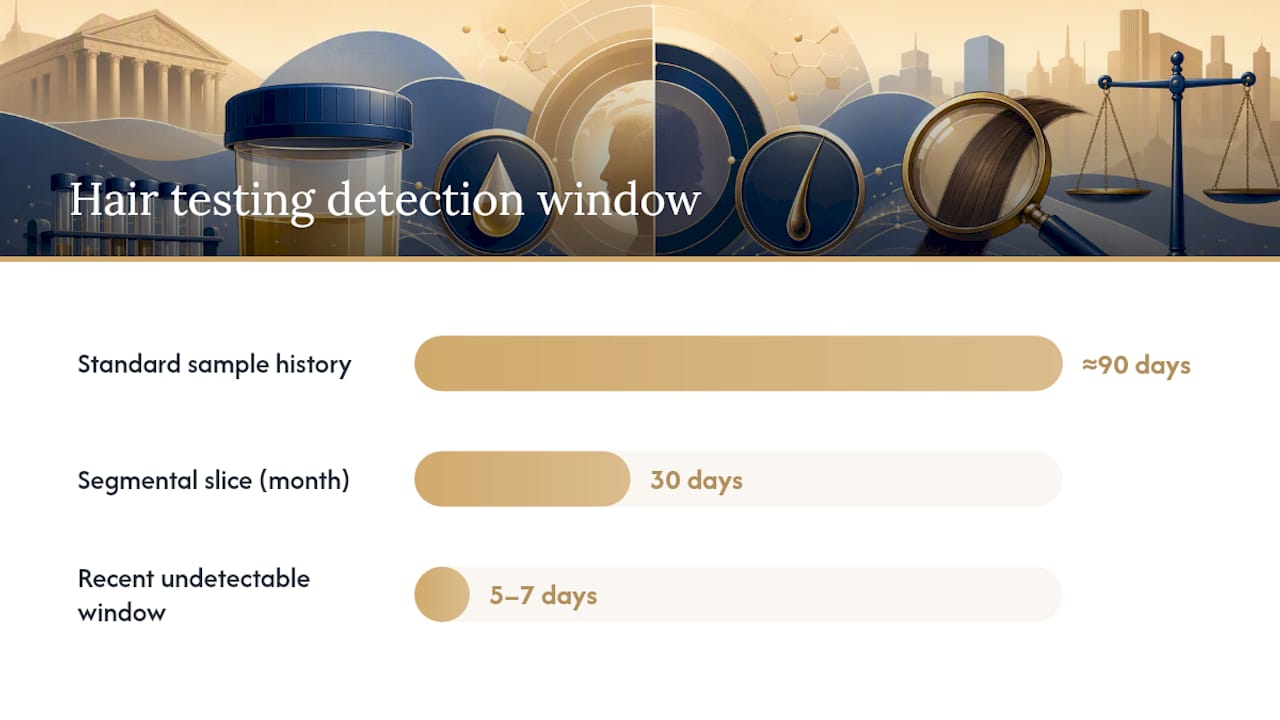
Segmental analysis takes this further by cutting the sample into month-long sections and testing each one separately, building a rough timeline of use rather than a single yes-or-no answer. This gets used most often in perinatal cases or child-protection matters, where the exact timing of exposure carries legal weight, though interpreting segment boundaries still requires careful lab work since growth rates vary somewhat between individuals.
Sample collection has its own quirks. Scalp hair is preferred, but body hair can substitute when scalp hair isn't available, though body hair grows more slowly and complicates the timeline math. Hair color and chemical treatments introduce a documented bias: darker, more heavily pigmented hair tends to bind certain drugs at higher concentrations than lighter hair, and bleaching or dyeing can strip drug residue out of the shaft entirely, potentially producing a false negative.
- Scalp hair reflects roughly 90 days of history per standard sample length.
- The most recent 5 to 7 days sit outside the detectable window.
- Bleaching, dyeing, and other cosmetic treatments can reduce detectable drug levels.
- Darker, more pigmented hair may show elevated results compared to lighter hair with identical exposure.
- Environmental contact with drug residue or smoke can contaminate a sample from the outside.
Pro Tip: If you've recently colored or chemically treated your hair before a scheduled test, mention it to the collector and ask whether the lab's report will note treatment history. It won't get you out of a legitimate positive, but it matters if a borderline result ever needs a second look.
Which Test Is More Accurate, and Where Each One Falls Short
Neither method is more accurate in an absolute sense. They're accurate at different things, and the research backs that up clearly. A systematic comparison of urine and hair testing among young adult opioid users found hair testing consistently picked up more self-reported drug use over its 90-day window, particularly for chronic or concealed use that a short urine window would simply miss. Someone who used a drug six weeks ago and stopped will often test clean on urine and positive on hair, and that's not a testing error. It's two tools measuring two different timeframes.
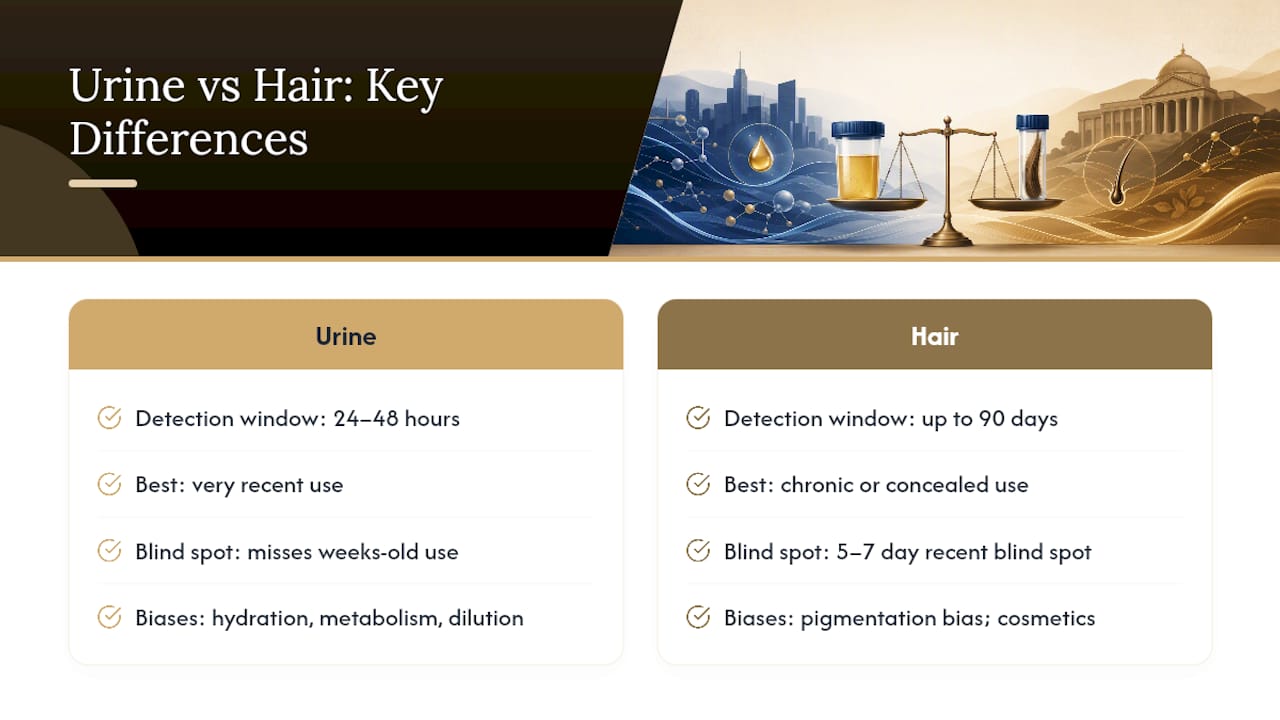
Where urine pulls ahead is very recent use. If the question is "did this person use something in the last 24 to 48 hours," urine answers it more directly than hair ever could, since hair's 5 to 7 day blind spot makes it structurally incapable of catching same-week use. This is exactly why post-accident and reasonable-suspicion testing programs default to urine rather than hair.
Bias sources deserve equal attention on both sides. Hair testing's pigmentation bias is well documented: darker hair can bind certain drugs at meaningfully higher rates than lighter hair under identical exposure, which raises genuine equity concerns in workplace and legal settings. Cosmetic treatments cut the other direction, potentially masking use that actually happened. Urine has its own error sources, mainly around metabolite detection windows that shift based on hydration, body fat, and metabolism, plus the ever-present risk of dilution or substitution during unobserved collection.
Statistic Callout: Multi-thousand sample driver's license regranting studies found hair positivity rates running several-fold higher than urine positivity for cocaine and stimulants in the same population, a gap almost entirely explained by hair's longer detection window rather than any inherent superiority in sensitivity.
Confirmation standards are what actually make a result defensible, on either matrix. Screening-level immunoassay results are a starting point, not a verdict. Lab guidance is explicit that final determinations should rest on GC-MS or LC-MS/MS confirmation, and chain-of-custody documentation, meaning an unbroken, recorded trail of who handled the sample and when, is often where legal challenges actually succeed or fail. A positive result with sloppy documentation is a weaker case than a negative result with pristine paperwork, and that's true whether the sample was urine or hair.
Detection Windows by Drug Class: Urine vs Hair
Every hair window above assumes a standard 1.5 inch sample and excludes the most recent 5 to 7 days of use, which won't show up regardless of drug class. Urine ranges assume normal hydration and kidney function; dehydration or certain medical conditions can shift numbers slightly in either direction.
Choosing the Right Test for Your Situation
The right test depends on what question you're actually trying to answer, not which test sounds more thorough. Walk through these questions before deciding:
- What time period matters? If you need to know about the last few days, urine is the only realistic option. If months of history matter, hair is the better fit.
- Are you bound by DOT or federal program rules? If so, hair isn't an approved option for the mandated portion of testing, urine or oral fluid is.
- How concerned are you about tampering? Hair's collection process leaves far less room for manipulation than an unobserved urine collection.
- What's the budget and timeline? Urine is cheaper and faster; hair costs more and takes longer to process through specialized labs.
- Does the scenario call for both? Probation monitoring, custody disputes, and some pre-employment programs sometimes use both matrices together, urine for a recent snapshot and hair for the longer pattern.
For pre-employment screening where an employer wants a broader history, hair often makes sense. For post-accident testing, reasonable-suspicion cases, or anything DOT-regulated, urine is the standard and often the only compliant choice. For probation monitoring or DUI probation violation cases, urine's short window supports frequent recent-use checks, while hair sometimes enters the picture for longer compliance windows.
Pro Tip: If a positive result carries real consequences, request the confirmatory lab report in writing before accepting the result as final, and hold onto every document from the collection process, including chain-of-custody forms and collection timestamps.
When a Test Result Becomes a Legal Problem
A disputed drug test rarely gets resolved by arguing with the lab directly. The first move is documentation: get the confirmatory lab report, note the exact collection date and conditions, and preserve any paperwork tied to chain-of-custody. Gaps in that chain, procedural errors at collection, or plausible external contamination are the areas where results actually get successfully challenged.
Medical explanations matter too. Certain prescriptions, secondhand exposure, and even some cosmetic products can produce results that need context a lab report alone won't provide. A drug-related DUI case, a probation violation, or a custody dispute tied to a test result all call for a review of the same underlying question: was the test administered and interpreted correctly? An effective case review starts with the lab report, the collection form, and a clear timeline of what happened before and after the sample was taken.
What This Comparison Actually Tells Us
The conventional advice treats urine and hair testing like competing products, one better, one worse. That framing misses the point. These are two instruments built for different jobs, and the real skill is matching the instrument to the question being asked, not picking whichever sounds more rigorous.
What gets underrated is how much the 5 to 7 day hair blind spot actually matters in practice. People assume a clean hair test rules out recent use. It doesn't, and that gap has real consequences in custody hearings and probation reviews where timing is everything.
What deserves more attention than it gets is the pigmentation bias issue. It's not a fringe concern. It's a documented flaw that disproportionately affects certain populations, and anyone relying on a hair result in a high-stakes legal setting should ask about it directly rather than assume the lab controlled for it.
If there's one thing readers should prioritize, it's this: a positive result is not a conviction, and it's not automatically defensible either. Confirmation testing and clean documentation decide far more legal outcomes than most people realize.
— Jake
How Logan Noblin Law Handles Disputed Test Results
This firm provides a defense approach that emphasizes the paperwork and documentation, not just the test result itself. Instead of accepting a positive result at face value, the defense approach involves examining chain-of-custody records, collection conditions, and lab confirmation methods thoroughly before treating any result as definitive.

If a drug test has triggered a DUI charge, a probation violation, a custody dispute, or a drug crime allegation, a consultation typically starts with the same documents discussed throughout this piece: the lab report, the confirmatory test results, and the collection or chain-of-custody forms. Bring whatever you have, even if it feels incomplete. Logan Noblin's background handling drug crime cases and DUI probation violations means he knows exactly where labs and collectors tend to cut corners. If a test result has put your record, your license, or your custody rights at risk, start with a case review to find out where the evidence actually stands.
Sources
- A comparison of the utility of urine- and hair testing in detecting self-reported drug use among young adult opioid users
- UNODC manual on hair, sweat and oral fluid testing
- Hair strand drug test: How it works, uses, and what to expect (Healthline)
- Urine vs. Hair vs. Saliva Drug Testing: Detection Windows, Costs, and Best Use Cases Compared
- BBC News: coverage on hair testing interpretation concerns
FAQ
Is hair drug testing more accurate than urine testing?
Neither is more accurate overall; they measure different things. Hair testing tends to catch more chronic or concealed use over its 90-day window, while urine is better at catching very recent use within the last few days.
Which drug test is hardest to pass?
Hair testing is generally harder to beat through tampering since collection is directly observed and the sample can't easily be diluted or substituted. Urine testing has more documented workarounds, which is why labs check temperature strips and creatinine levels immediately after collection.
Do most companies do hair or urine drug tests?
Urine testing remains the standard for most workplace and DOT-regulated programs because it's approved for federally mandated testing and costs less to run at scale. Hair testing shows up more often in pre-employment screening where employers want a longer look-back period.
What makes you fail a hair follicle test?
A positive hair test result comes from detectable drug metabolites incorporated into the hair shaft during the roughly 90 days before collection, based on lab confirmation using GC-MS or LC-MS/MS. Contamination from external contact, secondhand smoke exposure, or hair pigmentation differences can occasionally affect results, which is part of why disputed results warrant a review of the confirmatory lab report rather than acceptance at face value.