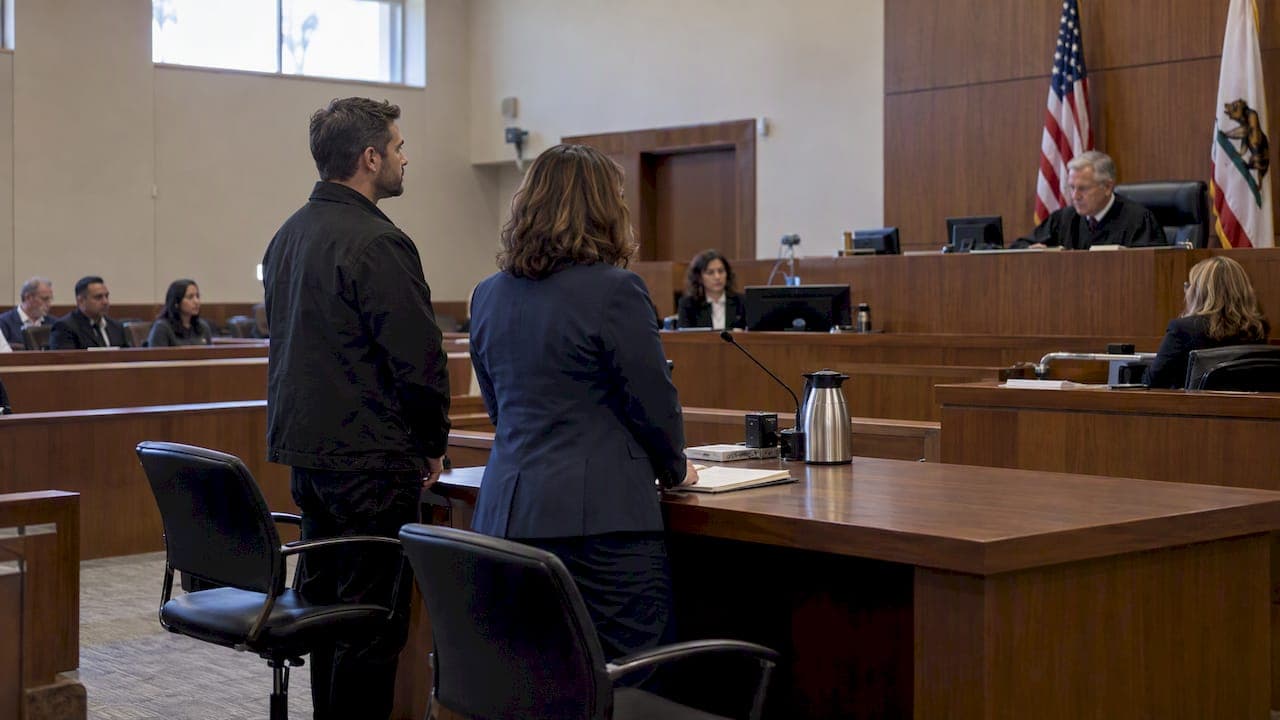
A California DUI arrest sets off two separate cases: one at the DMV over your license, and one in criminal court over the charge itself. The DMV clock is short, 10 days, while the court case usually unfolds over weeks or months, starting with an arraignment and, in most cases, ending in a negotiated plea rather than a trial. This guide walks through each stage in order, with the deadlines and decisions that matter at each one.
TL;DR
- You have 10 days from the DMV notice to request a hearing on your license suspension. Miss it and the suspension generally takes effect without you being heard.
- The DMV hearing and the criminal case are independent. Winning one does not decide the other.
- The arraignment is the first court date. It sets the case schedule and is not a trial. Do not treat it as your only chance to speak.
- Most DUI cases end in a negotiated resolution, so the early weeks, when evidence is gathered and charges are reviewed, shape the outcome.
- Veterans and service members may qualify for military diversion, which can lead to dismissal instead of a conviction.
Table of Contents
- Two cases start the moment you are arrested
- Stage 1: The DMV hearing request (the 10-day deadline)
- Stage 2: Charges are filed
- Stage 3: The arraignment
- Stage 4: Discovery and pretrial hearings
- Stage 5: Negotiation and plea decisions
- Stage 6: Trial, if the case goes that far
- Stage 7: Sentencing and what follows a conviction
- A different route for veterans and service members
- A timeline at a glance
- Our perspective: why the first weeks matter most
- Talk to a San Diego DUI defense attorney
- FAQ
- Sources
Two cases start the moment you are arrested
People are often surprised that a DUI arrest in California is really two proceedings running side by side.
- The DMV case (administrative). The DMV acts on your driving privilege after an arrest. It looks at the stop, the arrest and the chemical test, not at whether you are guilty.
- The court case (criminal). A prosecutor decides what to charge, and a judge in the superior court handles the case. This is where fines, probation, DUI school and possible jail are decided.
The DMV explains that the administrative hearing is separate from court: a win at the hearing does not automatically end the criminal charge, and a conviction can proceed whatever the DMV decides. Plan for both from day one.
Stage 1: The DMV hearing request (the 10-day deadline)
After a DUI arrest, the DMV starts an Administrative Per Se (APS) suspension of your driving privilege. The DMV states that you must request a hearing within 10 days of receiving the suspension notice.
This is the deadline people lose most often, because it arrives when you are dealing with a car impound, work and family. A few practical points:
- Find the date on the paperwork you were handed at arrest and count from it. Do not wait for court papers.
- The hearing looks at narrow questions: whether the stop and arrest were lawful and what the chemical test showed. It is not a mini-trial on guilt.
- A hearing gives your lawyer a chance to question the officer's evidence early, which can be useful later in the criminal case.
- If you want to see agency records yourself, such as reports or recordings, it helps to know how California public records deadlines work, though your attorney will normally obtain evidence through the court case.
We handle these hearings as part of DUI defense. If you are within the 10-day window, our San Diego DMV hearing page explains how the process works.
Driving while the case is pending
A full suspension does not always mean you cannot drive. The DMV says first-time, non-injury offenders can often get an ignition interlock device (IID) restricted license after serving a 30-day suspension, if they meet requirements such as proof of enrollment in a DUI program, proof of financial responsibility and payment of fees. Our guide to the ignition interlock device in California covers installation and what to expect day to day.

Stage 2: Charges are filed
After an arrest, the prosecutor reviews the police report, the chemical test results and any video before deciding what to file. A first DUI without injury is typically handled as a misdemeanor. Cases involving injury, prior convictions or other aggravating facts can be charged more seriously, and that changes the path through court, including extra steps before trial.
If you were released with a citation, the arraignment date is usually written on your paperwork. If you were booked and released, you may receive notice by mail. Do not assume that no news means no case. Confirm the date with the court clerk or have your attorney do it.
Stage 3: The arraignment
The arraignment is your first formal court appearance. According to the California courts' self-help center, it is where you are officially informed of the charges and your rights, including the right to an attorney. It is not a trial, and its main purpose is to set future dates and, if needed, enter a plea.
What typically happens:
- The judge reads or summarizes the charges.
- You enter a plea. Most people plead not guilty at this stage, which preserves every option while the evidence is reviewed.
- The court addresses release conditions and sets the next dates.
In many misdemeanor DUI cases your attorney can appear for you, so you may not need to stand in court yourself. Ask before assuming either way, because missing a required appearance can lead to a bench warrant. If that has already happened, see our warrants and probation services.
What a pleading of not guilty does and does not mean
A not guilty plea at arraignment is not a claim you have made at trial. It is a procedural step that keeps the case open so your lawyer can request the police reports, video, and testing records, and look for problems with the stop, the field sobriety tests or the chemical test.
Stage 4: Discovery and pretrial hearings
Between arraignment and any trial, most of the real work happens. Your attorney requests the evidence and examines it. Common areas of review include:
- The traffic stop: was there a lawful reason for it?
- Field sobriety tests: how were they explained and performed, and what were the conditions?
- Chemical testing: how and when the breath or blood sample was taken, stored and analyzed.
- Your statements: what you said, and whether it was properly obtained.
- Body-camera and dash-camera footage: whether it matches the written report.
There are usually several pretrial dates. Some are brief status checks. Others involve motions, where your attorney asks the judge to exclude evidence or dismiss the case. Your lawyer will tell you which dates require you in person.
Stage 5: Negotiation and plea decisions
Court resources note that the vast majority of criminal cases are resolved without a trial, typically through a negotiated plea. In a DUI case, that means the prosecutor and your attorney discuss whether the charge, the terms of probation or the sentence can change in light of the evidence.
What you want to know before agreeing to anything:
- What conviction would be on your record, and what it means for insurance, employment, professional licenses and immigration status.
- What conditions come with it: probation length, fines, DUI program, any jail, interlock requirements.
- Whether a stronger argument on the evidence or a diversion route could produce a better result.
If your DUI is also a threat to a professional license, say so at the start. A plea that looks routine to one person can have serious consequences for a nurse, pilot, contractor or commercial driver. We handle CDL DUI cases where a conviction affects a livelihood as well as a license.
Can you take DUI classes first to help your case?
Many people enroll in a program early, hoping it will pause or shorten the case. California law does not work that way. The Vehicle Code prohibits courts from suspending or staying proceedings so that an accused person can complete DUI education or treatment before conviction. Early counseling can still be worthwhile for you personally, and the IID restricted license requires program enrollment, but it will not by itself stop the case or earn a dismissal.
Stage 6: Trial, if the case goes that far
When no acceptable resolution exists, or when your attorney believes the evidence is weak, the case can go to trial. A DUI trial follows the same pattern as other criminal trials:
- Jury selection.
- Opening statements.
- Witness testimony, usually the arresting officer and a lab or testing witness, with cross-examination.
- Defense evidence, which may include an expert on testing or on how alcohol is absorbed.
- Closing arguments, jury instructions and deliberation.
The prosecution must prove the charge beyond a reasonable doubt. Not every case is suited to trial, and the decision is yours after your attorney explains the risks and the realistic alternatives.
Stage 7: Sentencing and what follows a conviction
If you plead or are convicted, the judge sets the sentence. For a first offense, this commonly includes a combination of probation, fines, and a DUI program. The DHCS says first offenders are generally required to complete a state-licensed DUI program: typically 3 months (30 hours) for standard cases and 9 months (60 hours) where the blood alcohol concentration is 0.20% or higher. Our guide to how the AB 541 first-offense program works covers the details.

Cost worries should not stop anyone from enrolling. DHCS says participants have the right to a financial assessment of their ability to pay, programs must disclose that right, and eligible participants can sometimes pay as little as $5 a month.
After a case ends, you may later be able to seek relief on your record. See our page on DUI expungement in San Diego.
A different route for veterans and service members
Not every DUI case has to end in a conviction. California's military diversion statute, Penal Code 1001.80, lets a court grant diversion to eligible defendants who are current or former service members, with charges that can be dismissed after successful completion of the terms. Eligibility turns on the facts of your service and the case. Our guides explain the details:
- Military diversion (PC 1001.80) explained
- Can active-duty service members still use it for a DUI?
- Can you enter military diversion without pleading guilty?
Other diversion routes exist for different situations. See our overview of diversion and treatment programs.
A timeline at a glance
| Stage | What happens | Your key task |
|---|---|---|
| Arrest | DMV notice issued; case opens | Note the date on your paperwork |
| Within 10 days | Window to request a DMV hearing | Request the hearing or have your attorney do it |
| Charging | Prosecutor reviews evidence and files | Hire counsel before the first date |
| Arraignment | Charges read, plea entered, dates set | Attend, or have counsel appear if allowed |
| Pretrial | Evidence review, motions, negotiation | Respond quickly to your attorney's requests |
| Trial or plea | Case resolved | Decide with full information |
| Sentencing | Probation, fines, DUI program | Comply with every condition |
Our perspective: why the first weeks matter most
We see the same pattern in San Diego DUI cases. The people who do best are rarely the ones who found a legal trick late. They are the ones who protected the 10-day DMV deadline, stayed away from any conversation that could hurt them, and brought a lawyer in before the arraignment, when evidence can still be requested and preserved.
We also believe a DUI case is a story as well as a set of lab numbers. Judges and prosecutors respond to who you are: your work, your family, your record, and what happened that night. Our approach combines careful review of the stop and the testing with a clear, honest account of the person behind the file, and we look early at whether diversion or another resolution fits. Many clients who come to us are first-time offenders afraid of losing a job or a license. That fear is reasonable, and it is exactly why the early steps matter.
— Logan Noblin
Talk to a San Diego DUI defense attorney
If you have been arrested for DUI in San Diego, the Law Office of Logan Noblin, APC defends DUI cases in court and handles the related DMV matters. Start with our DUI defense practice, or go straight to our page for first-time DUI cases. We can review your paperwork, check your deadlines and explain what your next court date means.
FAQ
What is the DUI process in California?
It begins with the arrest and a DMV notice, then a 10-day window to request a hearing on your license. In parallel, the court case moves through filing of charges, arraignment, pretrial hearings and negotiation. Most cases resolve by plea, and a minority go to trial.
Do I have to go to the DUI arraignment?
Often not in person for a misdemeanor, because your attorney may be able to appear for you and enter the plea. That depends on the court and the charge, so confirm with your lawyer or the clerk. Never simply skip it, since a missed required appearance can lead to a warrant.
Can I take DUI classes before court to get my case dismissed?
No. California law bars courts from pausing a DUI case so you can complete education or treatment before conviction. Enrolling early can still help with an IID restricted license and with your own goals, but it does not dismiss the charge.
If I win the DMV hearing, is my criminal case over?
No. The two cases are independent, so a DMV win does not dismiss the criminal charge, and a criminal outcome does not depend on the DMV result. You need to defend both.
Sources
- California DMV: Administrative Hearings
- California DMV: Statewide Ignition Interlock Device Pilot Program
- California Courts Self-Help: Arraignment
- California Courts Self-Help: Criminal Court Overview
- California Vehicle Code, Court Restrictions (Division 11.5, Chapter 4, Article 5)
- California Penal Code, Military Diversion Program (Chapter 2.9C)
- DHCS: Driving Under the Influence Programs
- DHCS: DUI Program Fees
- Javitch Law Office: California public records deadlines