
What is California's Military Diversion Program under Penal Code 1001.80?
California's Military Diversion Program, codified in Penal Code 1001.80, gives current and former U.S. military members charged with misdemeanors a path to avoid conviction entirely. Instead of facing prosecution, eligible defendants enter a pretrial diversion program focused on treatment for service-related conditions. Complete it successfully, and the charges are dismissed. The arrest is legally deemed never to have occurred.
The program's core logic is rehabilitative, not punitive. California recognizes that many service members end up in the criminal justice system because of untreated trauma, not criminal character. SB 1227, passed in 2013–2014, established the statutory framework that became what courts now implement statewide.
Key facts at a glance:
- Applies to current or former members of the U.S. military charged with misdemeanors
- Qualifying conditions: sexual trauma, traumatic brain injury (TBI), PTSD, substance abuse, or mental health problems stemming from military service
- Requires the defendant's consent and a waiver of speedy trial rights
- Diversion period cannot exceed two years
- Successful completion results in full dismissal and the legal fiction that no arrest occurred
- DUI charges are included, per case law clarified through Wade v. Superior Court
Table of Contents
- Who actually qualifies for military diversion in California?
- What does participation in the program actually require?
- How do courts handle military diversion requests, and what protections apply?
- Resources available to defendants and attorneys navigating this process
- Expert legal insight: how to give yourself the best shot at success
- How to petition for military diversion: the step-by-step process
- What happens when you complete the program, and what if you don't?
- How military diversion compares to other California diversion programs
- How program completion affects your military record and veteran benefits
- Logancriminaldefense: experienced military diversion defense in San Diego
- Key Takeaways
Who actually qualifies for military diversion in California?
Eligibility under Penal Code 1001.80 turns on two things: military status and a qualifying condition. You must have served, or currently serve, in any branch of the U.S. military. Beyond that, the statute requires only that you may be suffering from one of the listed conditions as a result of that service.

That evidentiary standard matters. Courts apply a "reasonable possibility" threshold — you don't need to prove the condition directly caused the offense. For DUI cases, this is a significant shift. Earlier courts sometimes demanded a causal link between, say, PTSD and the decision to drink and drive. That stricter standard has been rejected by California courts.
Qualifying conditions include:
- Military sexual trauma (MST)
- Traumatic brain injury (TBI)
- Post-traumatic stress disorder (PTSD)
- Substance abuse disorders connected to service
- Other mental health problems arising from military service
Discharge status is not a barrier. Whether you received an honorable discharge, a general discharge, or something else, eligibility is not restricted by the nature of your separation or whether you saw combat. What matters is demonstrating a nexus between your condition and your military service.
"Courts denying diversion based on offense nature rather than rehabilitative goals may abuse discretion, underscoring the rehabilitative intent of Penal Code 1001.80." — Wade v. Superior Court (2019)
What does participation in the program actually require?
Once a court places you in diversion, the program is not passive. You are expected to engage actively with treatment and report your progress on a structured schedule. Courts typically review your case monthly in the early stages, then shift to less frequent intervals as long as you remain in stable compliance.
Standard participation requirements include:
- Enrollment in a court-approved treatment program (mental health counseling, substance abuse treatment, DUI classes where applicable)
- Semiannual progress reports filed with the court and prosecutor at minimum
- Compliance with any protective orders in domestic violence-related cases
- Random drug or alcohol testing if substance abuse is part of the underlying issue
- Possible community service or restitution obligations depending on the offense
- Waiver of speedy trial rights for the duration of diversion
The statute gives preference to programs with a demonstrated history of treating veterans, including those operated by the VA or Department of Defense. Courts are required to assess whether VA or DoD services fit your situation before defaulting to community-based alternatives.
How do courts handle military diversion requests, and what protections apply?
The court's role is both evaluative and supervisory. When you petition for diversion, the judge reviews whether you meet eligibility criteria and whether diversion serves the rehabilitative purpose of the statute. Critically, the court cannot deny diversion simply because the underlying offense seems serious. Wade v. Superior Court established that denying diversion based on offense nature rather than your rehabilitative prospects constitutes an abuse of discretion.
"If the defendant has performed satisfactorily during the period of diversion, at the end of the period of diversion, the criminal charges shall be dismissed." — California Penal Code 1001.80(e)
If you fall out of compliance, the court holds a hearing to determine whether to reinstate criminal proceedings. That hearing requires notice to you first. Noncompliance doesn't automatically end diversion, but persistent failure to engage with treatment will. On the protective side, health information submitted as part of your eligibility petition is handled with confidentiality, and courts are directed to coordinate with VA and DoD treatment resources rather than treating your case as purely a criminal matter.
Resources available to defendants and attorneys navigating this process
The Judicial Council of California provides statewide guidance on military diversion procedures, and individual Superior Courts publish their own program information sheets. San Mateo, Orange County, and Contra Costa are among the counties with detailed public-facing guides.
Practical resources to know:
- Judicial Council of California: Statewide policy guidance and standardized forms for diversion proceedings
- County Superior Court websites: Local program sheets, filing deadlines, and court-specific procedures
- County Veterans Service Officers (CVSOs): Can assist with documentation, VA referrals, and eligibility support
- VA mental health services: Primary treatment referral source under the statute's preference mandate
- DoD-affiliated treatment programs: Preferred by statute for active-duty defendants
- Specialized recovery planning resources: Tailored treatment approaches that align with what courts look for in diversion compliance
The Superior Court of Orange County explicitly notes that the program uses existing VA and DoD resources rather than creating a parallel system. That means your existing treatment relationships with the VA can often be formalized as part of your diversion plan.
Expert legal insight: how to give yourself the best shot at success
The biggest mistake defendants make is treating the petition as a formality. Courts want to see documented evidence of a qualifying condition and a clear nexus to military service, not just a DD-214 and a request. Many counties require formal petitions with detailed service and health nexus documents filed at least one week before the scheduled hearing. A DD-214 alone rarely gets you in the door.
"A DD-214 alone is insufficient. Formal application including detailed eligibility and nexus statements must be filed one week before the hearing." — Contra Costa Superior Court Military Diversion Information Sheet
What experienced defense attorneys focus on:
- Obtaining medical or psychological evaluations that document the qualifying condition and its connection to service
- Framing the nexus argument clearly in the written petition
- Selecting a treatment program the court will view favorably, ideally VA or DoD-affiliated
- Preparing clients for the graduated review schedule and what "satisfactory performance" looks like to each judge
- Addressing relapses proactively rather than waiting for the court to raise noncompliance
Pro Tip: Connect with your VA primary care provider or a VA mental health clinician before your first court date. A documented treatment relationship already in place signals to the court that you are serious about rehabilitation, and it gives your attorney concrete evidence to anchor the nexus argument.
How to petition for military diversion: the step-by-step process
The petition process varies by county, but the core steps are consistent across California's Superior Courts.
-
Confirm eligibility: Verify your military status and identify which qualifying condition applies to your case. Gather service records (DD-214 or active-duty orders) and any existing medical or mental health documentation.
-
Obtain a psychological or medical evaluation: A licensed clinician's report documenting your condition and its connection to military service is the foundation of a strong petition. Courts look for specificity, not generalities.
-
File the formal petition: Submit the written petition to the court at least one week before the hearing date. The petition should include your eligibility statement, the nexus evidence, and a proposed treatment plan. Check your county's Superior Court for the specific form requirements.
-
Identify a treatment program: Propose a VA, DoD, or court-approved community program. The statute requires the court to give preference to programs with a history of treating veterans.
-
Appear at the diversion hearing: Your attorney presents the petition. The court evaluates eligibility and, if approved, sets the terms of diversion including the treatment plan, reporting schedule, and any additional conditions.
-
Sign the consent and speedy trial waiver: Diversion cannot begin without your written consent and a formal waiver of your right to a speedy trial.
-
Begin treatment and comply with reporting: Engage with your assigned program immediately. Progress reports go to the court and prosecutor at least every six months.
What happens when you complete the program, and what if you don't?
Successful completion produces a concrete legal outcome: the charges are dismissed, and the arrest is deemed never to have occurred under Penal Code 1001.80. You can legally answer "no" when asked about prior arrests or diversions on most applications. Critically, the record cannot be used to deny you employment, a professional license, or a benefit without your consent.
Unsuccessful completion carries the opposite result. If the court finds you are not performing satisfactorily or not benefiting from treatment, it can terminate diversion and reinstate criminal proceedings. You then face the original charges as if diversion had never been granted. There is no automatic second chance, though your attorney can argue mitigating circumstances at the reinstatement hearing.
The stakes are real in both directions. Completion means a clean slate. Termination means a criminal conviction is back on the table.
How military diversion compares to other California diversion programs
California offers several pretrial diversion options, and understanding where Penal Code 1001.80 fits helps you assess your options clearly.
| Program | Who It Covers | Offense Scope | Key Distinction |
|---|---|---|---|
| Military Diversion (PC 1001.80) | Current/former military members | Misdemeanors (and certain felonies) | Service-related condition required; VA/DoD treatment preference |
| Mental Health Diversion (PC 1001.36) | Any defendant | Misdemeanors and felonies | Broader population; condition must be significant factor in offense |
| Drug Diversion (PC 1000) | Any defendant | Nonviolent drug possession | Narrower scope; drug offenses only |
| Deferred Entry of Judgment (DEJ) | First-time drug offenders | Specific drug offenses | Requires guilty plea first; less favorable than true diversion |
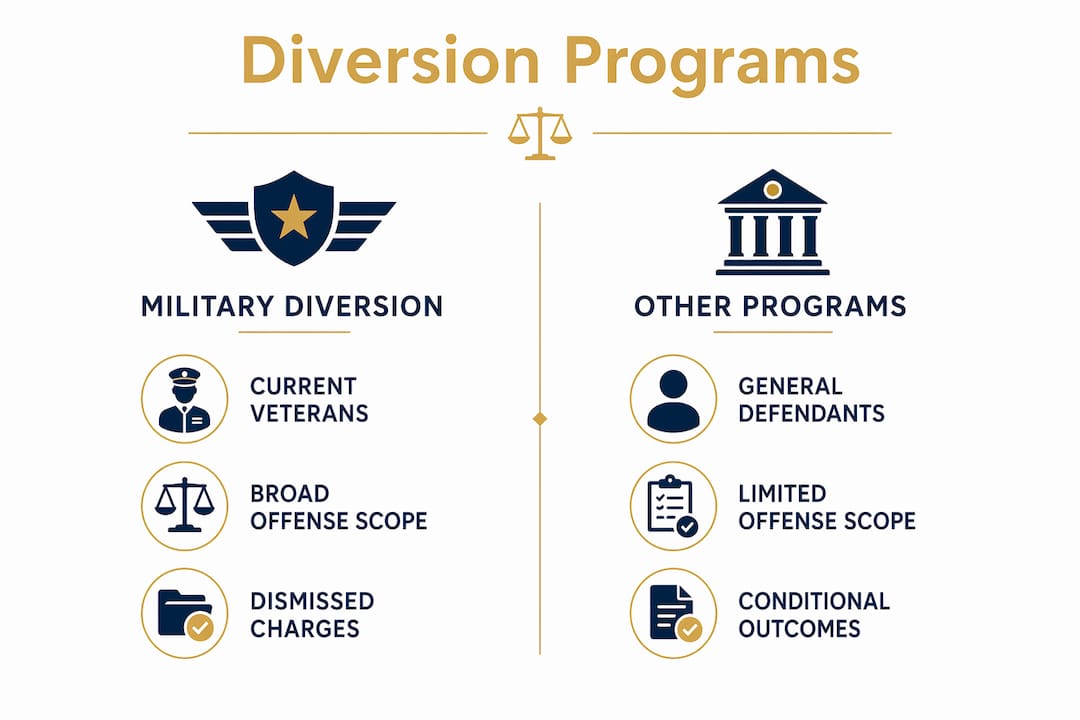
Military diversion under PC 1001.80 is the most favorable option for eligible service members. Unlike PC 1000 or DEJ, it does not require a guilty plea. Unlike PC 1001.36, it does not require proving the condition was a significant factor in the offense for misdemeanor charges. The diversion treatment programs available through the military pathway also tend to be better resourced, given the VA and DoD infrastructure behind them.
How program completion affects your military record and veteran benefits
This is where many veterans have questions, and the answers are largely favorable. Successful completion of military diversion does not create a federal criminal record. Because the arrest is deemed never to have occurred under California law, it should not appear on background checks used by most employers or licensing boards.
For veteran benefits, the picture is similarly positive. A dismissed charge under PC 1001.80 generally does not affect VA healthcare eligibility, disability compensation, or GI Bill benefits. The VA evaluates benefit eligibility based on federal standards, not state criminal records, and a diverted and dismissed state misdemeanor does not constitute a federal conviction.
Active-duty service members should be aware that military administrative processes operate independently of civilian courts. A civilian diversion does not automatically resolve any parallel military administrative action. If your command has initiated a separation proceeding or a security clearance review, the civilian diversion outcome is relevant but not necessarily dispositive. Consulting with a military defense attorney who understands both civilian and military administrative processes is the right move in that situation.
Logancriminaldefense: experienced military diversion defense in San Diego

San Diego has one of the largest active-duty military populations in the country, and Logancriminaldefense has built its practice around the legal challenges that come with that reality. Logan Noblin, a former "Attorney of the Year," handles military diversion cases under PC 1001.80 with the kind of precision the petition process demands: documented nexus arguments, court-ready treatment plans, and a track record of dismissals that speak for themselves.
Where other firms treat military diversion as a checkbox, Logancriminaldefense builds a case around your specific service history and condition. That distinction shows up in outcomes. Whether you are facing a DUI charge as an active-duty service member or a veteran dealing with a misdemeanor rooted in untreated PTSD, the firm knows how to present your story to a judge in a way that gets diversion approved and kept on track.
Contact Logancriminaldefense for a consultation on your San Diego criminal defense options. The sooner you get the petition right, the better your position at that first hearing.
Key Takeaways
California's Military Diversion Program under Penal Code 1001.80 offers eligible service members a legally clean exit from misdemeanor charges, provided they complete a structured treatment program within two years.
| Point | Details |
|---|---|
| Eligibility standard | Any current or former military member with a reasonable possibility of a service-related condition qualifies. |
| Discharge status irrelevant | Eligibility is not restricted by discharge type or combat history; nexus to service is what counts. |
| DUI charges included | Wade v. Superior Court confirmed DUI offenses cannot be categorically excluded from diversion. |
| Successful completion outcome | Charges are dismissed and the arrest is legally deemed never to have occurred under PC 1001.80. |
| Logancriminaldefense | Provides specialized PC 1001.80 defense in San Diego, building documented nexus petitions for military diversion approval. |