
What does California Vehicle Code 23153 actually require?
A DUI with injury California charge under Vehicle Code 23153 is not simply about being impaired behind the wheel. The prosecution must prove two things happened at the same time: you drove under the influence of alcohol, drugs, or both, and you committed an illegal act or neglected a legal duty while driving, and that act or neglect caused bodily injury to someone else. The impairment alone is not enough.
This distinction matters more than most people realize. Under VC 23153(a) through (g), the law covers alcohol, prescription drugs, illegal substances, and any combination. Commercial drivers face a lower BAC threshold of 0.04%, and rideshare drivers carrying passengers for hire face that same 0.04% standard under VC 23153(e). The statute is broad by design.
The California Criminal Jury Instructions spell out exactly what jurors must find before convicting:
- The defendant drove a vehicle
- The defendant was under the influence at the time
- While driving under the influence, the defendant committed an illegal act or neglected a legal duty
- That illegal act or neglect was a substantial factor in causing bodily injury to another person
That last element is where many defenses are built. Prosecutors must prove the illegal act or neglect caused the injury, not merely that the driver was impaired when the crash occurred.
DUIs make up one in 10 arrests nationwide, and in 2021, 32% of fatal motor vehicle accidents in California involved a driver under the influence of alcohol, drugs, or both.
VC 23153 is a "wobbler" offense, meaning prosecutors can charge it as either a misdemeanor or a felony depending on the circumstances.
Penalties and sentencing for DUI causing injury in California
The range of consequences for a DUI causing injury conviction is wide, and the gap between misdemeanor and felony outcomes is significant. A first offense charged as a misdemeanor typically carries up to one year in county jail, fines, probation, and mandatory enrollment in an alcohol and drug education program. Felony convictions are a different category entirely.

Felony DUI causing injury can result in up to four years in state prison and fines reaching $5,000. Additional sentencing enhancements apply when multiple victims are injured, when a prior DUI conviction exists, or when the injuries are severe. Each injured victim beyond the first can add one to six years to a prison sentence under California's enhancement statutes.
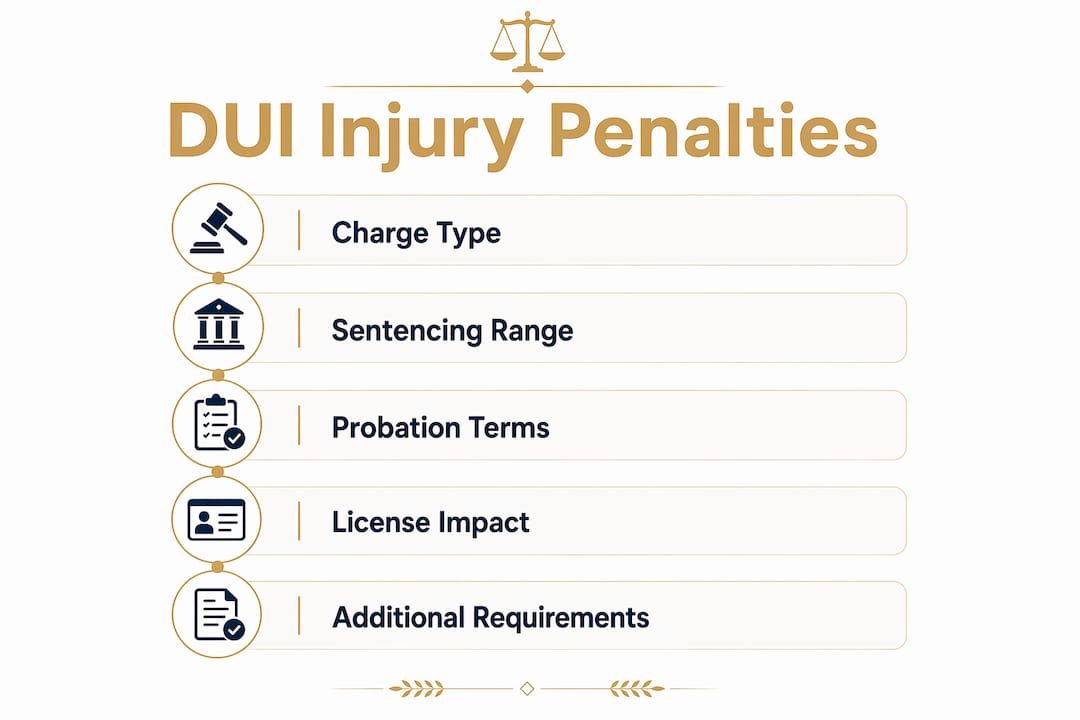
Common sentencing components across both charge levels include:
- Jail or state prison (days to years depending on charge level and enhancements)
- Fines up to $5,000 for felony convictions, plus court assessments that substantially increase the total
- Formal or informal probation, typically three to five years
- Mandatory alcohol and drug education programs, ranging from three months to 30 months
- License suspension by both the court and the DMV
- Ignition interlock device (IID) requirement as a condition of restricted driving privileges
- Restitution paid directly to injured victims
Probation and treatment programs are standard post-conviction requirements. Judges also retain discretion to impose additional conditions based on the specific facts of the case, including the severity of injuries and the defendant's prior record.
Related offenses that often accompany a DUI causing injury charge
Prosecutors rarely file a VC 23153 charge in isolation when an accident involves injuries. Depending on the facts, additional charges frequently appear alongside or instead of the primary DUI causing injury count.
Felony hit and run under Vehicle Code 20001 is one of the most common companion charges. If a driver leaves the scene after causing injury, that separate felony charge stacks on top of the DUI offense. DUI hit and run cases carry their own penalties and complicate plea negotiations considerably.
Watson murder, California's version of second-degree murder applied to DUI fatalities, applies when a driver with a prior DUI conviction causes a death. The prior conviction serves as evidence that the driver had been warned about the dangers of impaired driving, satisfying the "implied malice" standard for murder.
Other charges that commonly appear in DUI causing injury cases:
- Vehicular manslaughter while intoxicated under Penal Code 191.5, when a death results
- DUI with a child passenger under VC 23572, which adds mandatory jail time enhancements
- Refusal of chemical testing, which triggers automatic DMV penalties and can be used as evidence of consciousness of guilt at trial
- Misdemeanor DUI under VC 23152, sometimes filed as an alternative or lesser charge
The wobbler nature of VC 23153 gives prosecutors real discretion. Injury severity, the defendant's history, and the strength of the evidence all influence whether the charge lands as a misdemeanor or a felony.
How the DMV administrative process works separately from your criminal case
Most people arrested for DUI causing injury focus entirely on the criminal case. That is a costly mistake. The California DMV initiates an immediate administrative action against your driving privilege the moment you are arrested, completely independent of what happens in criminal court.

This process is called Administrative Per Se (APS). The DMV can suspend your license even if criminal charges are later dismissed. A first-time refusal of chemical testing results in a mandatory one-year license suspension, regardless of the criminal outcome.
Steps and rights in the DMV administrative process:
- Request a DMV hearing within 10 days of receiving the suspension notice or you lose the right to contest it
- The hearing is separate from any criminal court date and requires its own preparation
- You may challenge the basis for the suspension, the legality of the stop, and the accuracy of chemical test results
- Losing the DMV hearing does not mean losing the criminal case, and vice versa
- First-offense injury cases have specific restriction options that may allow limited driving during suspension
Pro Tip: Request your DMV hearing the same day you hire an attorney. The 10-day window runs from the date of the suspension notice, not from your first court appearance, and missing it forfeits your right to contest the suspension entirely.
The DMV administrative suspension operates on its own timeline. Winning your criminal case does not automatically restore your license.
How do you actually defend against a DUI causing injury charge?
The strongest defenses in VC 23153 cases attack the elements prosecutors must prove, not just the BAC reading. Challenging the accuracy of a breathalyzer or blood test is one avenue, but experienced defense attorneys look further.
"Defenses against DUI causing injury charges typically focus on challenging the accuracy of sobriety tests, disputing causation of injury, or disproving neglect or illegal concurrent acts." Logancriminaldefense
Causation is often the most powerful defense angle. The prosecution must prove that your illegal act or neglect, not just your impairment, was a substantial factor in causing the injury. If another driver's actions, a road defect, or the injured party's own conduct contributed to the crash, that causation chain is worth attacking directly.
Key defense considerations for anyone facing this charge:
- Consult an attorney immediately, before speaking with investigators or insurance adjusters
- Preserve evidence: dashcam footage, witness contact information, and accident scene photos can disappear quickly
- Challenge the traffic stop itself: an unlawful stop can suppress everything that follows
- Examine the chemical test chain of custody: blood samples must be properly collected, stored, and analyzed
- Evaluate plea alternatives: in some cases, negotiating a reduction to misdemeanor DUI or a lesser charge protects against felony consequences
Pro Tip: Your criminal defense strategy and your DMV hearing defense are not the same. Statements made at a DMV hearing can surface in criminal proceedings. An attorney who handles both simultaneously protects you on both fronts.
Logan Noblin at Logancriminaldefense has built a track record of not-guilty verdicts and case dismissals in San Diego DUI cases by focusing on the specific narrative of each client's case rather than applying a generic defense template. The DUI causing injury defense approach matters as much as the legal arguments themselves.
How a DUI causing injury conviction affects civil liability
A criminal conviction for DUI causing injury does not end the legal exposure. The injured party retains the right to file a separate civil lawsuit for damages, and a criminal conviction makes that civil case significantly easier to win. Under California law, a guilty plea or verdict in the criminal case can be used as evidence of negligence in the civil proceeding.
Civil damages in these cases can include medical expenses, lost wages, pain and suffering, and in cases involving egregious conduct, punitive damages. California courts have awarded substantial civil judgments in DUI injury cases where the defendant had prior DUI convictions or a particularly high BAC. The criminal and civil cases run on separate tracks, so a civil suit can proceed even while a criminal appeal is pending.
Long-term consequences: license suspension and ignition interlock devices
The license consequences of a DUI causing injury conviction extend well beyond the initial suspension. California courts impose their own suspension on top of the DMV administrative action, and the two do not always run concurrently. For a felony conviction, the court-ordered revocation can last years.
Ignition interlock devices are now a standard requirement for anyone seeking to drive during or after a suspension period. An IID requires the driver to pass a breath test before the vehicle will start, and the device logs every test result. Installation and monthly monitoring fees run to several hundred dollars per year, and any violation of IID conditions can trigger additional suspension. The license suspension consequences compound quickly when both the DMV and the court impose separate actions.
How victim impact statements shape sentencing outcomes
California law gives injured victims the right to address the court at sentencing, and judges take those statements seriously. A victim impact statement describes the physical, emotional, and financial harm the victim experienced as a direct result of the offense. In DUI causing injury cases, these statements often include accounts of ongoing medical treatment, lost income, and psychological trauma.
Judges are not bound by victim impact statements, but they carry real weight in sentencing decisions, particularly when the court is weighing probation against incarceration or deciding the length of a prison term. A well-documented victim statement describing permanent injury or long-term disability can push a sentence toward the upper end of the statutory range. Defense counsel can respond with mitigation evidence, including the defendant's background, remorse, and rehabilitation steps taken before sentencing.
Probation conditions and post-conviction monitoring
Probation in a DUI causing injury case comes with specific conditions that go beyond standard supervision. Courts routinely require formal probation rather than informal probation for felony convictions, meaning a probation officer actively monitors compliance. Violations can result in the original suspended sentence being imposed.
Standard probation conditions in these cases typically include:
- No driving with any measurable amount of alcohol in the system
- Mandatory completion of a court-approved alcohol and drug education program
- Regular check-ins with a probation officer
- Compliance with IID requirements for the full probation period
- No new criminal offenses
- Payment of all fines, fees, and victim restitution on schedule
Failure to complete the required alcohol education program is one of the most common probation violations in DUI cases, and courts treat it as a serious breach. The programs range from three months for a first misdemeanor to 30 months for repeat or felony offenders, and attendance records are reported directly to the court.
If you are facing a DUI causing injury charge in San Diego, the decisions you make in the first 10 days after arrest shape everything that follows. Logancriminaldefense represents clients at both the DMV hearing and in criminal court, building a defense strategy that addresses both proceedings from day one.

Contact Logancriminaldefense for a direct consultation with Logan Noblin on your DUI causing injury case.
Key Takeaways
A DUI causing injury conviction in California triggers both criminal penalties and a separate DMV license suspension, and both must be challenged within strict deadlines to protect your rights.
| Point | Details |
|---|---|
| Two-part prosecution burden | Prosecutors must prove an illegal act or neglect, not just impairment, caused the injury under VC 23153. |
| Wobbler charge classification | VC 23153 can be charged as a misdemeanor or felony based on injury severity and prior convictions. |
| Felony sentencing exposure | Felony DUI causing injury carries up to four years in state prison and fines up to $5,000. |
| 10-day DMV deadline | You must request a DMV hearing within 10 days of the suspension notice or lose the right to contest it. |
| Civil liability runs separately | A criminal conviction can be used as evidence of negligence in a civil lawsuit filed by the injured party. |