
A DUI becomes a felony in California under five specific circumstances, and the difference between a misdemeanor and a felony can mean state prison instead of county jail. If your situation fits any of these triggers, contact a criminal defense attorney today — not tomorrow.
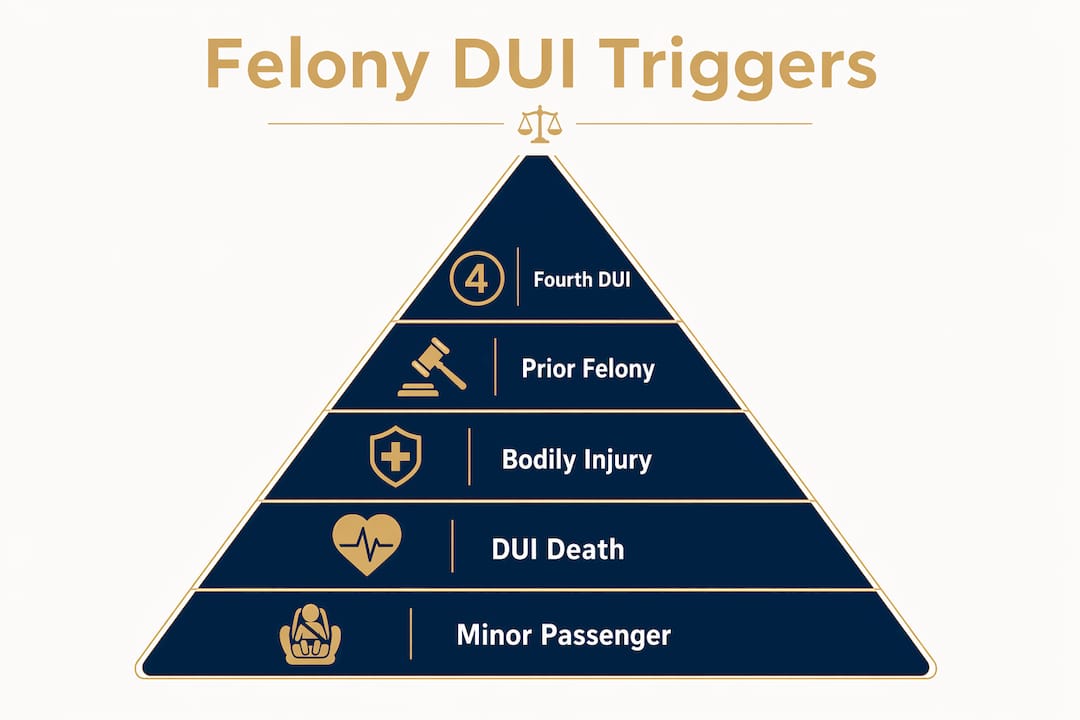
The five felony triggers at a glance:
- Fourth DUI within 10 years under Vehicle Code § 23550 et seq.
- Any DUI after a prior felony DUI conviction under VC § 23550.5
- DUI causing bodily injury to another person under VC § 23153 (a wobbler)
- DUI causing death under Penal Code § 191.5 and related statutes
- DUI involving a minor passenger with child endangerment facts under VC § 23572 and Penal Code § 273a
Most consequential penalties if charged as a felony:
- State prison exposure (16 months, 2 years, or 3 years for many felony DUI convictions; up to 15 years to life for Watson murder)
- Longer license revocation (duration depends on the specific felony and DMV rules)
- Permanent felony record affecting employment, housing, firearms rights, and professional licenses
- Mandatory ignition interlock device (IID) installation
- Restitution to injured victims
Immediate steps after a felony DUI arrest:
- Invoke your right to counsel and say nothing substantive to police.
- Preserve all evidence: photographs, witness contact information, dashcam footage, and medical records.
- Request a DMV administrative hearing within 10 days of arrest or your license is automatically suspended.
- Write down everything you remember about the stop and arrest while it is fresh.
Pro Tip: The DMV hearing and the criminal case run on separate tracks. Winning or losing one does not automatically decide the other — but missing the 10-day DMV deadline forfeits your right to contest the administrative suspension entirely.
Table of Contents
- When does a DUI become a felony in California?
- What happens when a DUI causes injury?
- When a DUI causes a death: manslaughter, murder, and what's at stake
- How prior DUIs change your charges and sentencing
- What are the penalties for a felony DUI in California?
- How do you defend against a felony DUI charge?
- What should you do immediately after a felony DUI arrest?
- Can a felony DUI be reduced or expunged in California?
- Key Takeaways
- Why the real cost of a felony DUI is almost never the prison sentence
- Facing a felony DUI charge? Here is how Logancriminaldefense can help
- Useful sources
When does a DUI become a felony in California?
California law identifies five situations where a DUI charge can be elevated from a misdemeanor to a felony. Each trigger is defined by statute, and understanding which one applies to your case determines the entire defense strategy.
Fourth DUI within 10 years (VC § 23550)
A fourth DUI conviction within a lookback period is automatically treated as a felony. The lookback period runs from the date of the prior arrest, not the conviction date. What counts as a prior? California DUI convictions under VC § 23152 or § 23153, wet reckless pleas under VC § 23103/23103.5, and certain out-of-state DUI convictions that would have been a DUI under California law. Expunged convictions can still count as priors for enhancement purposes — a point many people miss.

Any DUI after a prior felony DUI (VC § 23550.5)
Once you have a felony DUI on your record, every subsequent DUI is automatically charged as a felony regardless of how many years have passed. There is no lookback window here. A DUI after a prior felony DUI can trigger felony status under VC § 23550.5 regardless of the time elapsed.
DUI causing bodily injury (VC § 23153)
Vehicle Code § 23153 makes it unlawful to drive under the influence and, through an act or neglect, proximately cause bodily injury to another person. This is a wobbler, meaning prosecutors can file it as either a misdemeanor or a felony. Injury severity, the defendant's criminal history, and the number of victims all influence that decision.
DUI causing death (Pen. Code § 191.5)
A DUI that results in someone's death can be charged as vehicular manslaughter while intoxicated, gross vehicular manslaughter while intoxicated, or second-degree murder under the Watson doctrine. Each carries dramatically different sentencing exposure, covered in detail below.
DUI involving a minor passenger (VC § 23572; Pen. Code § 273a)
Driving under the influence with a child under 14 in the vehicle triggers mandatory sentence enhancements under VC § 23572. Depending on the facts, a separate child endangerment charge under Penal Code § 273a may also be filed, which can itself be a felony. Readers facing this situation should review the firm's dedicated DUI with children defense resources.
The 10-year lookback rule deserves extra attention. Prosecutors count priors from the date of the prior arrest, not the date of conviction. A case that took two years to resolve still anchors the lookback to the original arrest date. Out-of-state DUIs are evaluated by whether the conduct would have been a DUI under California law — most standard DUI convictions from other states qualify.
What happens when a DUI causes injury?
DUI causing injury under VC § 23153 is one of the most commonly charged felony DUI offenses in California, and it is also one of the most negotiable. Understanding how prosecutors build these cases and where the leverage points are is critical.
Elements prosecutors must prove
To convict under VC § 23153, the prosecution must establish that the defendant was driving under the influence, that they committed an act forbidden by law or neglected a duty while driving, and that this act or neglect proximately caused bodily injury to another person. The proximate cause element is often where defense attorneys find the most traction — if the injury resulted from the other driver's conduct, the causal chain breaks.
Evidence prosecutors typically rely on:
- Medical records documenting the nature and extent of injuries
- Police crash reports and officer observations at the scene
- Witness statements from passengers, bystanders, and other drivers
- Blood or breath test results and chain-of-custody documentation
- Photographs and video footage from the scene
- Expert accident reconstruction testimony in serious cases
Penalties and enhancements
A first conviction for felony DUI causing injury carries imprisonment in state prison or county jail for a minimum term and fines, under VC § 23554. When the offense occurs within a lookback period of a prior DUI or wet reckless conviction, the exposure increases to a longer jail or state prison term under VC § 23560.
With multiple prior DUI convictions within a lookback period, a DUI causing injury conviction carries longer state prison terms under VC § 23566(a).
Under VC § 23558, a person who proximately causes bodily injury to multiple victims can receive additional state prison enhancements for each additional injured victim, up to statutory limits. Those enhancements must be charged in the accusatory pleading and proven at trial or admitted by the defendant.
Where injury DUIs get reduced
Wobbler status gives defense attorneys real leverage. When injuries are minor, the defendant has no prior record, and the evidence of impairment is contested, prosecutors sometimes agree to file or reduce the charge to a misdemeanor. A wet reckless plea under VC §§ 23103 and 23103.5 is another resolution that carries lower jail exposure — up to 90 days in county jail — though it can still count as a prior for future DUI enhancements.
When a DUI causes a death: manslaughter, murder, and what's at stake
A DUI death case is not a single charge. California law offers prosecutors three distinct theories, each with different elements and sentencing ranges. Which theory they pursue often depends on the defendant's prior DUI history.
Vehicular manslaughter while intoxicated (Pen. Code § 191.5(b))
This is a wobbler. Prosecutors must prove the defendant drove under the influence and caused a death through an unlawful act or gross negligence. As a misdemeanor, it carries up to one year in county jail. As a felony, the exposure is 16 months, 2 years, or 3 years in state prison.
Gross vehicular manslaughter while intoxicated (Pen. Code § 191.5(a))
This is a straight felony. The "gross negligence" standard requires conduct that creates a high probability of great bodily injury or death — something beyond ordinary carelessness. Sentencing runs 4, 6, or 10 years in state prison. A prior DUI conviction can push the sentence to 15 years to life.
Watson murder (Pen. Code § 187)
Second-degree Watson murder carries 15 years to life in state prison. Prosecutors pursue this theory when the defendant had a prior DUI conviction and received the Watson advisement at sentencing, which is standard practice in California DUI cases. The logic: you were warned that drunk driving kills, you drove drunk anyway, and someone died. That, the prosecution argues, is implied malice.
The practical consequence is stark. A first-time DUI death case might resolve as a wobbler manslaughter with a 16-month to 3-year exposure. The same facts with one prior DUI on the record can become a murder charge with a 15-to-life exposure.
Civil liability runs parallel. A wrongful-death lawsuit operates under the civil preponderance standard, not the criminal beyond-a-reasonable-doubt standard. A criminal acquittal does not bar a civil judgment. Defense strategy in the criminal case must account for how evidence and admissions might affect the civil exposure.
How prior DUIs change your charges and sentencing
The counting rules for DUI priors are specific, and getting them wrong can mean the difference between a misdemeanor and a felony filing.
What the 10-year lookback actually measures
The lookback runs from the date of the prior arrest to the date of the current offense. A prior DUI arrest from 2016 still counts against a 2025 offense. The following convictions count as priors under California law:
- Any California DUI conviction under VC § 23152 or § 23153
- A wet reckless conviction under VC § 23103/23103.5
- Out-of-state DUI convictions where the conduct would have been a DUI under California law
- Prior felony DUI convictions (with no time limit under VC § 23550.5)
One point that surprises many people: an expunged DUI can still count as a prior for enhancement purposes. Expungement clears the public record and restores certain civil rights, but it does not erase the conviction for DUI enhancement counting.
The automatic upgrade mechanics
Under VC § 23550, a fourth DUI within 10 years is automatically a felony. Under VC § 23550.5, any DUI after a prior felony DUI conviction is automatically a felony, with no time limit. These are not discretionary decisions by the prosecutor — the statute mandates the felony classification.
Practical defense strategies for people with priors
The most effective approach depends on how solid the prior convictions are. Defense attorneys routinely challenge the validity of prior convictions, particularly out-of-state ones or older California convictions where the record is incomplete. If a prior can be successfully challenged, the current charge may drop from a felony to a misdemeanor.
Where priors are solid, the focus shifts to negotiating the current charge. Prosecutors sometimes agree to a misdemeanor filing or a wet reckless plea when the current offense is a borderline case and the defendant demonstrates genuine rehabilitation. Diversion and treatment programs may also be available in limited circumstances, particularly for defendants with documented substance abuse treatment histories.
What are the penalties for a felony DUI in California?
The sentencing exposure for a felony DUI depends on which trigger applies, how many priors exist, and whether enhancements attach. The table below summarizes the core statutory ranges.
| Charge | Prison/Jail Exposure | Fine Range | License Consequence |
|---|---|---|---|
| Felony DUI causing injury (1st, no priors) | 16 months, 2 years, or 3 years in state prison or county jail (as a wobbler) | — | — |
| Felony DUI causing injury (with 1 prior within 10 yrs) | 2, 3, or 4 years in state prison | — | — |
| Felony DUI causing injury (2+ priors within 10 yrs) | 2, 3, or 4 years in state prison | — | — |
| Gross vehicular manslaughter while intoxicated | 4, 6, or 10 years state prison | Varies | Revocation |
| Watson murder (2nd degree) | 15 years to life | Varies | Revocation |
The California DUI overview from the Committee on Revision of the Penal Code confirms these incarceration ranges, DMV administrative suspension lengths, and enhancement rules.
Enhancements that increase exposure
- Multiple victims: One additional year per extra injured victim under VC § 23558 (maximum three enhancements)
- Child passenger: Mandatory sentence enhancement under VC § 23572 for a minor under 14 in the vehicle
- Chemical test refusal: Longer license suspension and additional jail time
- Great bodily injury: Penal Code § 12022.7 enhancement adds 3 years to a felony DUI causing injury sentence
Long-term collateral consequences
A felony DUI conviction reaches far beyond the sentence itself. Total costs of a DUI conviction — including fines, fees, insurance increases, and lost income — can reach tens of thousands of dollars.
Collateral consequences that follow a felony DUI:
- Employment: Felony convictions appear on background checks and disqualify candidates from many jobs, particularly in government, finance, and transportation.
- Professional licensing: Healthcare, law, education, and other licensed professions require disclosure of felony convictions. Licensing boards can discipline, fine, or revoke licenses regardless of the criminal outcome.
- Firearms: A felony conviction prohibits possession of firearms under both California and federal law.
- Housing: Many landlords run criminal background checks, and felony convictions create significant barriers to rental housing.
- Immigration: Noncitizens face serious immigration consequences from felony DUI convictions, including potential deportation, inadmissibility, or denial of naturalization. Immigration law is complex and fact-specific — consult an immigration attorney alongside criminal defense counsel.
- IID requirement: Mandatory ignition interlock device installation for a period determined by the court and DMV.
How do you defend against a felony DUI charge?
Felony DUI defense is not a single motion or argument. It is a systematic investigation that starts at the moment of arrest and runs through trial if necessary. Here is what a defense attorney will actually do.
Technical defenses worth knowing
Unlawful stop: The Fourth Amendment requires reasonable suspicion for a traffic stop. If the officer lacked it, a suppression motion can exclude all evidence gathered after the stop, potentially collapsing the entire case.
Field sobriety test problems: Standardized field sobriety tests (SFSTs) — the walk-and-turn, one-leg stand, and horizontal gaze nystagmus — have specific administration protocols. Deviations from those protocols undermine the reliability of the results.
Breath and blood test challenges: Breathalyzer calibration records, maintenance logs, and the officer's certification are all discoverable. Blood test chain-of-custody documentation must be complete and unbroken. A gap in the chain or a calibration failure can render the chemical test inadmissible.
Medical conditions: Conditions like GERD, acid reflux, diabetes, and certain neurological disorders can produce false-positive breath test results or mimic signs of impairment. A toxicology expert can explain these to a jury.
Causation in injury cases: In DUI causing injury cases, the prosecution must prove the defendant's impairment caused the injury. If the other driver ran a red light, the causal chain may be broken regardless of the defendant's BAC.
The defense workflow
- Investigate: Obtain all police reports, body camera footage, dashcam video, chemical test records, and witness statements. Preserve physical evidence from the vehicle.
- Hire experts: Toxicologists, forensic blood analysts, and accident reconstruction specialists can challenge the prosecution's evidence at every level.
- File suppression motions: Challenge the stop, the arrest, the chemical testing, and any statements made without proper Miranda warnings.
- Negotiate: A wet reckless plea under VC §§ 23103/23103.5 carries up to 90 days in county jail and avoids felony status. Charge reductions from felony to misdemeanor are possible when the evidence is contested or injuries are minor.
- Prepare for trial: If negotiations fail, a jury trial gives the defense the opportunity to challenge every element the prosecution must prove beyond a reasonable doubt.
Questions to ask a potential attorney: How many felony DUI cases have you taken to trial? Have you handled Watson murder cases? Do you work with independent toxicologists and accident reconstruction experts? What is your approach to DMV hearings?
What should you do immediately after a felony DUI arrest?
The hours after a felony DUI arrest are the most consequential for your defense. Here is the prioritized checklist.
- Invoke your right to counsel immediately. Say nothing beyond basic identification. Politely decline to answer questions about where you were, what you drank, or what happened until your attorney is present.
- Request a DMV administrative hearing within 10 days. This is the single most time-sensitive administrative step. Missing the deadline means automatic license suspension with no opportunity to contest it. Avoiding license suspension requires acting fast on this front.
- Preserve evidence. Photograph your vehicle, note the exact location of the stop, and collect contact information for any witnesses. If there was a dashcam, preserve the footage before it overwrites.
- Obtain medical records. If you were injured or had a medical condition that night, get those records. They may explain symptoms that officers interpreted as impairment.
- Write down everything. Memory fades quickly. Document the sequence of events: where you were, what you consumed, the officer's exact words, and every test you were asked to perform.
- Contact a criminal defense attorney. Not a general practitioner. A criminal defense attorney with specific felony DUI experience in California.
Timing callouts:
- DMV hearing request: 10 days from arrest
- Arraignment: typically within 48–72 hours of arrest for in-custody defendants
- Bail hearing: often at arraignment or shortly after booking
Pro Tip: Bring the following to your first attorney meeting: the arrest report or citation number, any paperwork given to you at booking, contact information for witnesses, your prior driving record if you have it, and any medical records relevant to conditions that night. The more organized you are, the faster your attorney can identify the strongest defense angles.
Can a felony DUI be reduced or expunged in California?
The short answer is: sometimes, and it depends on the specific charge, the sentence imposed, and when you apply. Recent statutory changes, including AB 321, have expanded options for some defendants.
Reduction from felony to misdemeanor
Wobbler offenses — including DUI causing injury under VC § 23153 — can be reduced from a felony to a misdemeanor. This can happen at sentencing if the judge grants probation, or later through a motion under Penal Code § 17(b). AB 321 created additional pathways for certain felony DUI convictions to be reclassified, particularly for defendants who have completed their sentence and demonstrated rehabilitation.
Steps to seek reduction:
- Consult a criminal defense attorney to evaluate whether the conviction is a wobbler and whether you meet the eligibility criteria.
- File a motion under PC § 17(b) if you were sentenced to probation rather than state prison.
- Present evidence of rehabilitation, completion of DUI programs, and absence of new offenses.
Expungement under Penal Code § 1203.4
Expungement allows a defendant to withdraw a guilty plea, enter a not guilty plea, and have the case dismissed — but only after successfully completing probation. For felony DUI convictions where the defendant served time in state prison rather than county jail, expungement under PC § 1203.4 is generally not available. Defendants who served county jail time on a felony DUI may be eligible.
Important caveats:
- Professional licensing boards in healthcare, law, and education typically require disclosure of felony convictions even after expungement. The board may still impose discipline.
- Immigration consequences are not cured by expungement. A noncitizen who obtains an expungement may still face deportation or inadmissibility based on the underlying conviction.
- An expunged DUI conviction still counts as a prior for future DUI enhancement purposes under California law.
For a step-by-step guide to the DUI expungement process in San Diego, Logancriminaldefense has detailed resources available.
Key Takeaways
A felony DUI in California triggers state prison exposure, permanent record consequences, and collateral harms to employment, licensing, and immigration status that make early, experienced legal representation the single most important decision you can make.
| Point | Details |
|---|---|
| Five felony triggers | Fourth DUI within 10 years, any DUI after a prior felony DUI, DUI causing injury, DUI causing death, and DUI with certain child endangerment facts. |
| Prison vs. jail | Felony DUI convictions carry state prison exposure ranging from 16 months, 2 years, or 3 years for most felony DUI offenses, up to 15 years to life for Watson murder cases. |
| 10-day DMV deadline | Request your DMV administrative hearing within 10 days of arrest or lose the right to contest the license suspension. |
| Collateral consequences | A felony conviction affects firearms rights, professional licenses, housing, employment, and immigration status beyond the criminal sentence. |
| Logancriminaldefense | The Law Offices of Logan Noblin, APC in San Diego handles felony DUI defense, DMV hearings, injury and death cases, and expungement with a track record of not guilty verdicts and dismissals. |
Why the real cost of a felony DUI is almost never the prison sentence
Most people who search for information about felony DUI charges are focused on one question: will I go to prison? That is understandable. But in practice, the clients who come through the door at the Law Offices of Logan Noblin, APC often face a more complicated reality: the criminal sentence resolves, and then the rest of their life has to be rebuilt around a felony conviction.
A nurse who picks up a felony DUI causing injury does not just face prison time. The California Board of Registered Nursing will receive a report, open an investigation, and potentially revoke or suspend the license — regardless of what happens in criminal court. The same is true for teachers, attorneys, financial advisors, and anyone holding a federal security clearance. The criminal case is the beginning of the problem, not the end.
The Watson murder doctrine illustrates a related point that most people do not appreciate until it is too late. Every time a California court sentences someone for a DUI, the judge delivers a Watson advisement: driving under the influence can kill, and if you do it again and someone dies, you can be charged with murder. That advisement is not a formality. It is evidence, preserved in the court record, that will be used against you if you are ever in a DUI death case. A prior DUI is not just a prior for enhancement counting — it is a building block for a murder charge.
The defenses that matter most in felony DUI cases are usually not the dramatic ones. They are the quiet, technical ones: a breathalyzer that was not calibrated on schedule, a field sobriety test administered on a sloped surface, a blood draw that sat unrefrigerated for 18 hours. These are the details that experienced defense attorneys find during discovery, and they are the details that create reasonable doubt or force a charge reduction. The work happens before trial, not during it.
Facing a felony DUI charge? Here is how Logancriminaldefense can help
When the charge is a felony, the stakes are too high for general legal advice or a public defender stretched across 200 cases. The Law Offices of Logan Noblin, APC brings focused, experienced felony DUI defense to clients in San Diego — with a record of not guilty verdicts and successful dismissals that reflects what aggressive, prepared advocacy actually looks like.

Logan Noblin, a former "Attorney of the Year," handles the full range of serious DUI matters: felony DUI causing injury, DUI causing death (including Watson murder defense), fourth-offense and repeat felony DUI, DMV administrative hearings, and expungement and record reduction under AB 321. The firm also handles DUI with children charges and commercial driver CDL defense. Every consultation is confidential. The firm's approach combines thorough pre-trial investigation, expert witnesses, and courtroom advocacy built around your specific facts.
To get started, contact the Law Offices of Logan Noblin, APC for a case evaluation. Bring your arrest paperwork, any prior conviction records, and a written timeline of the events surrounding your arrest. The sooner you call, the more options remain open.
This article provides general legal information about California DUI law and is not legal advice for any specific situation. Laws change, and individual circumstances vary — consult a qualified California criminal defense attorney for advice about your case.
Useful sources
Primary California statutes:
- Vehicle Code § 23152 — Basic DUI offense
- Vehicle Code § 23153 — DUI causing bodily injury
- Vehicle Code §§ 23550 and 23550.5 — Felony DUI triggers for repeat offenders
- Vehicle Code § 23558 — Multiple-victim enhancements
- Penal Code § 191.5 — Vehicular manslaughter and gross vehicular manslaughter while intoxicated
- Penal Code § 187 / Watson doctrine — Second-degree murder in DUI death cases
- Penal Code § 1203.4 — Expungement eligibility
Government and legislative resources:
- California DMV — Administrative suspension procedures and IID requirements
- California DUI overview, Committee on Revision of the Penal Code — Sentencing ranges, DMV timelines, and enhancement rules
- California Department of Health Care Services — DUI treatment program requirements
Firm resources for readers seeking representation:
- San Diego DUI Lawyer, Law Offices of Logan Noblin, APC — Primary DUI practice page
- Is a DUI a Felony in California? — San Diego defense guide
- How AB 321 Downgrades Felony DUIs — Recent law changes
- DUI Expungement in San Diego — Record clearing guide