
What are the penalties for a first time DUI in California?
A first time DUI in California carries a specific set of consequences that hit fast and from multiple directions at once. The criminal court handles fines and possible jail time. The California DMV moves separately on your license. Both processes start the moment you are arrested.
Here is what a first offense typically looks like under California Vehicle Code 23152:
- Fines: Base fines range from $390 to $1,000, though penalty assessments and court fees push the real total significantly higher.
- Jail time: Possible 96 hours up to six months, though many first-time offenders avoid actual custody depending on the facts.
- License suspension: Four months for a BAC of 0.08% or higher; one year if you refused chemical testing.
- DUI education program: Minimum 30 hours for BAC under 0.20%; minimum 60 hours for BAC at 0.20% or higher or if you refused chemical testing.
- Probation: Typically three to five years, with conditions including no driving with any measurable alcohol, no new criminal offenses, and mandatory program completion.
- Ignition interlock device (IID): May be required as a condition of a restricted license.
BAC level changes everything. At 0.08%, you face the standard first-offense track. At 0.15% or 0.20%, prosecutors and the DMV both treat the case as enhanced, which means longer programs, stricter probation terms, and less flexibility in plea negotiations. Refusing the chemical test entirely does not protect you. It triggers the one-year suspension and the longer education program, and courts treat refusal as an aggravating factor.
Pro Tip: The pink Notice of Suspension form you receive at arrest functions as a temporary 30-day license. Do not throw it away. It also contains the deadline information for your DMV hearing request.
How does the California DMV handle your license after a first DUI?

The California DMV operates completely independently from the criminal court. Most people focus on the court date and miss the more urgent deadline: you generally have 10 days from arrest to request an Administrative Per Se (APS) hearing. Miss that window, and the DMV suspends your license automatically once the temporary 30-day document expires.
What the DMV suspension timeline looks like
- BAC of 0.08% or higher (first offense): Four-month administrative suspension.
- Chemical test refusal (first offense): One-year suspension, no restricted license option during that period.
- Requesting an APS hearing: Typically extends your temporary driving privileges until the hearing is decided, buying you time while your attorney works the case.
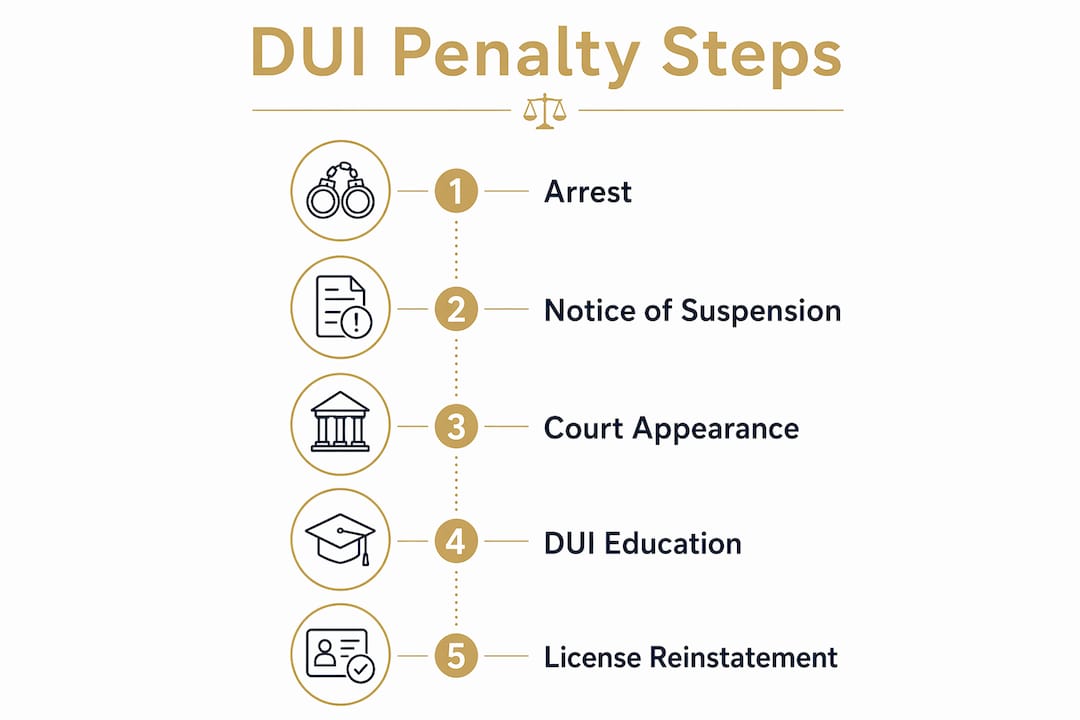
Steps to reinstate your license
- Request the APS hearing within 10 days. Call the DMV Driver Safety Office, not a standard DMV branch. Your attorney can handle this call on your behalf.
- Serve the suspension period if the hearing does not go in your favor, or if you choose not to contest it.
- Enroll in a licensed DUI education program and provide proof of enrollment to the DMV.
- File an SR-22 (proof of insurance) with the DMV. Your insurer files this on your behalf, but you need to request it.
- Install an ignition interlock device if required for a restricted license. The IID allows you to drive to work and to DUI school during the suspension period.
- Pay the DMV reissue fee and submit all required documentation to restore full driving privileges.
The restricted license option is genuinely useful for most working adults. It lets you drive to and from work, to DUI school, and in some cases anywhere with an IID installed. The exact terms depend on your BAC, whether you refused testing, and the county. An attorney who handles license suspension defense regularly knows which options apply to your specific situation.
What DUI education programs does California require after a first offense?
California courts do not give you a choice about attending a DUI program. Successful completion is a condition of probation, and failing to enroll or finish the program can result in probation revocation.
The California Department of Health Care Services licenses these programs and the court assigns you to one based on your BAC level and whether you refused testing.
- BAC under 0.20%: Minimum 30-hour program including education sessions, group counseling, and individual interviews.
- BAC of 0.20% or higher, or test refusal: Minimum 60-hour program covering the same activities.
- Program credit: You cannot count any program activities completed before the date of your current violation. Everything starts fresh.
- Failure to enroll or complete: The court must revoke probation unless good cause is shown.
The programs are not just a box to check. They involve regular attendance, participation in group sessions, and periodic individual check-ins with counselors. Missing sessions has consequences. Courts receive progress reports from program providers, so noncompliance surfaces quickly.
One thing people often underestimate: the 9-month program for high-BAC cases or refusals runs nearly a full year. Combined with probation terms, fines, and IID requirements, the total burden of a first DUI conviction extends well beyond the initial court date.
What is the legal process after a first DUI arrest in California?
A DUI arrest triggers two separate proceedings: the DMV administrative case and the criminal court case. They run on different timelines, involve different decision-makers, and can produce different outcomes. Winning one does not automatically win the other.
From traffic stop to arraignment
- Traffic stop: An officer observes a traffic violation or driving pattern suggesting impairment and initiates a stop.
- Field sobriety tests and preliminary alcohol screening (PAS): You may be asked to perform field sobriety tests and blow into a PAS device. You can decline the PAS before arrest if you are 21 or older and not on DUI probation, though declining field tests may still lead to arrest based on observed behavior.
- Arrest and chemical testing: Once arrested, California's implied consent law requires you to submit to a breath or blood test. Refusal at this stage triggers the one-year suspension and enhanced penalties.
- Processing and release: You receive a citation with a court date, the pink Notice of Suspension form (your temporary license), and a release.
- DMV hearing request: You have 10 days from arrest to call the DMV Driver Safety Office and request an APS hearing. This is the most time-sensitive step.
- Arraignment: Your first court appearance, where charges are formally read and you enter an initial plea. Most defense attorneys advise pleading not guilty at arraignment to preserve negotiating room.
- Pre-trial motions and negotiations: Your attorney reviews police reports, chemical test records, and body camera footage. Challenges to the stop's legality, the testing procedures, or the chain of custody can affect the outcome.
- Resolution: Cases resolve through dismissal, a plea agreement, or trial. Dismissal is not the most common outcome, but it does happen when evidence is weak or constitutional violations occurred during the stop or arrest.
- Probation conditions typically include no driving with any measurable alcohol, mandatory program completion, payment of fines, and no new criminal offenses.
- Insurance impact: A DUI conviction triggers an SR-22 requirement and typically causes a significant premium increase. Shopping insurers after the SR-22 period ends (usually three years) can help reduce costs.
- Background checks and employment: A misdemeanor DUI conviction appears on criminal background checks. Certain professional licenses, including those for healthcare, law, and commercial driving, carry additional reporting requirements.
- Immigration: Non-citizens should consult an immigration attorney immediately. A DUI conviction can have serious immigration consequences depending on visa status and prior record.
Pro Tip: Do not post anything about your arrest or the circumstances on social media. Prosecutors can and do use those posts.
The total financial cost of a first DUI in California goes well beyond the base fine. Attorney fees, program costs, IID installation and monthly fees, SR-22 premiums, and the DMV reissue fee add up to a figure that surprises most people.

How can expert legal representation change the outcome of your first DUI case?
Experienced DUI defense attorneys do two things simultaneously that most people cannot do alone: they manage the DMV administrative case and the criminal court case in parallel, each with its own deadlines and strategy. Missing either track costs you options.
On the DMV side, an attorney can request the APS hearing, subpoena the arresting officer, and challenge the stop, the arrest, and the chemical test results in a forum where the rules of evidence are less formal than criminal court. Winning the DMV hearing does not erase the criminal case, but it preserves your license while the court case plays out.
On the criminal side, the defense work focuses on the specific facts: Was the traffic stop legally justified? Were the field sobriety tests administered correctly? Was the breathalyzer properly calibrated and maintained? Was the blood draw handled with an unbroken chain of custody? Any one of these issues, if documented, can affect the prosecution's evidence and the plea offers on the table.
A first DUI in California is a serious legal matter, but it is not the end of a person's career, family life, or driving future. The system is designed to move quickly, and drivers who respond quickly preserve the most options. The ten-day DMV deadline, the criminal court process, the testing review, the defense analysis, and the long-term consequences all matter. So does the choice of attorney and the speed of the initial response.
What a skilled attorney brings to first-offense cases specifically:
- Early intervention: Contesting the DMV suspension before it takes effect, often extending driving privileges through the hearing process.
- Evidence review: Identifying procedural errors in the arrest, testing, or documentation that weaken the prosecution's case.
- Plea negotiation: Prosecutors offer different deals depending on the strength of the defense file. A well-prepared attorney changes what is on the table.
- Sentencing advocacy: Even when conviction is likely, the difference between 96 hours of jail and no custody time, or between a 3-month and 9-month program, often comes down to how the defense presents the client's circumstances to the court.
- Long-term planning: Advising on expungement eligibility, professional license implications, and immigration consequences from the start.
Logancriminaldefense, the Law Offices of Logan Noblin, APC, handles both the DMV and criminal sides of first DUI cases in San Diego with the kind of attention to detail that changes outcomes. Logan Noblin, a former "Attorney of the Year," has built a track record of not-guilty verdicts and dismissals across DUI and criminal defense cases throughout San Diego County.
Can you expunge a first-time DUI conviction in California?
Yes, expungement is available for most first-time DUI convictions in California, and it is worth pursuing once you are eligible. Under Penal Code 1203.4, if you completed probation without violations (or the court terminates probation early), you can petition to withdraw your guilty or no-contest plea, re-enter a not-guilty plea, and have the case dismissed.
The practical effect is meaningful. An expunged conviction no longer needs to be disclosed on most private-sector job applications. It does not erase the record entirely, but it changes what shows up and what you are legally required to report.
A few important limits apply. An expunged DUI still counts as a prior offense if you are arrested for DUI again within 10 years. It does not restore a suspended or revoked license. It does not remove the conviction from DMV records, which means insurance companies can still see it. And certain government jobs and professional licensing applications still require disclosure of expunged convictions.
The process involves filing a petition with the court where you were convicted, paying a filing fee, and attending a hearing if the court requires one. Most straightforward first-offense cases are granted without significant opposition. Timing matters: you must have completed all probation terms, paid all fines, and finished the DUI education program before filing. If you are still on probation, you can petition the court to terminate probation early and then immediately file for expungement.
Key Takeaways
A first DUI conviction in California triggers immediate license suspension, mandatory education programs, fines, and probation terms that can last three to five years, making early legal action the single most important step.
| Point | Details |
|---|---|
| License suspension timeline | Four months for BAC at 0.08% or higher; one year for chemical test refusal. |
| DMV hearing deadline | Request an APS hearing within 10 days of arrest or lose the right to contest suspension. |
| Education program length | Minimum 30 hours for BAC under 0.20%; minimum 60 hours for BAC at 0.20% or higher or refusal. |
| Fines and total costs | Base fines range from $390 to $1,000, but penalty assessments, program fees, IID costs, and SR-22 premiums push the real total much higher. |
| Expungement eligibility | Most first-time offenders can petition under Penal Code 1203.4 after completing probation, though DMV records and prior-offense counting remain unaffected. |
Your next step after a first DUI arrest in California

The 10-day DMV deadline is not a suggestion. Once it passes, your license suspension becomes automatic and your ability to challenge the administrative case disappears. The criminal case continues separately, but you will have lost one of your most important early options.
Logancriminaldefense handles both tracks from day one. Logan Noblin and the team at the Law Offices of Logan Noblin, APC, have the experience to contest your DMV suspension, review the evidence in your criminal case, and build the strongest possible defense for your specific facts. Whether the goal is dismissal, reduced charges, or minimizing the long-term impact on your record and career, the work starts immediately.
Contact Logancriminaldefense today for a consultation. The sooner you act, the more options remain on the table.