A DUI DMV hearing is an administrative proceeding that determines whether your driver's license will be suspended or revoked after a DUI arrest. This hearing runs parallel to your criminal case and operates under entirely different rules. The California Department of Motor Vehicles holds this hearing independently of any criminal court, meaning the outcome of one does not control the other. You have exactly 10 calendar days from your arrest date to request this hearing. Miss that window, and your license suspension becomes automatic. Understanding what this proceeding involves, and how to fight it, is the most direct path to keeping your driving privileges intact.
What is the DUI DMV hearing process and timeline?
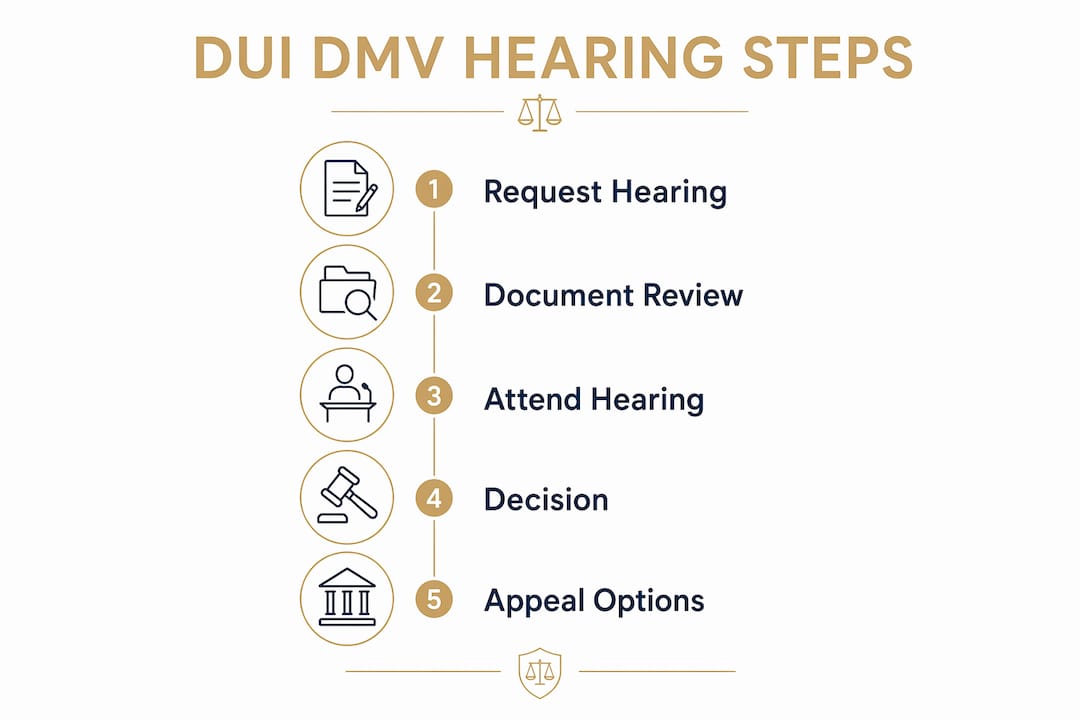
The DMV administrative hearing, formally called an Admin Per Se (APS) hearing, follows a strict procedural timeline. Every step matters, and missing any one of them can cost you your license before you ever set foot in a courtroom.
The process works like this:
- Arrest and pink slip. When you are arrested for DUI, the officer typically confiscates your license and issues a pink temporary driving permit. That permit is valid for 30 days.
- 10-day deadline. You have 10 calendar days from the arrest date to request a DMV hearing. Failure to request one within this window leads to automatic license suspension 30 days after your arrest.
- Stay of suspension. A timely hearing request freezes your suspension. Your temporary permit remains valid while the hearing is pending, which can take weeks or months.
- Hearing scheduling. The DMV schedules the hearing at a Driver Safety Office, not a courtroom. Hearings are conducted in person or by phone.
- The hearing itself. A DMV hearing officer reviews documentary evidence, hears arguments, and issues a written decision. Most decisions arrive within a few weeks of the hearing date.
- Two hearing types. A standard APS hearing applies when you submitted to a chemical test. If you refused testing, an expanded refusal hearing covers additional legal questions.
Pro Tip: Request your hearing in writing and keep a copy. A documented request protects you if the DMV later claims it was not received in time.
Missing the 10-day deadline is the single most common and most preventable mistake drivers make. The DMV does not grant extensions for oversight or confusion. Act the same day you are released if possible.

What legal criteria must the DMV prove to suspend your license?
The DMV does not need to prove its case beyond a reasonable doubt. The standard at an APS hearing is preponderance of the evidence, meaning the hearing officer only needs to find it more likely than not that the facts support suspension. That is a significantly lower bar than what criminal prosecutors must clear.
Under California Vehicle Code § 13557, the DMV must establish three core elements at a standard APS hearing:
- Reasonable cause for the stop. The officer must have had a lawful reason to pull you over or make contact.
- Lawful arrest. The arrest itself must have followed proper legal procedure.
- BAC of 0.08% or higher. A valid chemical test must show your blood alcohol concentration met or exceeded the legal limit at the time of driving.
For refusal cases, the DMV must also prove that you were properly advised of the consequences of refusing a chemical test and that you willfully refused.
The DMV builds its case almost entirely on paperwork. Key documents include the DS 367 form (the officer's sworn statement), breathalyzer calibration records, and the arresting officer's report. The official records exception allows the DMV to admit these documents without calling the officer to testify in person. That means the state's case is largely pre-assembled before the hearing begins.
| DMV element | What it requires |
|---|---|
| Reasonable cause | Articulable facts justifying the traffic stop or contact |
| Lawful arrest | Proper procedure followed at the time of arrest |
| BAC 0.08%+ | Valid, documented chemical test result |
| Refusal (if applicable) | Proper advisement and willful refusal on record |
Pro Tip: Request all DMV documents before your hearing. You are entitled to review the evidence the state plans to use. Errors in those documents are your strongest weapon.
How can you challenge evidence and win a DMV hearing?
Winning a DMV administrative hearing requires attacking the paperwork, not the officer's credibility. The hearing officer acts as prosecutor, judge, and jury, which creates a structural bias toward state evidence. Disputing an officer's story rarely moves the needle. Exposing technical and procedural flaws in documents does.
The most effective defense strategies include:
- Challenging the traffic stop. If the officer lacked reasonable suspicion to pull you over, the entire case collapses. Dashcam footage, witness statements, and the officer's own report can reveal inconsistencies.
- Disputing the arrest's legality. An unlawful arrest invalidates the evidence collected after it. Procedural errors during the arrest are worth examining closely.
- Breathalyzer calibration records. Breath testing devices must be regularly calibrated and maintained. Missing or outdated calibration logs can render a BAC result unreliable.
- 15-minute observation period. California law requires officers to observe a driver for at least 15 minutes before administering a breath test. Gaps in the observation log are a legitimate challenge.
- Operator certification. The officer who administered the breath test must hold a valid certification. An expired or absent certification undermines the test's validity.
- Blood test chain of custody. Blood samples must be collected, stored, and analyzed under strict protocols. Any break in the chain of custody can make results inadmissible.
- Rising BAC defense. Alcohol absorbs into the bloodstream over time. If your BAC was rising at the time of the test, your actual BAC while driving may have been below 0.08%.
- Paperwork errors. An unsigned DS 367 form, inconsistent dates, or missing information can be grounds to exclude the document entirely.
Technical flaws in reports and device calibration records form the strongest basis for winning a DMV hearing. This is not about telling a better story. It is about proving the state's own documents do not hold up.
Pro Tip: Think carefully before offering live testimony at the DMV hearing. Anything you say creates a record that criminal prosecutors can use against you later. Defense attorneys often advise clients to let the documents do the work.
The decision to testify carries real risk. Live testimony at the DMV hearing can be used by criminal prosecutors in your separate court case. Skilled DMV hearing representation focuses on documentary challenges precisely to avoid creating that kind of record.
What happens after the DMV hearing?
The hearing officer issues a written decision, typically within a few weeks. The outcome falls into one of two categories, and each carries distinct consequences.
If you win:
- Your license is reinstated with no administrative suspension on record.
- The DMV hearing result does not affect your criminal case, but the evidence gathered during the hearing can support your criminal defense strategy.
- No IID requirement or restricted license period applies from the DMV side.
If you lose:
- A first-time DUI suspension lasts four months, separate from any criminal court penalties. That independence matters: you can lose the DMV hearing and still win in criminal court, or vice versa.
- Longer suspensions apply for prior DUI convictions or test refusals.
- Restricted licenses may be available, including an Ignition Interlock Device (IID) license or a work and school restricted license, allowing limited driving during the suspension period.
- Reinstatement typically requires completing a DUI program, paying reinstatement fees, and filing an SR-22 insurance certificate.
The DMV hearing and the criminal DUI case are parallel and autonomous proceedings. Winning one does not dismiss the other. Losing one does not guarantee losing the other. That separation is critical to understand when building your overall defense.
Post-hearing appeals are possible. If you lose, you can petition the superior court for a writ of mandate to challenge the DMV's decision. This is a narrow legal remedy, but it exists and has succeeded in cases where the hearing officer made procedural or evidentiary errors.
Key Takeaways
A DUI DMV hearing is a document-driven administrative proceeding where attacking technical and procedural flaws in the state's paperwork is the most effective path to protecting your license.
| Point | Details |
|---|---|
| 10-day deadline is absolute | Request your DMV hearing within 10 calendar days of arrest or face automatic suspension. |
| Lower burden of proof | The DMV only needs preponderance of evidence, not proof beyond a reasonable doubt. |
| Paperwork beats testimony | Challenging calibration records, DS 367 errors, and chain of custody is more effective than disputing officer accounts. |
| Hearings are independent | Winning or losing the DMV hearing does not determine the outcome of your criminal DUI case. |
| Restricted licenses exist | An IID or work-restricted license may be available after a lost hearing to preserve some driving ability. |
What I've learned from watching drivers lose winnable DMV hearings
Most drivers who lose their license at a DMV hearing do not lose because the evidence against them was airtight. They lose because they did not request the hearing in time, did not review the documents beforehand, or showed up without understanding what the hearing officer actually cares about.
The structural reality of these hearings is uncomfortable. The hearing officer is not a neutral arbiter. That officer serves as investigator, prosecutor, and judge simultaneously, and the state's paperwork arrives pre-packaged and presumed reliable. Walking in expecting a fair fight on the merits is a mistake.
What actually works is treating the hearing like a document audit. Every form, every calibration log, every observation period notation is a potential crack in the state's case. I have seen hearings won on a single unsigned DS 367 form. I have seen them won because a breathalyzer's last calibration was two days past the required interval. The criminal court standard of reasonable doubt does not apply here, but the DMV's documents still have to be accurate and complete.
The other mistake I see constantly is drivers assuming the DMV hearing is less important than the criminal case. It is not. Losing the hearing means losing your license for months, which affects your job, your family, and your daily life immediately. The criminal case may take a year to resolve. The DMV suspension starts in 30 days.
Get an attorney who knows this process specifically. General criminal defense experience is not enough. DMV administrative hearings have their own rules, their own evidentiary standards, and their own procedural traps. The 10-day window alone has ended more cases before they started than any other single factor.
— Jake
How Logancriminaldefense approaches DUI DMV hearings
Facing a DMV hearing without experienced legal representation puts your license at serious risk. Logancriminaldefense, the Law Offices of Logan Noblin, APC, has built a track record of aggressive DUI defense in San Diego, including representation at California DMV administrative hearings.
Logan Noblin, a former "Attorney of the Year," understands that the DMV hearing is not a formality. His team reviews every document the state plans to use, identifies technical and procedural flaws, and builds a defense strategy designed to protect your driving privileges from day one. Whether you are facing a first-time DUI or a more complex situation, the firm's San Diego DUI defense team is prepared to fight both the administrative and criminal sides of your case. Contact Logancriminaldefense today to protect your license before the 10-day window closes.
FAQ
What is a DUI DMV hearing?
A DUI DMV hearing is an administrative proceeding held by the California DMV to determine whether your driver's license should be suspended after a DUI arrest. It is separate from criminal court and focuses on specific legal criteria under California Vehicle Code § 13557.
How long does a first-time DUI suspension last?
A first-time DUI administrative suspension lasts four months if you lose the DMV hearing or fail to request one. This suspension runs independently from any penalties imposed by the criminal court.
What happens if I miss the 10-day deadline?
Missing the 10-day deadline results in automatic license suspension 30 days after your arrest. The DMV does not grant extensions, so contacting an attorney immediately after your arrest is critical.
Can I drive while waiting for my DMV hearing?
Yes. A timely hearing request freezes the suspension and keeps your temporary driving permit valid while the hearing is pending. That permit is typically valid for 30 days from the arrest date.
Does winning the DMV hearing dismiss my DUI charges?
No. The DMV hearing and the criminal DUI case are independent proceedings. Winning the administrative hearing protects your license but does not affect the criminal charges against you.