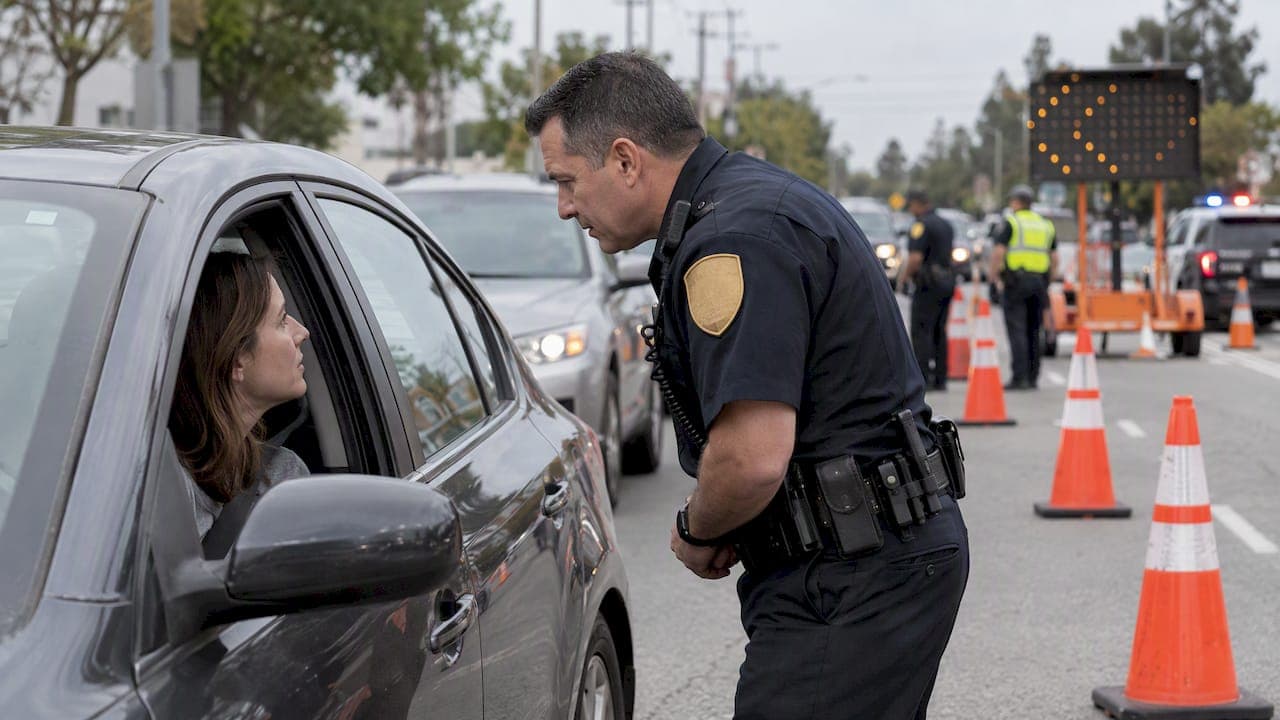
Yes, sobriety checkpoints are lawful in California when run under court-approved guidelines, but you keep key rights even when a checkpoint stops you. California Vehicle Code §2814.2 requires you to stop when posted signage calls for it, hand over your license and registration, and nothing more. You can stay silent beyond that, decline voluntary searches and field sobriety tests, and if you are arrested, contact a lawyer right away to protect both your license and your criminal case.
TL;DR:
- At a required stop, provide your license, registration, and insurance; most drivers may refuse questions beyond identification and voluntary roadside tests before arrest.
- You may decline a vehicle search absent a warrant or independent probable cause, and you may record the encounter when doing so is safe.
- After arrest, refusing a required chemical test can trigger an administrative license suspension separate from court; request a DMV hearing promptly because the deadline is short.
- A legal turn before a checkpoint is allowed, but an abrupt U turn or shoulder driving can justify a separate traffic stop.
- A stop may be challenged for missing approval, an ignored neutral screening formula, or excessive delay; request the operational plan and supervisor approval records.
Table of Contents
- What to Expect at a DUI Checkpoint in California
- Your Rights at a Checkpoint: Stops, Silence, Searches, and Recording
- Can You Turn Around Before Reaching a Checkpoint?
- Breath Tests, Implied Consent, and Your License After an Arrest
- When Checkpoint Stops Cross the Line: Ingersoll Safeguards and Suppression
- If You're Arrested at a Checkpoint: Immediate Steps
- How a DUI Lawyer Evaluates a Checkpoint Arrest
- Typical Penalties for a DUI Conviction After a Checkpoint Arrest
- Documenting and Reporting a Checkpoint That Didn't Follow the Rules
- Commercial Drivers vs. Personal Vehicle Drivers at Checkpoints
- Checkpoints and Immigration Enforcement in California
- Why Calm, Early Action Changes the Outcome
- How We Help After a Checkpoint Arrest
- FAQ
- Sources
What to Expect at a DUI Checkpoint in California
A lawfully run checkpoint looks organized, not improvised. Officers typically post advance signage, use marked patrol vehicles, set up cones or barriers, and wear visible identification so drivers understand they have reached an official stop rather than a random roadblock.
Checkpoints also follow a neutral screening pattern, such as stopping every third or fifth car, so officers cannot single out specific drivers without a reason. Most stops last only long enough for an officer to check your license, observe your demeanor, and ask whether you have been drinking. If nothing raises concern, you are usually waved through within a minute or two.
A secondary screening area is where things slow down. You might get directed there if an officer notices slurred speech, the smell of alcohol, or open containers. At that point, expect more direct questions and a closer look at your behavior.
What to watch for at a lawful checkpoint:
- Posted signs announcing the checkpoint ahead of time
- Marked police vehicles and officers in visible uniforms or identification
- A consistent pattern for which cars get stopped
- A brief initial contact unless something prompts further screening
Recognizing these features helps you respond calmly instead of reacting to what feels like an unexpected confrontation.
Your Rights at a Checkpoint: Stops, Silence, Searches, and Recording
California law requires you to stop when a checkpoint posts a required stop and to provide your license, registration, and proof of insurance. That is where your legal obligation to cooperate ends. California Vehicle Code §2814.2 covers the stop requirement, but it does not require you to answer questions about where you have been or how much you have had to drink.
Here is a practical rundown of what you can do:
- Stop and provide your license, registration, and insurance when signage requires it.
- Stay silent beyond identifying yourself; you can say, "I'm choosing not to answer questions" without being confrontational.
- Decline a voluntary vehicle search unless an officer has a warrant or probable cause independent of the checkpoint.
- Decline pre-arrest field sobriety tests and the preliminary alcohol screening (PAS) breath test, both of which are voluntary for most drivers before an arrest.
- Record the interaction on your phone if you can do so safely, since California is a one-party consent state for your own encounters with police in public.
Refusing voluntary tests does not mean refusing to cooperate entirely. Officers will document your refusal, and that documentation can appear later in a police report, but refusal alone is not a crime the way refusing a post-arrest chemical test can be. Our overview of refusing a field sobriety test breaks down what refusal actually looks like in practice and what consequences follow.
Pro Tip: Keep your hands visible, speak clearly, and state your rights calmly once. Repeating yourself or arguing rarely changes the outcome and can extend the stop.
Can You Turn Around Before Reaching a Checkpoint?
Yes, you can lawfully avoid a checkpoint by turning around before you enter it, as long as you do not break a traffic law in the process. California Vehicle Code §2814.2 contemplates this kind of avoidance, and officers generally will not pursue a driver simply for turning off before the checkpoint.
The catch is in how you do it. A legal turn at an intersection or a safe lane change is fine. An abrupt U-turn across double yellow lines, backing up in traffic, or driving onto a shoulder to escape the line gives officers an independent reason to stop you, and that stop has nothing to do with the checkpoint itself.
Safe ways to avoid a checkpoint include:
- Turning at a marked intersection before the checkpoint comes into view
- Using a legal lane change well ahead of the stop
- Avoiding sudden braking, swerving, or shoulder driving
If your avoidance maneuver looks erratic, officers often treat it as reasonable suspicion for a traffic stop, separate from whatever checkpoint you were trying to skip.
Breath Tests, Implied Consent, and Your License After an Arrest
The roadside PAS breath test and field sobriety tests before an arrest are voluntary for most drivers. Once you are arrested, though, California's implied consent law requires you to submit to a chemical test, either breath or blood, to determine your blood alcohol content.
Refusing a chemical test after a lawful DUI arrest can trigger an automatic administrative license suspension under the DMV's APS rules, separate from whatever happens in criminal court. This suspension process moves on its own timeline and does not wait for a conviction.
That separation matters because you typically have only a short window after arrest to request a DMV hearing and contest the administrative suspension. Missing that window can cost you driving privileges even if your criminal case later gets dismissed. Our guide on avoiding license suspension after a DUI in San Diego walks through how to request that hearing and what to expect from it.

Calling a lawyer quickly after an arrest lets you pursue both tracks at once: challenging the administrative suspension and building your criminal defense, rather than letting one deadline slip while you focus on the other.
When Checkpoint Stops Cross the Line: Ingersoll Safeguards and Suppression
California's checkpoint framework traces back to Ingersoll v. Palmer, which upheld sobriety checkpoints as a limited exception to the usual requirement of individualized suspicion, provided certain safeguards are in place. Later decisions, including People v. Banks and related Supreme Court precedent, clarified how courts weigh publicity, duration, and the conduct of officers on scene.
The Ingersoll safeguards include:
- Supervisory officers, not officers in the field, decide where and when a checkpoint operates
- A neutral, predetermined formula governs which vehicles get stopped
- Safety measures such as lighting, signage, and marked vehicles reduce danger to drivers and officers
- The initial detention stays brief unless specific facts justify further questioning
CHP checkpoint policy under HPM 70.4 builds these requirements into operational guidance for how checkpoints get planned and run.
When a checkpoint operation skips supervisory sign-off, abandons the neutral screening formula, or holds drivers far longer than needed to check for impairment, that gap becomes the opening a defense attorney needs to challenge the stop.
These gaps often support a motion to suppress evidence under Penal Code 1538.5, which asks a court to exclude evidence gathered through an unlawful stop. A California State Auditor review found that checkpoint data is self-reported by grantees and that oversight of individual checkpoint operations is limited, which is part of why requesting the actual operational plan and supervisor approval often matters more than relying on an officer's account alone.
If You're Arrested at a Checkpoint: Immediate Steps
What you do in the hours after an arrest shapes both your criminal case and your license status.
- Stay cooperative and polite at the scene, but continue to limit your statements to basic identifying information.
- Ask for medical attention if you need it, and make sure any request is documented.
- Note details while they are fresh: the time, location, which officer you dealt with, and anything unusual about the stop.
- Request the DMV hearing notice and calendar the deadline the moment you are released.
- Take photos of the checkpoint setup, signage, and your vehicle if you can safely access the scene afterward, and write down names of any witnesses.
- Preserve any dashcam or phone video before it gets overwritten or deleted.
Pro Tip: Save every document the officer gives you, including the pink temporary license and any citation, since these contain deadlines tied directly to your DMV hearing rights.
Contacting an experienced DUI attorney within days, not weeks, keeps your suppression arguments and DMV options open. A lawyer who requests the checkpoint's operational records early has a far better chance of catching the kind of procedural gaps that lead to suppression or a stronger negotiating position. For many clients, this also means reviewing early whether ignition interlock requirements will factor into license terms down the line.
How a DUI Lawyer Evaluates a Checkpoint Arrest
When we review a checkpoint case, we start with the paperwork: the operational plan, supervisor approval, the screening formula actually used, and the timeline of the stop. A checkpoint that deviated from its own plan, ran past its approved hours, or held a driver well beyond what a brief screening requires often gives us real grounds to challenge the evidence.
We pair that review with DMV hearing preparation, since the administrative and criminal tracks move independently and both need attention from day one. Diversion programs, including options for veterans and clients facing mental health considerations, sometimes become part of the strategy depending on the facts of the case and the client's background.
Typical Penalties for a DUI Conviction After a Checkpoint Arrest
A DUI conviction arising from a checkpoint stop carries the same range of penalties as any other DUI arrest in California, since the checkpoint itself does not change the underlying offense. A first-time conviction typically involves fines, mandatory DUI education classes, probation, and a license suspension, with the specifics depending on your blood alcohol level and any aggravating factors like a minor in the vehicle.
Second and subsequent offenses within ten years bring steeper consequences: longer license suspensions, mandatory jail time in many cases, and extended DUI education requirements. Prior convictions substantially raise the stakes each time, which is part of why early legal involvement matters even when the initial contact happened at a checkpoint rather than through a moving violation.
Our guide to a first-time DUI and our resource on second DUI offenses walk through how these penalty tiers typically play out, while our page on multiple DUI offenses covers what changes when a driver has two or more prior convictions.
Because checkpoint stops sometimes surface other issues, like drug-related impairment, penalties can shift depending on what substance is involved. Our page on drug-related DUI charges explains how those cases differ from alcohol-only DUI charges.

Documenting and Reporting a Checkpoint That Didn't Follow the Rules
If something about a checkpoint felt off, whether it was the lack of signage, an unusually long detention, or an officer who seemed to target specific vehicles outside the stated screening pattern, write it down as soon as possible while the details are fresh.
Useful documentation includes the time and location of the stop, the names or badge numbers of officers involved, photos of the checkpoint setup, and any video you or a passenger captured. If you were cited or arrested, your attorney can formally request the checkpoint's operational plan and supervisor approval records as part of discovery, which is often the clearest way to confirm whether the stop followed Ingersoll safeguards.
Reporting concerns informally to the agency that ran the checkpoint is an option, but it rarely changes the outcome of your specific case. The more effective path is raising the issue through your defense attorney, who can use procedural flaws to challenge evidence directly in court rather than through a complaint process that operates separately from your case.
Commercial Drivers vs. Personal Vehicle Drivers at Checkpoints
Commercial drivers face a stricter standard at checkpoints than drivers in personal vehicles. California treats commercial driver's license (CDL) holders as subject to a lower blood alcohol threshold, and a conviction can jeopardize both a driving record and a livelihood in ways that extend well beyond a standard license suspension.
Checkpoint procedures themselves do not differ dramatically; officers still use the same signage, screening formula, and brief-stop approach. What changes is the stakes and sometimes the scrutiny, since a commercial vehicle stopped at a checkpoint may draw additional questions about hours of service, cargo, or vehicle inspection status alongside any impairment check.
A CDL holder facing a DUI arrest from a checkpoint stop should treat the DMV timeline with extra urgency, since the consequences for a commercial license often compound faster than for a standard license. Our page on CDL DUI defense covers how these cases typically unfold and what is at risk.
Checkpoints and Immigration Enforcement in California
California's checkpoint framework is designed around traffic safety and impairment, not immigration status. State and local law enforcement agencies operating sobriety checkpoints are generally restricted under California's sanctuary state policies from inquiring about immigration status or cooperating with federal immigration enforcement during a routine checkpoint stop.
That said, a checkpoint stop that leads to an arrest, particularly for a serious offense, can still result in information being shared with federal authorities down the line depending on the circumstances of the case and applicable law. Drivers who are not U.S. citizens and get arrested at a checkpoint should treat the situation with particular care and loop in an attorney immediately, since a conviction can carry consequences beyond the criminal case itself.
We handle federal and border-related matters alongside standard criminal defense, and our page on federal and border defense covers how these cases intersect with broader immigration consequences.
Why Calm, Early Action Changes the Outcome
Most of the checkpoint cases that end well start the same way: the driver stayed calm, said little beyond what the law required, and called a lawyer before answering more questions than necessary. The ones that go sideways usually involve a driver who tried to explain their way out of trouble on the spot, handing officers more to work with.
Checkpoint cases live or die on details: the screening formula, the timeline, the paperwork behind the operation. Drivers who protect those details early, rather than after the fact, tend to walk away with better outcomes.
— Logan Noblin
How We Help After a Checkpoint Arrest
If a checkpoint stop turned into a DUI arrest, we handle both sides of the problem: the criminal case and the DMV hearing that can cost you your license before that case is even resolved. We work on DUI defense, license restoration efforts, and diversion programs for clients who qualify.

Bring your citation, any paperwork from the arrest, and your recollection of how the checkpoint was set up to your first conversation with us. We review the operational details that often get overlooked and move quickly on DMV deadlines. Visit the Law Office of Logan Noblin to schedule a consultation and start building your defense.
This article is general information, not a substitute for advice from a qualified lawyer. Consult a qualified legal professional about your own circumstances before acting on anything here.
FAQ
What is the legal DUI limit in California?
Exceeding the applicable blood alcohol limit while driving can support a DUI charge regardless of whether the stop happened at a checkpoint or through a traffic violation.
Does Google Maps tell you about DUI checkpoints?
Mapping and navigation apps sometimes display user-reported checkpoint locations, but this feature depends on other drivers submitting reports in real time and is not official law enforcement information. Relying on an app does not change your legal obligation to stop when a lawfully posted checkpoint requires it under California Vehicle Code §2814.2.
Does California allow DUI checkpoints?
Yes, California allows sobriety checkpoints under the framework established in Ingersoll v. Palmer, which requires safeguards like supervisory planning, neutral screening formulas, and limited detention times. Checkpoints that skip these safeguards can face legal challenges in court.
What happens if you get 3 DUIs in CA?
A third DUI conviction within ten years in California typically brings significantly longer license suspension, mandatory jail time, and extended DUI education programs compared to a first or second offense. Our page on multiple DUI offenses explains how these enhanced penalties are structured and what defense options may apply.
Sources
- California Vehicle Code §2814.2
- DMV: Driving under the influence (DUI) guidance
- CHP HPM 70.4: Sobriety/driver license checkpoints (policy chapter)
- California State Auditor: Checkpoint monitoring / OTS review (2011-110)
- People v. Banks / People v. Alvarez / Sitz (case law context)