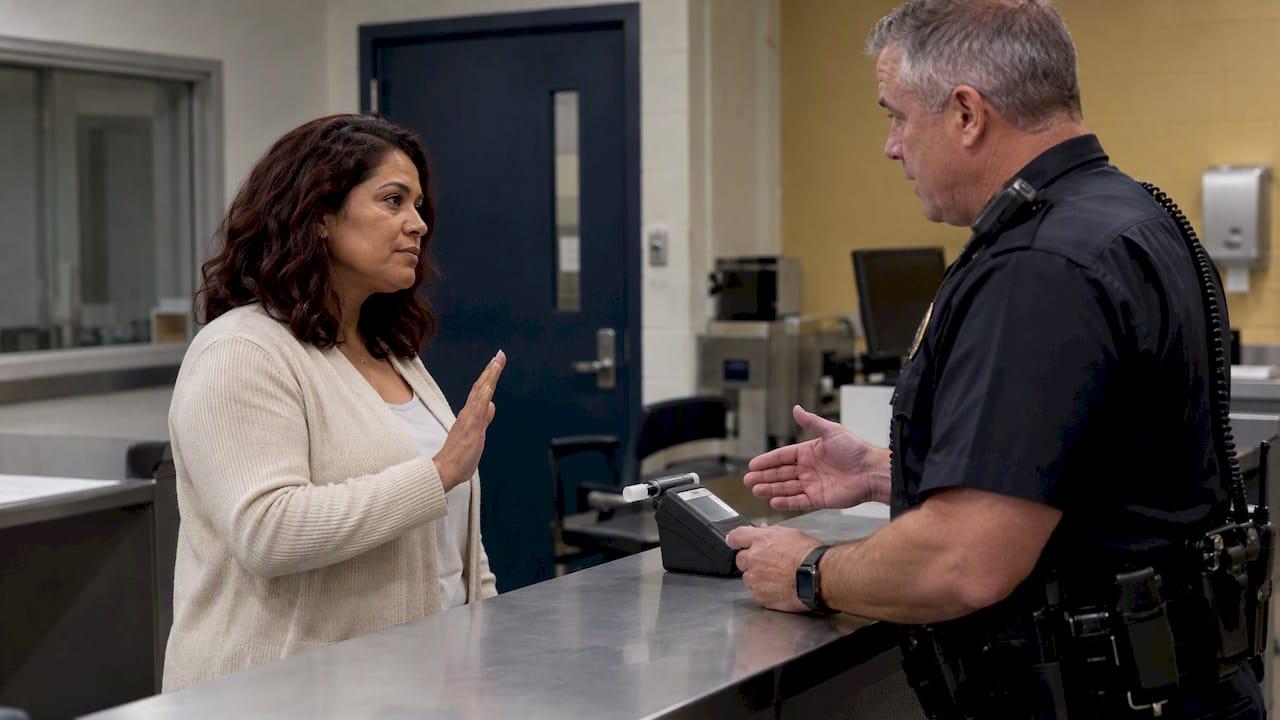
If you refuse a breath or blood test after a lawful DUI arrest in California, you are not avoiding a DUI case. You are adding to it. The DMV will move to suspend your license for a year, the prosecutor can allege a refusal enhancement that adds mandatory jail time on a conviction, and a jury may be told that your refusal suggests you knew you were impaired. You still have real defenses, and many refusal cases turn on details such as whether the officer gave the required warning. This guide explains how the law works, what each consequence looks like, and what to do in the first days.
TL;DR
- After a lawful DUI arrest, California's implied-consent law requires you to submit to a breath or blood test. You choose which one for an alcohol arrest.
- A refusal means an administrative license suspension of one year for a first refusal, longer with priors, and you have only 10 days to ask the DMV for a hearing.
- If you are convicted of DUI, a proven willful refusal adds mandatory jail time on top of the usual penalties. Refusing does not stop the DUI charge.
- Roadside field sobriety tests are a different matter, and generally voluntary. The post-arrest chemical test is not.
- Refusal cases are often winnable on the facts: lawfulness of the arrest, the advisement, and whether the conduct was truly a willful refusal.
Table of Contents
- What the implied-consent law says
- What counts as a refusal
- Breath, blood, or urine: what you choose
- The DMV consequences
- The criminal consequences
- Refusing does not stop the DUI case
- Field sobriety tests are different
- Defenses to a refusal allegation
- What to do in the first days
- Our perspective
- Get a lawyer reviewing your refusal case
- FAQ
- Sources
What the implied-consent law says
Every driver in California is treated as having agreed to chemical testing. Under Vehicle Code section 23612, anyone who drives a motor vehicle is deemed to have consented to a test of their blood or breath if they are lawfully arrested for a DUI-related offense. The test must be incidental to that arrest, and the officer must have reasonable cause to believe you drove in violation of Vehicle Code section 23140, 23152, or 23153.
California courts have long described these laws as remedial. They exist to reduce the hazards of impaired driving by securing drivers' cooperation in producing scientific evidence, as the court explained in McDonnell v. Department of Motor Vehicles. That purpose explains why the penalty for saying no is built into your license rather than left to the criminal case.
Two points trip people up.
Consent is deemed, not given in the moment. You signed nothing at the roadside, but by driving you accepted the rule. Telling the officer you do not consent does not change it.
The arrest has to be lawful first. Implied consent only applies after a lawful arrest. If the stop was unjustified or the officer lacked reasonable cause to arrest, the foundation of the refusal allegation can fail. That is the first place we look.
What counts as a refusal
Per the California DMV, a refusal occurs when a driver does not submit to or complete a required breath or blood test after the officer requests it following a lawful DUI arrest. Note the words "or complete." You can be charged with refusal without ever saying no.
Conduct that officers commonly write up as refusal:
- Saying "no" or "I want a lawyer first"
- Staying silent or not responding to repeated requests
- Failing to blow hard enough or long enough for the machine to register a sample
- Resisting or pulling away during a blood draw
- Conditioning the test on something, such as speaking to an attorney
That last one matters. You do not have a right to have an attorney present when deciding whether to test or which test to take, according to the Orange County Sheriff's Department policy on impaired driving. Asking for a lawyer and refusing to proceed until one arrives can be treated as a refusal.
The word that carries the legal weight is "willful." A person who genuinely cannot complete a test, for example because of a medical condition, is in a different position from one who chooses not to. We come back to this in the defenses section.
Breath, blood, or urine: what you choose
If you are arrested on suspicion of alcohol DUI, the officer must tell you that you have a choice. Under section 23612, you pick blood or breath. The Court of Appeal in Espinoza v. Shiomoto summarized the structure this way: the arrestee generally chooses blood or breath, must use the other test if unable to complete the chosen one, and must give urine if both blood and breath are unavailable.
Urine is not a free alternative. The DMV says urine testing is unavailable unless drug influence is suspected, blood and breath tests are unavailable, or the driver has hemophilia or takes anticoagulants for a heart condition (California DMV).
When the officer suspects drugs
If the officer has reasonable cause to believe you were under the influence of drugs and a blood test will reveal evidence of it, you can be required to submit to a blood test even if you chose breath (Vehicle Code 23612). Drivers who take prescription medication or have used cannabis should understand that a clean breath result does not end the encounter. If your case involves drugs, see our page on drug DUI defense in San Diego.
Why blood is not compelled without a warrant
The constitutional picture is more nuanced. Birchfield permits warrantless breath tests after arrest but not compelled blood tests, and the California court held that no warrant is needed when a suspect freely chooses a blood test over breath, as described in the appendix to Gutierrez v. California. In practice, the law punishes the refusal but does not usually let officers force the test without a warrant. Do not treat that as a reason to refuse. The penalties for refusing apply either way.
The DMV consequences
The DMV acts on a refusal whether or not you are ever convicted of anything. According to the DMV, a refusal leads to an immediate administrative suspension or revocation of driving privileges, lasting one year for a first refusal and up to three years for subsequent ones. Those penalties are separate from, and in addition to, any court-imposed jail, fines, or other penalties.
The officer must advise you of this. Under section 23612, the warning covers a one-year suspension, or a two- or three-year revocation for qualifying prior offenses or prior license actions.
| Situation | DMV result for refusal |
|---|---|
| First refusal | One-year suspension |
| Refusal with qualifying prior offense or license action | Two- or three-year revocation, depending on the history |
The table follows the statute's advisement and the DMV's summary. Your own history decides which line applies, and a lawyer can read your record and tell you.
The 10-day deadline
This is the part people miss. You must ask the DMV for an administrative hearing within 10 days of receiving notice of the suspension to challenge it (California DMV). Miss it and the suspension takes effect without any review. The hearing is a separate proceeding from your court case, with its own issues and its own rules. Our guide to the DUI DMV hearing walks through what happens, and we also represent clients at DMV administrative hearings in San Diego.
If you drive for a living, the stakes are higher. A refusal can carry commercial-license consequences that do not apply to other drivers, so a CDL holder should speak to a CDL DUI lawyer before the 10 days run out.
The criminal consequences
The refusal enhancement
In court, a refusal is not a stand-alone charge for most drivers. It is an allegation attached to the DUI case. Under Vehicle Code section 23577, if you are convicted of DUI and willfully refused or failed to complete the test, the court must add mandatory jail time: 48 continuous hours for a first conviction, 96 hours for a second, and 10 days for a third DUI punishable under section 23546. That time applies whether or not probation is granted and cannot be stayed.

For context on what a first DUI conviction already carries, see our guides to first-time DUI penalties in San Diego and first-time DUI in California.
What the prosecutor has to prove
The refusal enhancement is not automatic. Under CALCRIM No. 2131, the prosecution must prove beyond a reasonable doubt that:
- An officer requested the test
- The officer gave the required advisements
- You willfully refused or failed to complete the test
- The arrest was lawful, with reasonable cause to believe you violated Vehicle Code section 23140, 23152, or 23153
Each of those four items is a place for a defense lawyer to work. The Judicial Council frames this as a separate allegation, so it can increase consequences without replacing proof of the underlying DUI.
Refusal as evidence of guilt
There is a second criminal cost that does not show up as jail time. A jury can be instructed that refusal may show consciousness of guilt. CALCRIM No. 2130 says the jury decides what a refusal means and how much it matters, and that refusal alone cannot support a DUI conviction. In People v. Bolourchi (2024), the Court of Appeal affirmed that a jury may draw an adverse inference from a validly established refusal to submit to a post-arrest blood test in a drug-DUI case.
So refusing has a hidden cost. You give the prosecution a piece of evidence, and you keep no chemical result that might have been favorable. A breath or blood reading can also be challenged on calibration, timing, or sampling grounds, which is often more workable than defending against an inference of guilt.
Proposed new refusal crime
Legislators have floated making refusal its own crime. AB 702 proposed a crime for willful refusal to take a breath test, with punishment based on prior DUI convictions, according to the bill text. That was a proposal from the 2017-2018 session, and what governs a case now is the enhancement and DMV structure described above.
Refusing does not stop the DUI case
A common belief is that without a number there is no case. That is wrong. Prosecutors build DUI cases from driving behavior, the officer's observations of speech, eyes, and balance, any roadside tests, video, and your statements. With a refusal added, they also have the refusal itself.
What refusal does change is the quality of the scientific evidence. Without a chemical result, the case rests on the officer's account, and that is a different kind of case to defend. It is not a reliable shortcut, though, given the license suspension and the enhancement that come with it. A lawyer weighs that tradeoff only after the fact. If you are reading this because you have already refused, the useful question is what to do next.
Field sobriety tests are different
Many drivers mix up the roadside tests and the post-arrest chemical test. They are governed differently.
Field sobriety tests, such as the walk-and-turn or one-leg stand, are generally voluntary before arrest, and declining them does not trigger the implied-consent penalties described here. The same is true of the handheld roadside breath device used before an arrest for most adult drivers. The chemical test after arrest is the one the law requires. We cover the practical tradeoffs in our article on whether you can refuse a field sobriety test, and if the stop happened at a roadblock, our guide to DUI checkpoint rights covers what still applies.
One caution: officers often blur the line, saying "you have to blow" at the roadside when the law does not require a roadside test. How the request was phrased and whether you were already under arrest can matter a great deal later.
Defenses to a refusal allegation
Refusal cases are more defensible than most people expect. The strongest arguments tend to fall into these groups.
The arrest or stop was unlawful. Implied consent depends on a lawful arrest with reasonable cause. If the officer lacked grounds, both the DMV suspension and the enhancement can fall.
The advisement was missing or wrong. The statutory warning is a required condition for the DMV refusal suspension. In Munro v. Department of Motor Vehicles (2018), the officer never gave or attempted the admonition, and the Court of Appeal reversed the suspension, even though the driver was disruptive. The court held the officer must at least attempt it. Body camera and dash camera footage often settle this question.
The conduct was not a willful refusal. Confusion, language barriers, intoxication that impaired comprehension, a medical condition, or a breath device that failed can all separate a failure to complete from a willful refusal. The enhancement requires willfulness.
The driver was not actually driving. Both the DMV and the court must connect you to driving. Cases involving a parked car, a passenger who was not the driver, or a driver identified only by hearsay have a different footing.

Procedural errors at the DMV. Late or defective paperwork, missing officer testimony, and mistakes in the sworn report can all matter at the administrative hearing, which has a lower standard than the criminal case but is still contestable.
What to do in the first days
- Count 10 days from the notice. Write down the date you received the DMV paperwork and request the hearing in time. This is the only step with a hard clock.
- Keep every document. The pink temporary license, the officer's notice, and any release paperwork matter to your lawyer.
- Write down what happened while you remember it. Note when you were stopped, what was said about testing, whether anyone read you a warning, and whether you were offered a choice.
- Do not discuss the case online or with the arresting agency. Statements can be used.
- Talk to a DUI defense attorney before the DMV deadline and your first court date. Our guide to how the DUI court process works shows what comes after arraignment.
For ways to protect your driving privileges after any DUI arrest, our license suspension guide lays out the options.
Our perspective
People who refuse a test usually did so out of fear, confusion, or advice from a friend, not because they planned a legal strategy. In our experience that matters, because the case that follows is rarely as hopeless as the client assumes. A refusal allegation has several elements, and every one depends on how the arrest was conducted and what the officer said and recorded. We start by reviewing the stop, the advisement, and the video, because that is where refusal cases are most often won or lost.
We also think clients deserve plain talk about the tradeoffs. A refusal gives the prosecution an argument about consciousness of guilt, adds a possible jail enhancement, and starts a DMV clock. It also removes a number that might have been challenged. Which of those matters most depends on your facts, your record, and your job. That is why we build a story for the judge or jury around the whole night, not just the test, and why we try to act early, sometimes before charges are filed.
— Logan Noblin
Get a lawyer reviewing your refusal case
The Law Office of Logan Noblin, APC defends DUI cases in San Diego, including refusal allegations, DMV hearings, and cases where a license or career is on the line. If you refused a test or failed to complete one, contact our DUI defense team and bring your DMV paperwork. For a second or later offense, we also handle second DUI cases, where the refusal consequences are heavier.
FAQ
Can I refuse a breathalyzer in California?
You can physically say no, but it carries penalties. After a lawful DUI arrest, the implied-consent law treats refusal as grounds for a one-year license suspension for a first refusal, and a convicted driver faces mandatory jail time under the refusal enhancement. The roadside handheld breath device before arrest is different from the post-arrest test, and is generally voluntary for adult drivers.
Can I choose a blood test instead of a breath test?
Yes, in an alcohol-related arrest the officer must tell you that you may choose blood or breath. If the officer reasonably suspects drugs and a blood test would show evidence, you can be required to give blood even if you chose breath. If you cannot complete the chosen test, you must take the other one.
What is the penalty for a first refusal?
Administratively, the DMV suspends your license for one year. Criminally, if you are convicted of DUI and the refusal is proven, the court adds 48 continuous hours in county jail for a first conviction. The two sets of penalties are separate, so the suspension applies even if the criminal case ends in a reduction or dismissal.
Can I fight a refusal allegation?
Often, yes. The prosecution must prove the arrest was lawful, the officer gave the required advisements, and your refusal was willful. Cases have been reversed where the officer never gave the warning. The request for a DMV hearing must be made within 10 days, so act quickly.
Can I demand a lawyer before deciding to test?
No. California does not give you the right to have an attorney present when deciding whether to submit to a chemical test. Insisting on one before testing can be treated as a refusal, so it is better to complete the test and let your lawyer challenge the results afterward.
Sources
- California Vehicle Code 23612
- California Vehicle Code 23577
- California DMV: Driving Under the Influence
- McDonnell v. Department of Motor Vehicles
- Orange County Sheriff's Department Policy 514, Impaired Driving and Evidence Collection
- Espinoza v. Shiomoto (2017)
- Gutierrez v. California appendix
- Munro v. Department of Motor Vehicles (2018)
- CALCRIM No. 2131, Refusal Enhancement
- CALCRIM No. 2130, Refusal and Consciousness of Guilt
- People v. Bolourchi (2024)
- AB 702 bill text