
A "wet reckless" in California is a negotiated reduction from a DUI charge to reckless driving under Vehicle Code §23103.5, with a formal notation that alcohol or drugs were involved. The immediate upside is real: lower fines, shorter probation, and no mandatory court-imposed license suspension. The catch is just as real: a wet reckless counts as a prior DUI offense for 10 years, meaning a second arrest within that window triggers mandatory minimums as if you had a prior DUI conviction. Two things you should do right now: request an Administrative Per Se (APS) hearing with the DMV as soon as possible after your arrest, and contact an experienced DUI attorney before you accept any plea offer.
Table of Contents
- What legally qualifies as a wet reckless in California?
- When will a prosecutor offer a wet reckless plea?
- What criminal penalties come with a wet reckless conviction?
- How does the DMV process work after a wet reckless?
- Wet reckless vs. DUI: how do the key differences stack up?
- Does a wet reckless count as a prior DUI offense?
- What are the immigration and professional-licensing risks?
- Advantages and disadvantages of accepting a wet reckless plea
- What can an experienced DUI attorney do for your case?
- Key Takeaways
- What attorneys see that most clients miss
- Facing a DUI charge in San Diego? Here is what Logancriminaldefense offers
- Useful sources for further reading
What legally qualifies as a wet reckless in California?
The term "wet reckless" does not appear in the California Vehicle Code by name. What exists is VC §23103.5, which requires prosecutors who reduce a DUI charge under VC §23152 to a reckless driving charge under VC §23103 to state on the record that alcohol or drugs were involved in the offense. That notation is what makes the plea "wet" rather than a standard "dry" reckless driving conviction.
A few mechanics matter here:
- You cannot be originally charged with a wet reckless. It only exists as a negotiated plea reduction from a DUI charge.
- The prosecutor must place a factual basis on the record acknowledging alcohol or drug involvement before the court accepts the plea.
- The resulting conviction is formally a reckless driving conviction, but the alcohol notation follows it for sentencing, DMV, and licensing purposes.
- VC §23152 is the DUI statute being reduced; VC §23103 defines reckless driving; VC §23103.5 is the bridge that requires the alcohol notation when that reduction happens.
The distinction between a wet reckless and a standard reckless driving conviction is not cosmetic. That notation triggers priorability rules, licensing-board reporting obligations, and DMV administrative consequences that a plain reckless driving plea would not.
When will a prosecutor offer a wet reckless plea?
Prosecutors have complete discretion here. There is no legal right to a wet reckless reduction, and county practice varies significantly. Some district attorney offices in California are more willing to negotiate DUI reductions than others, which is one reason local counsel matters so much.
What typically moves a prosecutor toward offering a reduction is a specific weakness in their case. The most common pressure points:
- A borderline BAC reading, particularly one close to the 0.08% threshold where measurement error becomes a real argument
- Questionable field sobriety test administration or scoring
- Problems with the stop itself, such as insufficient reasonable suspicion
- Chain-of-custody or testing issues with the blood or breath sample
- Minor incidents with no injuries and no aggravating factors
Defense counsel builds leverage by identifying these weaknesses early, filing appropriate motions, and presenting the prosecutor with a credible alternative narrative. The plea negotiation itself involves agreeing on the charge reduction, the factual-basis language the prosecutor will read into the record, and the specific terms of probation. Getting that factual-basis language right matters because it can affect how licensing boards and immigration authorities interpret the conviction later.
What criminal penalties come with a wet reckless conviction?

Under VC §23103, reckless driving carries a statutory fine range of $145–$1,000 and up to 90 days in county jail. In practice, for a typical first-time offender, jail time is uncommon. Most wet reckless sentences involve fines, probation, and an alcohol education program.
Typical first-offense outcomes:
- Fines: Typically $500–$1,500 after court assessments are added to the base fine
- Probation: Usually 1–2 years, compared to 3–5 years for a standard DUI
- Alcohol education: A shorter program than the DUI-mandated minimum; often a 3-month program rather than the 6- or 9-month programs required after a DUI conviction
- Jail: Up to 90 days is the statutory maximum, but actual jail sentences for first-time wet reckless convictions are rare
- License suspension: No mandatory court-imposed suspension, unlike a DUI conviction
The financial picture does not end at court fines. Insurance premiums typically rise after a wet reckless, though usually not as sharply as after a DUI. You may also face SR-22 filing requirements depending on how the DMV administrative process resolves. The hidden costs of a DUI-adjacent conviction in San Diego extend well beyond the courtroom.
Pro Tip: Before accepting any plea, confirm in writing the exact program length required, whether SR-22 insurance will be mandated, and how the plea language will be worded. These details are negotiable and can significantly affect your costs and obligations.

How does the DMV process work after a wet reckless?
The DMV's Administrative Per Se process runs completely separately from the criminal case. Even if your DUI charge is reduced to a wet reckless in court, the DMV can still suspend your license based on the original arrest, unless you successfully contest the suspension through an APS hearing.
The timeline is tight:
- You have 10 days from the date of arrest to request an APS hearing with the DMV.
- Missing that deadline means an automatic license suspension takes effect, regardless of what happens in criminal court.
- Winning the APS hearing protects your driving privileges independently of the criminal plea.
Practical steps to protect your license:
- Request the APS hearing immediately, even before your first court date
- Preserve all chemical test records, officer reports, and any dashcam or bodycam footage
- Work with your attorney to contest the administrative suspension on procedural or evidentiary grounds
- Understand that a wet reckless plea does not automatically eliminate IID requirements that the DMV may impose based on administrative findings tied to the arrest
The steps to avoid a DUI license suspension in San Diego require working both tracks simultaneously. Winning in criminal court and losing at the DMV is a real and common outcome when defendants do not have counsel managing both processes.
Pro Tip: The APS hearing is also a discovery opportunity. Testimony and evidence produced at the hearing can be used to strengthen your criminal defense strategy.
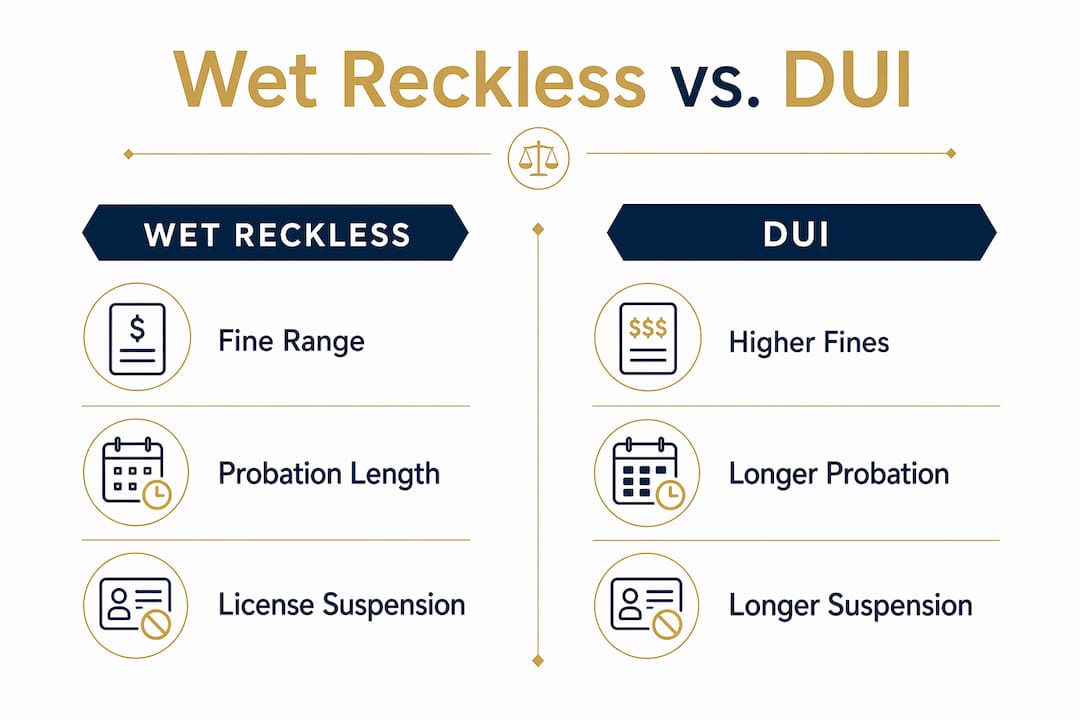
Wet reckless vs. DUI: how do the key differences stack up?
| Dimension | Wet Reckless (VC 23103.5) | DUI (VC 23152) |
|---|---|---|
| Criminal penalty | Fine $145–$1,000 + assessments; up to 90 days jail | $145–$1,000 fine; up to 90 days jail (first offense) |
| Probation | Typically 1–2 years | Typically 3–5 years |
| Court-imposed license suspension | None mandatory | Yes, mandatory |
| Alcohol education program | Shorter (often 3 months) | Longer (6–9 months minimum) |
| Insurance impact | Rates rise, usually less than DUI | Significant rate increase; SR-22 typically required |
| Priorability | Yes, counts as prior for 10 years | Yes, counts as prior for 10 years |
| Appears on criminal record | Yes | Yes |
The rows that tend to drive most defendants' decisions are probation length, the license suspension, and the program requirement. A shorter probation period means fewer years of compliance obligations, drug testing, and check-ins. No court-imposed suspension means you keep your license while the DMV process plays out.
What the table cannot capture: the insurance and background-check consequences are closer to a DUI than most people expect. A wet reckless still shows up on a criminal background check, and most insurers treat it as a serious traffic offense.
Does a wet reckless count as a prior DUI offense?
Yes, and this is the most consequential long-term fact about a wet reckless plea. Under California law, a wet reckless conviction counts as a prior DUI offense for a substantial period, measured from the date of the first arrest to the date of any subsequent DUI arrest.
Here is what that means in practice. Say you accept a wet reckless plea in March 2024. Your arrest date was January 2024. If you are arrested for DUI in November 2033, that falls within the 10-year window. The 2033 DUI would be charged as a second offense, triggering mandatory minimums that include at least 96 hours in jail, a longer license revocation, and a mandatory 18-month alcohol program.
Consequences of a second-offense DUI when a wet reckless is the prior:
- Mandatory minimum jail time increases substantially
- Probation length increases
- Ignition interlock device (IID) requirements become mandatory
- Negotiating room for another reduction shrinks considerably, since prosecutors are less willing to offer plea deals to repeat offenders
One more thing worth knowing: expungement under Penal Code §1203.4 does not erase priorable status. Courts can still use an expunged wet reckless as a prior for sentencing purposes in a later DUI case.
What are the immigration and professional-licensing risks?
This is where a wet reckless can cause damage that has nothing to do with criminal penalties. For non-citizens, an alcohol-related reckless driving conviction can raise moral turpitude concerns in immigration proceedings, depending on the specific facts and the immigration status involved. The analysis is fact-specific and not straightforward. Anyone with a visa, green card, pending application, or naturalization proceeding should consult an immigration attorney before accepting any plea, including a wet reckless.
Professions where mandatory reporting or board review is common after a wet reckless conviction:
- Physicians, nurses, and other licensed healthcare providers (Medical Board of California, Board of Registered Nursing)
- Commercial drivers holding a CDL — a wet reckless can affect CDL license status and federal driving eligibility
- Teachers and school employees (Commission on Teacher Credentialing)
- Attorneys (State Bar of California reporting requirements)
- Real estate licensees and financial professionals
The practical advice is simple: if your immigration status or professional license is at stake, do not accept any plea without first getting a written opinion from an immigration attorney or a licensing specialist. A wet reckless that saves you 30 days of probation is not worth it if it costs you a nursing license or triggers a removal proceeding.
Advantages and disadvantages of accepting a wet reckless plea
Advantages:
- Lower fines and shorter probation than a DUI conviction
- No mandatory court-imposed license suspension
- Shorter alcohol education program requirement
- Less social stigma on a background check than a DUI, though the conviction still appears
- Potentially lower insurance premium increases compared to a DUI
Disadvantages:
- Counts as a prior DUI offense for 10 years from arrest date
- Still appears on criminal background checks
- Insurance rates still rise; SR-22 may still be required depending on DMV outcome
- Licensing boards and immigration authorities may still treat it as an alcohol-related offense
- Expungement does not remove priorable status
Decision checklist before accepting a wet reckless plea:
- Do you have any prior DUI or wet reckless convictions within the last 10 years?
- Does your profession require reporting alcohol-related convictions to a licensing board?
- Are you a non-citizen, or do you have any pending immigration matter?
- How sensitive is your employer or industry to criminal records?
- How strong is the prosecution's case? Is there a realistic chance of acquittal or dismissal?
- What is the likelihood you will be arrested for DUI again within the next 10 years?
If the answer to questions 1, 2, or 3 is yes, the wet reckless may not be the straightforward win it appears to be. The strength of the prosecution's case, question 5, is what determines whether you have any leverage at all.
What can an experienced DUI attorney do for your case?
A skilled DUI attorney working a wet reckless negotiation is doing several things at once, and most of them happen before any plea offer is even on the table.
Attorney tasks in a typical wet reckless case:
- Review the arrest report, chemical test records, and chain-of-custody documentation for procedural errors
- File the APS hearing request immediately to preserve driving privileges
- Evaluate the stop and arrest for Fourth Amendment suppression issues
- Negotiate with the prosecutor on both the charge and the factual-basis language
- Assess how the plea language will affect licensing boards, immigration, and future DUI exposure
- Prepare mitigation materials to present to the prosecutor before any formal offer
Questions to ask during a consultation:
- How familiar are you with the local DA's office and their typical approach to wet reckless reductions?
- What weaknesses do you see in the prosecution's case based on the arrest report?
- If the DA won't offer a reduction, what is your strategy for trial or suppression?
- How will you handle the DMV APS hearing alongside the criminal case?
- What is your experience with licensing-board and immigration referrals for clients in my situation?
Documents to bring to your first meeting: the citation or arrest report, any chemical test results you received, the DMV order of suspension (the pink temporary license), and any dashcam or witness contact information you have. The APS hearing deadline is the most time-sensitive item. If you are past day 7 since your arrest, call an attorney today.
The local counsel advantage is real. An attorney who regularly appears before the same DA's office and the same DMV hearing officers knows what arguments land and which ones waste time. That local knowledge is often the difference between a wet reckless offer and a full DUI conviction.
Key Takeaways
A wet reckless under VC §23103.5 reduces immediate criminal penalties but carries a 10-year priorability rule that can make a future DUI arrest significantly more costly.
| Point | Details |
|---|---|
| Statutory basis | A wet reckless is a plea reduction under VC §23103.5, requiring an on-record alcohol notation. |
| Criminal penalties | Fines typically $500–$1,500 with assessments; probation 1–2 years; jail rare for first-time offenders. |
| 10-year priorability | A wet reckless counts as a prior DUI offense for 10 years, measured from arrest date to arrest date. |
| DMV is separate | Request an APS hearing within 10 days of arrest; a criminal plea does not automatically protect your license. |
| Logancriminaldefense | The Law Offices of Logan Noblin handles both the criminal plea and DMV defense for wet reckless clients in San Diego. |
What attorneys see that most clients miss
Most clients who walk into a consultation after a DUI arrest have already decided the wet reckless is the goal. That is understandable. It sounds better, it is better on paper, and the prosecutor may have already floated it informally. The problem is that accepting a plea without fully assessing your prior record, your profession, and your immigration status is one of the most common and most costly mistakes in DUI defense.
The 10-year priorability rule is the one that tends to sting years later. A client who accepted a wet reckless at 28 and gets arrested for DUI at 36 is facing a second-offense charge with mandatory minimums, and there is very little anyone can do about it at that point. The time to think about that scenario is before signing the plea, not after.
The other underappreciated issue is the factual-basis language. Prosecutors sometimes use broad language in the factual basis that can create problems for licensing boards or immigration proceedings. A good attorney negotiates that language carefully, not just the charge.
When should you push for suppression or trial instead? When the stop was constitutionally questionable, when the chemical test has documented chain-of-custody problems, or when the BAC was borderline and the field sobriety tests were poorly administered. A wet reckless is a good outcome when the prosecution has a solid case. When they do not, a dismissal or acquittal is a better one.
Facing a DUI charge in San Diego? Here is what Logancriminaldefense offers

Logancriminaldefense, the Law Offices of Logan Noblin, APC, is a San Diego criminal defense firm built specifically for cases where the stakes are high and the details matter. Logan Noblin, a former "Attorney of the Year," has secured multiple not-guilty verdicts and case dismissals across DUI defense, license protection, and related criminal matters. For a wet reckless client, the firm handles the full picture: criminal plea negotiation, DMV APS hearing representation, factual-basis language review, and referrals to immigration or licensing specialists when those risks are present.
If you hold a CDL, a professional license, or have any immigration matter pending, those factors belong in the strategy from day one, not as an afterthought after you have already signed a plea. The firm's San Diego DUI defense practice covers the full range of DUI-related charges, from first-offense negotiations to felony exposure. Schedule a consultation now to get a clear picture of your options before any deadline passes.
Useful sources for further reading
- California Vehicle Code §23103 — The reckless driving statute that defines the underlying offense and its penalty range ($145–$1,000 fine; up to 90 days jail).
- California Vehicle Code §23103.5 — The provision requiring prosecutors to note alcohol or drug involvement when reducing a DUI to reckless driving; the statutory basis for the wet reckless plea.
- California Vehicle Code §23152 — The DUI statute that a wet reckless plea reduces from; understanding its elements explains what the prosecution must prove and where defense leverage arises.
- California DMV — DUI Information — The DMV's own guidance on DUI consequences, APS hearings, and license suspension procedures; the authoritative source for administrative timelines.
- VC 23152(a) California DUI guide — A practical explainer on the DUI statute and what prosecutors must establish; useful background for understanding what a wet reckless plea avoids.
- Logancriminaldefense — Wet Reckless in California — The firm's detailed explainer on wet reckless pleas, local San Diego practice, and related defense strategies.
- Logancriminaldefense — Expunged DUI as a Prior — Explains the limits of expungement under PC §1203.4 and why an expunged wet reckless can still count as a prior for future DUI sentencing.
This article provides general legal information about California wet reckless pleas and is not legal advice for your specific situation. Laws and local practices change; confirm current rules with the California DMV, the relevant Vehicle Code sections, or a qualified DUI attorney before making any decisions about your case.