A misdemeanor conviction in California can show up on a background check, and it has no automatic expiration date. What matters is who is running the check, what kind of check it is, and whether the case was later dismissed. Most private employers face tight limits on what they can ask and use. Licensing boards, childcare regulators and fingerprint-based government checks do not.
Below is how each type of check works, what a dismissal under Penal Code 1203.4 does and does not accomplish, and what to do before an application goes out.
TL;DR
- Misdemeanor convictions generally appear on California background checks and do not fall off after a set number of years.
- Under the Fair Chance Act, most employers with five or more employees cannot ask about convictions until after a conditional job offer, and cannot consider dismissed or sealed convictions.
- A 1203.4 dismissal is not a true erasure. It stays visible to the Department of Justice, licensing agencies and fingerprint-based checks.
- Rideshare, contractor licensing, healthcare, childcare and government jobs follow their own rules, so disclose and explain rather than hope.
- Pull your own record first. The DOJ charges $25 to process a record review.
Table of Contents
- Does a misdemeanor show up on a California background check?
- What a private employer can ask, and when
- Is there a 7-year rule?
- Checks that go deeper than a typical employer
- What a dismissal under PC 1203.4 actually does
- Arrests, diversion and sealing
- Before you apply: a practical sequence
- Our perspective
- When it makes sense to talk to a lawyer
- FAQ
- Sources
Does a misdemeanor show up on a California background check?
Usually, yes. A standard California criminal background check typically reports convictions from county, state and federal courts. That includes misdemeanors as well as felonies. Many reports also list arrests that led to charges, and the status of each case.
Three things change the answer.
- The type of check. A commercial check built from court records is different from a fingerprint check run through the state Department of Justice. The first one depends on what a vendor finds. The second pulls the official state file.
- Who is asking. A retail employer, a landlord and a state licensing board each operate under different rules.
- What happened to the case. A conviction, a dismissal, a diversion completion and a sealed arrest are reported in very different ways, and sometimes not at all.
For a reader with a single old misdemeanor, the practical question is rarely "does it exist?" It is "will this particular person or agency see it, and can they legally use it?"
What a private employer can ask, and when
California's Fair Chance Act, in effect since January 1, 2018, generally prohibits employers with five or more employees from asking about your conviction history before making you a job offer. That means the "have you ever been convicted" box should not be on the first application. It also means a recruiter cannot run a criminal check during the first interview stage.
Once there is a conditional offer, the employer can check and can ask. The California Courts self-help guide explains that after an offer, they can do a criminal history check and ask about convictions. They still cannot consider certain records, including convictions that have been judicially sealed, dismissed or expunged.
If the employer wants to withdraw the offer
Seeing a misdemeanor does not give the employer a free pass to pull the offer. According to the state's Fair Chance Act guidance, the employer must first make a written individualized assessment explaining why the specific conviction is directly tied to the essential duties of the job. The guidance also says you get at least five business days to respond with evidence of rehabilitation or proof the record is wrong.
That window is worth using. Typical things to send back:
- A certified copy of a dismissal order, if you have one
- Proof that you completed probation, classes or community service
- Reference letters, training certificates or work history since the offense
- A short, factual explanation of the circumstances
A misdemeanor from years ago that has nothing to do with the job is hard for an employer to justify relying on. A recent theft conviction for a cash-handling role is a different conversation.
Is there a 7-year rule?
People ask this constantly, and the honest answer is: sometimes, in some places, and not as a promise.
Legal Services of Northern California notes that background checks by private companies generally cannot show dismissed misdemeanor convictions or convictions older than 7 years. That is a useful general description of commercial screening. It is not a guarantee, and it does not bind every check.
Seven years shows up elsewhere in a stricter form. Under California's Public Utilities Code, transportation network companies must run a local and national criminal check on each driver, and the statute sets out the screening requirements for rideshare drivers. Our research shows a seven-year lookback applies to certain misdemeanors in that setting, such as DUI, assault and domestic violence. Read the statute or ask a lawyer about your exact offense before assuming you qualify.
The takeaway: do not treat seven years as a clock after which you are safe. Treat it as one of several rules, each with its own scope.

Checks that go deeper than a typical employer
Some checks are built to see everything. The common thread is fingerprints or a government license.
| Situation | What the check usually sees | What to expect |
|---|---|---|
| Private employer, after conditional offer | Convictions, limited by Fair Chance Act and reporting rules | Dismissed convictions generally cannot be considered |
| Fingerprint-based job (healthcare, law enforcement, government contracts) | The full DOJ record, including dismissed convictions | Assume they will see it all |
| Contractor license | Convictions, with a rehabilitation analysis | Failing to report accurately can sink the application |
| Rideshare driver | Local and national check with a lookback for certain offenses | DUI, assault and DV misdemeanors matter |
| Childcare, in-home care, similar licensing | Health and safety statutes allow review of all convictions | Dismissals do not hide the case |
| Your own record request | The DOJ summary file | Fingerprints plus a $25 fee |
The fingerprint rule
The San Diego County Public Defender's expungement FAQ explains that a dismissal limits what appears on a background check, but it does not make the case disappear everywhere. If a job requires Live Scan fingerprints, assume the employer or agency will see your entire history, dismissed convictions included. In that setting, explaining the conviction and what you have done since is usually more persuasive than hoping it goes unnoticed.
The Tulare Superior Court's petition packet says the same about government jobs, jobs needing security clearance, and work requiring a government-issued license, certificate or permit: the conviction will be discovered in those situations, and the dismissal will be seen alongside it.
Licensing agencies
The Contractors State License Board warns on its application that failure to accurately report a conviction may result in a denied application. The board looks at rehabilitation, and for misdemeanors it generally looks for about three years of rehabilitation. The omission can hurt more than the offense.
The same logic applies to state-regulated care work. Licensing divisions at the California Department of Social Services operate under health and safety statutes that authorize review of criminal history beyond what an ordinary employer may use. If you are in nursing, teaching, real estate, security, or any other licensed field, a misdemeanor charge can reach your license even if the court outcome seems small.
What a dismissal under PC 1203.4 actually does
California does not have a true expungement. The Sacramento Superior Court says plainly that a 1203.4 dismissal does not seal the arrest or conviction and that the case still shows up on a background check in some contexts.
Here is what it does:
- Your guilty or no-contest plea is withdrawn and a not-guilty plea is entered, then the case is dismissed.
- On most private-sector job applications, you can generally answer "no" when asked about convictions. The Fair Chance Act FAQ is the place to check the details.
- Private employers covered by the Fair Chance Act cannot consider the dismissed conviction.
Here is what it does not do:
- It does not remove the case from public court files or Department of Justice records. The record shows the conviction as dismissed.
- It does not shield you from licensing boards, fingerprint-based screening, or specialized statutes.
- It does not by itself restore every right you might have lost.
Who qualifies and what it costs
Per the Monterey County Superior Court's information sheet, if you were convicted of a misdemeanor and were not sentenced to state prison and have completed your sentence, you may petition for dismissal under PC 1203.4. The same court lists filing fees of typically $150 if you completed probation and $60 if there was no probation, with fee waivers available. Fees vary by county and can change, so confirm with your own court clerk.
The petition is usually straightforward when you are fully done with probation, fines and restitution. It gets harder when something is still open, when the offense carries special restrictions, or when a judge has discretion. An error on the form or a missing payment can cause a rejection and months of delay. Our guide to avoiding a rejected filing with a county-by-county checklist walks through the common mistakes.
Arrests, diversion and sealing
Not every entry on a report is a conviction, and the difference matters.
Arrests without conviction. A private employer covered by California law generally cannot use an arrest that did not lead to a conviction. If the arrest still appears on your file, sealing may be an option. We explain how that works in record sealing in California, including the court forms and the arrest-record statute involved.
Diversion. If a misdemeanor is resolved through a diversion program, the goal is a dismissal instead of a conviction. California's misdemeanor diversion statute is covered in our piece on how PC 1001.95 works. A case that never becomes a conviction is a very different thing on a background check than a conviction you later have to dismiss.

Automatic relief. Some older records now qualify for automatic relief without a petition. Our overview of California's Clean Slate rules covers what is automatic and what still requires you to act.
Before you apply: a practical sequence
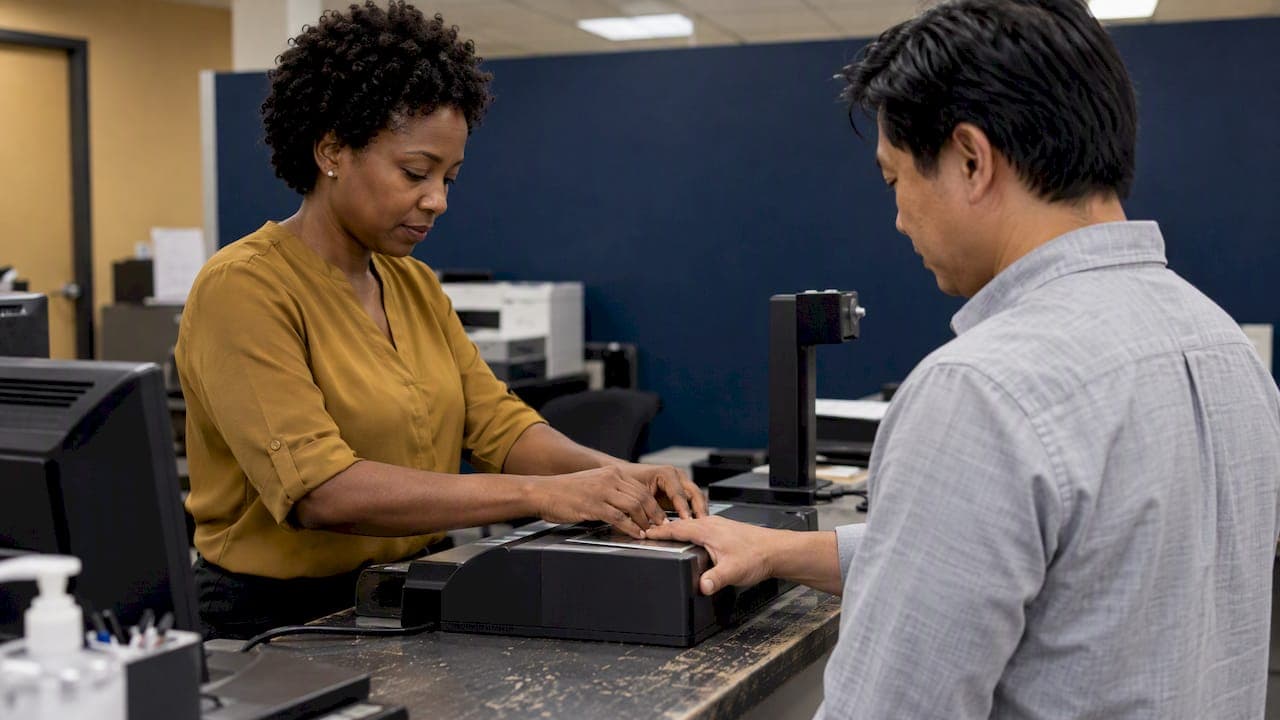
- Pull your own record. The California DOJ lets you request a copy of your record. You submit Live Scan fingerprints and pay a $25 processing fee, and a fee waiver may be available. Errors are common. A case marked open when it was closed, or a charge listed that was dropped, can cost you a job.
- Get certified court documents. Obtain the disposition, the dismissal order if you have one, and proof you finished probation.
- Decide whether the job is fingerprint-based or licensed. If yes, plan to disclose and explain. If no, the Fair Chance Act protections apply.
- Check eligibility for a dismissal, sealing or diversion relief. Do this early. Courts take weeks or months.
- Prepare a short explanation. Three or four honest sentences: what happened, what you did about it, what has changed. Avoid blaming others.
- Know your rights if an offer is pulled. Ask for the written assessment and respond within the window.
Our perspective
We see the same pattern over and over. A client arrives worried about a misdemeanor from years back, convinced it will end a career. Often it will not, but only if the record is handled before the application, not after the offer is rescinded.
The bigger point is where the work should start. The best outcome for a misdemeanor is a case that never turns into a conviction. That is why we look at pre-charge intervention, diversion eligibility and negotiated dismissals early, particularly for people in licensed professions, veterans and first-time defendants. Cleaning up a record later is valuable, but it leaves a trail that a fingerprint check can still follow.
For people whose conviction is already final, we focus on honest positioning. Misunderstanding what a dismissal does is one of the most common reasons people end up flagged for dishonesty on a licensing form. A dismissal helps a great deal in private employment and far less when a government agency is asking. Know which one you are facing before you answer a single question.
Every person has a story that is bigger than a charge on a page. Our job is to make sure the record tells the part of it that is accurate, and that decision makers get to read the rest.
— Logan Noblin
When it makes sense to talk to a lawyer
If you have a pending misdemeanor, a license at risk, or a conviction you want dismissed before a job or license application, talk to someone who handles these cases in San Diego courts. Our expungement and record-clearing services cover dismissals, early termination of probation, sealing arrest records and certificates of rehabilitation. If you are still facing a charge, our diversion practice looks at whether the case can be resolved without a conviction at all.
For a DUI misdemeanor specifically, the consequences reach driving privileges, insurance and professional licenses, which is why our misdemeanor DUI defense is dismissal-focused from the first meeting.
FAQ
How long does a misdemeanor stay on your record in California?
A misdemeanor conviction generally stays on your record for life unless you take action, such as petitioning for a dismissal under PC 1203.4. Even after dismissal, the case remains in court and Department of Justice files, marked as dismissed. There is no automatic time after which it disappears from every check.
Can an employer reject me for a misdemeanor?
Sometimes, but not automatically. If the employer has five or more employees, the Fair Chance Act requires a conditional offer first and a written individualized assessment before the offer is withdrawn. You then have at least five business days to respond with evidence of rehabilitation or to challenge the record's accuracy.
Will a dismissed misdemeanor show up on a background check?
On most private employer checks, it generally should not be considered. It can still appear on fingerprint-based checks and be seen by licensing agencies, government employers and agencies that work with vulnerable people. In those cases, plan to disclose both the conviction and the dismissal.
Can I pass a Level 2 background check with a misdemeanor?
It depends on the offense, how long ago it happened and the rules of the specific program or license. Level 2 screenings involve fingerprints, so assume the agency sees everything. Some offenses disqualify automatically, others are weighed on rehabilitation, so check the program's criteria and get legal advice before you apply.
Sources
- California Civil Rights Department: Fair Chance Act FAQ
- California Courts Self-Help Guide: Criminal history and job applications
- Legal Services of Northern California: What is an expungement
- California Public Utilities Code 5445.2
- San Diego County Public Defender: Expungement FAQ
- Tulare Superior Court: Petition for dismissal packet
- Contractors State License Board: Notice regarding convictions
- California Department of Social Services: Criminal record review
- Sacramento Superior Court: Expungement self-help
- Monterey Superior Court: Petition for dismissal
- California DOJ: Criminal Records, Request Your Own