If you were arrested in California but never convicted, you can almost always seal that arrest record under Penal Code section 851.91, and the process usually starts with filing a CR-409 petition in the county where the arrest happened. Before doing anything else, pull your DOJ RAP sheet to confirm the arrest is still showing and wasn't already sealed automatically. Juvenile records follow separate rules, and if a prosecutor is likely to fight the petition, talk to an attorney first.
TL;DR:
- Sealing records is automatic for arrests that did not lead to a conviction, but disputes can arise if the arrest involved pattern offenses or specific categories.
- Filing a petition requires precise paperwork, proper service, and attending a hearing, with outcomes including outright approval, denial, or conditions.
- The DOJ typically updates criminal history records within 30 days after sealing, but costs vary depending on court fees, legal assistance, and juvenile versus adult cases.
- When sealing is discretionary, submitting strong evidence of rehabilitation and showing no pattern of misconduct greatly improves the chances of approval.
- Sealed records remain accessible to criminal justice agencies and certain licensing boards, and do not fully erase the record from the system.
Table of Contents
- Who Qualifies for California Record Sealing Under PEN 851.91?
- How Do You File a Petition to Seal an Arrest Record?
- What Happens After a Judge Grants a Sealing Order?
- What Convinces a Judge When Sealing Isn't Automatic?
- How Are Juvenile Records Sealed in California?
- Does Sealing Fully Erase a Record?
- When Filing Alone Makes Sense and When It Doesn't
- How Logan Criminal Defense Handles Sealing and Expungement Cases
- Sources
- FAQ
Who Qualifies for California Record Sealing Under PEN 851.91?
Sealing an arrest record in California splits into two tracks, and knowing which one applies to you determines almost everything about how the case goes.
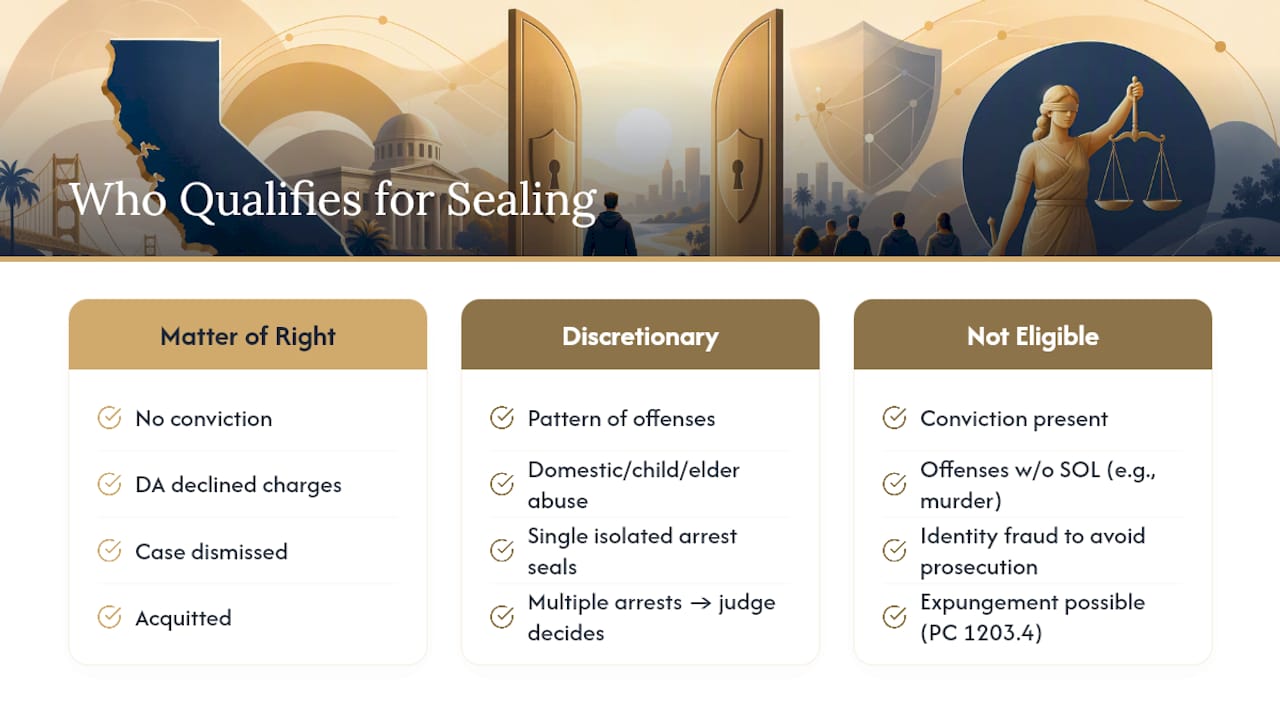
Matter of right covers arrests that never led to a conviction. If the district attorney declined to file charges, the case was dismissed, or you were acquitted, PEN §851.91 generally entitles you to sealing without the court weighing your character or circumstances. The judge's job is mostly to confirm the facts match the statute.
Discretionary sealing kicks in for narrower situations, particularly where a "pattern" of offenses exists in categories like domestic violence, child abuse, or elder abuse. A single dismissed domestic violence arrest usually seals as a matter of right. Multiple arrests in that category can push the decision into the judge's discretion, since the law treats repeated allegations differently than an isolated one.
Some arrests never qualify at all. You can't seal a record tied to an actual conviction, an offense with no statute of limitations like murder, or a case where you used someone else's identity to dodge prosecution. If any of those apply, sealing under this statute isn't available, though other relief like expungement under Penal Code 1203.4 might still fit.
How Do You File a Petition to Seal an Arrest Record?
Filing a CR-409 petition is mostly paperwork and precision. Miss a step and you'll either get bounced back by the clerk or face an easy objection from the prosecutor.
- Get the form. Download CR-409, the Judicial Council petition to seal arrest and related records. You need a separate petition for every arrest, even if they happened close together.
- Fill in the required fields. List the arresting agency, arrest date, booking number if you have it, and case disposition. Optional sections let you add a personal statement, which matters more once you're outside the matter-of-right category.
- Confirm where to file. If a criminal case was ever filed on the arrest, file in that same court. If no case was ever filed, file with the criminal clerk in the county where the arrest occurred.
- Serve the right parties. The prosecutor's office and the arresting agency both need copies, served at least 15 days before the hearing date according to CR-409-INFO, the Judicial Council's guidance sheet on this exact process.
- File proof of service. The court needs documentation that service actually happened, not just your word for it.
- Attend the hearing. For matter-of-right cases, many hearings are brief. For discretionary petitions, expect the judge to ask about the pattern issue or request more documentation before ruling.
The judge can grant the petition outright, deny it, or grant it with conditions attached. If granted, the court signs a CR-410 order, and that document is what sets everything else in motion.
What Happens After a Judge Grants a Sealing Order?
Once the court signs the order, the clock starts on the paperwork side. Under PEN §851.92, the court has to forward copies of the sealing order to the arresting agency and to the agency that manages the master criminal history record. That triggers updates across the system, not just at one office.
30 days. That's the statutory window for the Department of Justice to update the state summary criminal history with a notation reading "arrest relief granted," per Penal Code § 851.92.
Costs vary depending on your situation:
- Juvenile sealing petitions carry no court filing fee.
- Adult petitions can involve a filing fee that differs by county, so check with your local clerk or ask about fee waiver eligibility if cost is a barrier.
- Attorney fees, if you hire counsel, are separate from any court cost.
To confirm the order actually took effect, request an updated RAP sheet from the DOJ a few weeks after the hearing and look for the "arrest relief granted" notation.
What Convinces a Judge When Sealing Isn't Automatic?
When your petition falls into discretionary territory, the outcome depends heavily on what you put in front of the judge. Courts weigh hardship caused by the record, evidence of rehabilitation, general good character, and whether the arrest fits a broader pattern of similar conduct.
Strong petitions usually include:
- A personal declaration explaining the circumstances and any hardship the arrest has caused, such as lost job opportunities.
- Declarations from employers, coworkers, or community members who can speak to your character.
- Proof of steady employment or enrollment in school.
- Certificates showing completion of counseling, treatment, or any court-ordered program tied to the original arrest.
- Documentation of community service or volunteer work since the arrest.
If the arrest involved domestic violence, child abuse, or elder abuse allegations, the strongest move is showing there's no pattern. One isolated incident, followed by years without a repeat, reads very differently to a judge than a string of similar arrests.
Pro Tip: Before you file anything, check whether the arrest was already sealed automatically under a related statute like Penal Code 851.93. Filing a redundant petition wastes court time and can slow down relief you may already have.
How Are Juvenile Records Sealed in California?
Juvenile sealing runs on a different track than adult arrest sealing, and in some cases it happens without anyone filing a thing. Satisfactory completion of probation or a Deferred Entry of Judgment outcome can trigger automatic sealing. If that didn't happen in your case, you or your family need to file to make it happen.
The relevant forms are JV-595 and JV-596, and the probation department typically handles the legwork of compiling which agencies hold records tied to the case. Processing usually runs somewhere between 90 and 180 days, longer when records are scattered across multiple counties.
There's no court filing fee for juvenile sealing petitions. Once sealed, most employers and schools can't see the record, though narrow exceptions remain for certain federal applications and military enlistment screening.
Does Sealing Fully Erase a Record?
Sealing changes what most people can see, but it doesn't erase anything from the system. The California Department of Justice is direct about this: sealing typically adds a notation to your record rather than deleting it, and criminal justice agencies retain access even after an order is granted.
That access matters in a few specific ways. Sealed arrests can still surface in a later prosecution if you're charged again. Some licensing boards, particularly for peace officer positions or certain state professional licenses, may still require disclosure of a sealed arrest on the application. Firearm eligibility determinations can also look past a sealing order in narrow statutory situations.
If someone improperly discloses a sealed record, PEN §851.92(c) creates civil penalties for that violation, giving you recourse rather than leaving you without options.
When Filing Alone Makes Sense and When It Doesn't
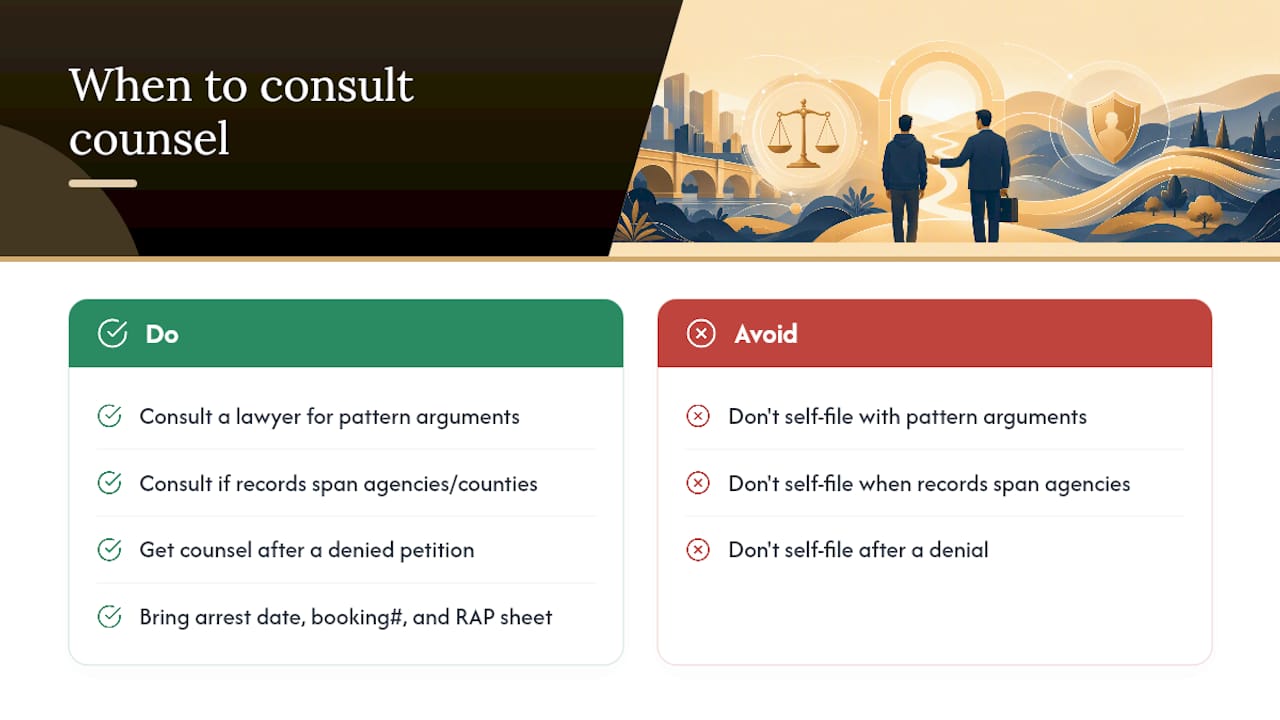
Matter-of-right petitions with a clean single arrest are often manageable without a lawyer if you're comfortable with court paperwork. Discretionary petitions are a different story. Once a prosecutor can argue a pattern, or once your record spans multiple agencies and counties, the margin for error shrinks fast.
The mistakes we see most often are filing in the wrong court, leaving required fields blank on the CR-409, botching service on the prosecutor or arresting agency, or simply forgetting to file proof of service. Any one of those can get a petition kicked back or denied outright. Attorneys help by drafting declarations that actually address a judge's concerns, confirming with probation exactly which agencies hold records, and following up to make sure DOJ actually updates the file.
— Jake
How Logan Criminal Defense Handles Sealing and Expungement Cases
If you're weighing whether to file a CR-409 yourself or bring in help, the calculation usually comes down to how much is riding on getting it right the first time. A denied petition means starting over, and every month that passes is a month a background check can still turn up the arrest.

The Law Offices of Logan Noblin, APC handles sealing arrest records and broader expungement work for clients across San Diego, drafting the CR-409 petition, gathering the declarations and documentation that matter for discretionary cases, coordinating with probation on juvenile matters, and tracking the case through to DOJ confirmation. That last step catches problems most self-filers never notice until a background check turns up an arrest that was supposedly sealed months earlier.
A consult makes the most sense if your petition faces a pattern argument, if your records are spread across more than one agency or county, or if a first petition already got denied. Bring your arrest date, booking number if you have one, and a current RAP sheet to the first meeting, and a legal professional can tell you quickly whether matter-of-right sealing applies or whether you're looking at a discretionary fight.
This article is general information, not a substitute for advice from a qualified lawyer. Consult a qualified legal professional about your own circumstances before acting on anything here.
Sources
- California Penal Code § 851.91
- CR-409-INFO: Information on How to File a Petition to Seal Arrest and Related Records
- Sealing Orders | State of California Department of Justice
FAQ
What Is the New Law for Expungement in California?
California doesn't have one single "new" expungement law. Relief still runs through separate statutes: Penal Code 1203.4 for expungement of certain convictions, and PEN §851.91 for sealing arrests that never resulted in a conviction. Which one applies depends entirely on how your case ended.
How Much Does It Cost to Seal or Expunge a Record in California?
Current published pricing isn't listed here, and court filing fees for adult petitions vary by county, so check with your local clerk about fees or waivers. Juvenile sealing petitions carry no court filing fee at all. For a specific quote on legal representation, Logancriminaldefense lists current information on its expungement services page.
Is It Better to Seal or Expunge a Record?
It depends on how your case ended. Sealing under PEN §851.91 applies to arrests without a conviction, while expungement applies to certain convictions after probation. Sealing is usually the stronger outcome for background checks, since the DOJ notes it isn't disclosed for most applicant or licensing purposes, while expungement still shows a conviction that was later dismissed.
What Records Cannot Be Sealed or Expunged in California?
Convictions generally can't be sealed under PEN §851.91, since that statute applies only to arrests without a conviction. Offenses with no statute of limitations, like murder, and arrests involving identity fraud used to evade prosecution, are also excluded from sealing regardless of the outcome.
Do Sealed Records Still Show Up on Background Checks?
Most employers and landlords won't see a sealed arrest, since the DOJ generally withholds sealed records from applicant-facing disclosures. Criminal justice agencies still retain access, and certain licensing applications, including some peace officer positions, may still require you to disclose it.