California's automatic record-relief program under SB 731 and its companion bills likely covers your record if you have a non-conviction, most misdemeanors, or many low-level felonies where you've completed your sentence. The state's Clean Slate laws don't erase records entirely, but they do seal them from public view and limit who can see them. Your single best next step right now: pull your California Department of Justice (CA DOJ) rap sheet and check your county court case dispositions.
Who is typically covered:
- Non-convictions (arrests, dismissals, acquittals)
- Most misdemeanor convictions after sentence completion plus a one-year waiting period
- Many low-level felony convictions after sentence completion plus a four-year waiting period with no new felony
Who is typically excluded:
- Convictions requiring sex offender registration
- Some serious violent felonies
- Anyone currently serving a sentence or on active supervised release
If your situation is straightforward, you may already have relief applied automatically. If your record involves immigration consequences, a professional license, or data errors, consult an attorney before assuming the system caught your case.
Table of Contents
- What California's Clean Slate laws actually do
- Who qualifies, how long you wait, and what disqualifies you
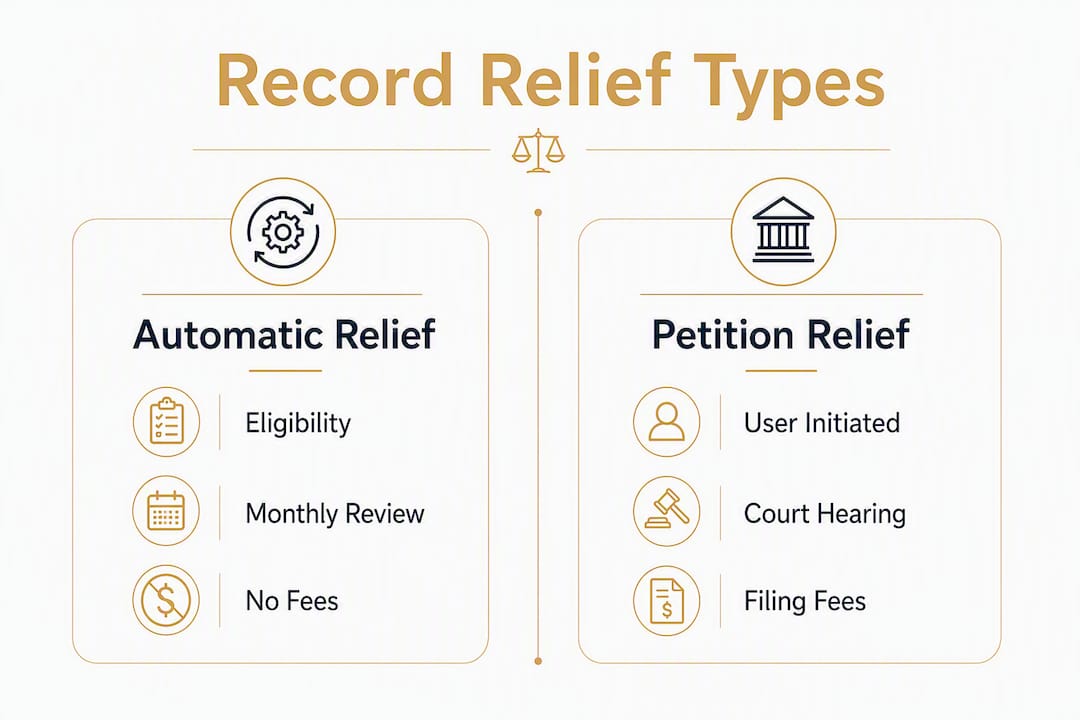
- Automatic relief versus petition-based relief: how they work differently
- How to check whether your record was sealed or dismissed
- What timelines and costs to expect
- Key limits: immigration, licensing, law enforcement, and firearm rights
- Why the automated system misses people and how an attorney fixes it
- Where to get help: legal aid, clinics, and when to hire a lawyer
- Key Takeaways
- A record is not a life sentence
- How the Law Offices of Logan Noblin, APC can help you move forward
- Official sources and further reading
What California's Clean Slate laws actually do
California's record-relief framework is built on SB 731, AB 1076, AB 145, and AB 168, which together create two distinct paths: state-initiated (automatic) relief and petition-based relief. The state's approach is sometimes called "Clean Slate" informally, but the formal statutory mechanism is a combination of dismissal entries and sealed/not-for-public-disclosure markers rather than true destruction of records. California courts confirm that law enforcement and certain agencies retain access even after relief has been applied.
The California DOJ runs eligibility logic monthly against the state criminal history repository. When a record qualifies, the DOJ notifies the relevant court, which then updates county records. This process began implementation in July 2022 and was expanded by SB 731 and AB 168 to cover more felony convictions and additional scenarios. AB 145 and AB 168 added further refinements in 2023 and 2024, including adjustments to how sentence-completion dates are calculated.
The scale of the program is significant. According to the Clean Slate Community of Practice, over the 18-month period from July 1, 2022 through December 31, 2023, California's automatic relief process resulted in 9,069,788 arrests and 2,834,905 convictions receiving relief. That's a meaningful shift in how many Californians can move past a record without ever filing a petition or paying a fee.
The primary statutory texts are California Penal Code sections 1203.425 (automatic conviction relief) and 851.93 (automatic arrest relief). The CA Courts self-help pages and CA DOJ automatic relief pages are the most accessible starting points for official guidance.
Who qualifies, how long you wait, and what disqualifies you
A California Policy Lab analysis cited by the Clean Slate Initiative estimated that nearly 90% of Californians with a conviction between 2010 and 2021 are likely eligible for automatic record relief, and roughly 70% could achieve a full Clean Slate. That's a broad net, but the 10–30% who fall outside it often face the most complicated situations.
Common eligible categories:
- Arrests that did not result in conviction (dismissals, acquittals, no charges filed)
- Misdemeanor convictions where the sentence is complete and one year has passed with no new conviction
- Many felony convictions where the sentence is complete, four years have passed, and no new felony conviction occurred
- Lower-level felony arrest dispositions where three years have passed in some scenarios
Common exclusions and edge cases:
- Any conviction requiring registration as a sex offender under Penal Code 290
- Serious violent felonies listed in Penal Code 667.5(c) in many circumstances
- Active supervised release, probation, or parole
- Convictions for offenses punishable by eight or more years in state prison (longer waiting windows apply)
- Cases where the DOJ database lacks accurate disposition data
One detail that trips people up: eligibility depends on accurate data in DOJ and court records. If your disposition was never properly reported to the DOJ, the automatic system won't flag your case as eligible, even if you legally qualify under the statute. That's a data problem, not a legal one, and it's fixable.
Pro Tip: Before assuming you're covered, confirm your county court actually transmitted your case disposition to the DOJ. Gaps in that pipeline are more common than most people expect.
Automatic relief versus petition-based relief: how they work differently
The core operational difference is simple: automatic relief is state-initiated, and petition-based relief is you-initiated. Knowing which path applies to your situation saves time and money.
| Dimension | Automatic relief | Petition-based relief |
|---|---|---|
| Who qualifies | Eligible records identified by DOJ logic | Anyone with an eligible conviction or arrest not caught automatically |
| How it starts | DOJ runs monthly database queries | Individual files a petition in the county court |
| Timing | Ongoing monthly processing; no action required | Weeks to months depending on court calendar and county |
| Who is notified | Court is notified by DOJ; court updates records | Court reviews petition; may set a hearing |
| Law enforcement access | Records remain accessible to law enforcement and certain agencies | Same — records are not destroyed |
| When legal help is usually needed | Rarely, unless records are incorrect or relief was missed | Often, especially for complex histories, immigration concerns, or data mismatches |
The DOJ's monthly process works like this: the DOJ queries its criminal history repository and the Supervised Persons File using biometric identifiers and case metadata. When a record meets the statutory criteria, the DOJ notifies the relevant court. The court then updates county records unless it provides supplemental information that prevents relief. If your case is overlooked, a petition is the remedy.
The Clean Slate State Profile for California confirms that automatic relief is subject to the limitations of the DOJ database. A missing or miscoded disposition means the system won't identify your record as eligible. Petition-based relief exists precisely for those gaps.
Common situations where a petition remains necessary: complex criminal histories spanning multiple counties, immigration-sensitive cases, records involving data mismatches between county dockets and the DOJ, and convictions that fall outside the DOJ's current database parameters. A San Diego expungement lawyer can walk you through whether a petition is the right move for your specific record.
How to check whether your record was sealed or dismissed
Pull your DOJ criminal history record first. That single document tells you more about your current record status than any other source.
-
Request your DOJ criminal history (rap sheet). Submit a request through the California DOJ's Record Review Program using form FD-258 (fingerprint card) or through the DOJ's online request portal. This is the same database the automatic relief system runs against, so it's the most authoritative source.
-
Contact the county court clerk for case-level dispositions. The DOJ rap sheet reflects what courts have reported, but individual case records at the county level may show more detail. Call or visit the clerk's office for each county where you had a case and ask for the current disposition on each case number.
-
Check the Supervised Persons File status. If you were on probation or parole, confirm with your supervising agency that your supervision has officially ended and that the termination date is correctly recorded. Active supervision disqualifies you from automatic relief, and an incorrect end date in the system can block it.
-
Review private background-check vendor results. If you're concerned about employment or housing checks, request your report from major consumer reporting agencies. These vendors pull from different data sources and may not update as quickly as the DOJ database. If a private report still shows a sealed or dismissed record, you have the right to dispute it under the Fair Credit Reporting Act.
What to look for on your records: A properly processed dismissal will show a notation like "dismissed" or "relieved of penalties and disabilities." A sealed arrest record should show a "not for public disclosure" flag. If you see neither and believe you qualify, that's the signal to act.
Pro Tip: Save PDFs of every record you pull, with the date you pulled them. If you later need to dispute an error or file a petition, that paper trail documents the baseline.
For help understanding how to seal arrest records at the county level, the CA Courts self-help pages and county clerk offices are the primary resources.
What timelines and costs to expect
Automatic relief costs you nothing in filing fees. The DOJ runs its eligibility logic monthly, so if your record qualifies, it will eventually be flagged without any action on your part. The practical question is how long "eventually" takes.

The DOJ identifies eligible records on its monthly cycle, then notifies the relevant court. Courts vary in how quickly they process those notifications and update county records. In practice, the gap between DOJ identification and a visible update in court records can range from a few weeks to several months, depending on county workload and data quality.
One source of confusion: the DOJ calculates sentence-completion timeframes using statutory requirements rather than official release dates, because release dates are inconsistently reported across jurisdictions. If you believe your sentence ended earlier than the DOJ's calculation, that's worth verifying with an attorney who can confirm the statutory completion date.
For petition-based relief, the timeline is longer. Filing a petition, waiting for a hearing date, attending the hearing, and receiving a judgment typically takes several months from start to finish, and that's assuming no complications. Petition filing fees vary by county, but fee waivers are available for those who qualify based on income. The CA Courts self-help pages include fee waiver forms (FW-001 and related forms) and instructions.
If you're on probation and want to accelerate your eligibility, early termination of probation under Penal Code 1203.3 can shorten your waiting period, since active probation blocks automatic relief.
Key limits: immigration, licensing, law enforcement, and firearm rights
State-level record relief does not automatically resolve consequences in every area of your life. This is the part most people underestimate, and it's where assuming the system handled everything can cause real harm.
Agencies and contexts that may still see your record:
- Immigration authorities (U.S. Citizenship and Immigration Services, Immigration and Customs Enforcement, immigration courts)
- Law enforcement agencies and prosecutors for all purposes
- Certain professional licensing boards (medical, nursing, teaching, real estate, law, and others)
- Federal agencies conducting federal background checks
- Employers in certain sensitive sectors (schools, childcare, law enforcement)
- Department of Education for positions involving access to children
Immigration: The Immigrant Legal Resource Center is explicit that state-level relief does not necessarily erase records for immigration purposes. Immigration authorities may still consider these convictions when evaluating status, applications, or removal proceedings. If you are not a U.S. citizen, consult an immigration attorney before relying on state relief to resolve any immigration consequence.
Professional licensing: Most California licensing boards have their own disclosure requirements and conduct independent background checks. A dismissed or sealed record may still need to be disclosed on a license application, depending on the board and the question asked. A Certificate of Rehabilitation can sometimes support a licensing application, but it doesn't guarantee approval.
Firearm rights: State record relief does not automatically restore firearm rights if a conviction triggered a prohibition under California or federal law. Restoration of firearm rights requires a separate legal process.
Voting rights: In California, voting rights are restored automatically upon release from state prison. Record relief under Clean Slate does not affect this separately.
Why the automated system misses people and how an attorney fixes it
Automation increases coverage, but it can't fix what it can't see. The DOJ's monthly process depends entirely on the quality of data flowing into its criminal history repository. When that data is incomplete or wrong, eligible people get left out.
Common failure modes:
- A county court never transmitted the final disposition to the DOJ, so the case appears unresolved in the state database
- Release or sentence-completion dates are recorded inconsistently across county systems, causing the DOJ's statutory calculation to produce a different result than expected
- Biometric identifiers (fingerprints) were incorrectly linked, so records from different cases are merged or separated incorrectly
- Court-to-DOJ data transfers fail silently, leaving a gap that neither party flags proactively
An attorney's workflow for fixing these problems is methodical; a Criminal Record Annulment Attorney traces case numbers across county dockets, gathers missing disposition documents, and either submits those documents to the court or DOJ directly, or files a petition when the automatic process was missed. Counsel traces case numbers across county dockets, gathers missing disposition documents, and either submits those documents to the court or DOJ directly, or files a petition when the automatic process was missed. The Clean Slate Community of Practice notes that this process often resolves cross-database mismatches that the automated system cannot self-correct.
CalMatters has reported that automatic relief increases access and equity by removing procedural barriers, but experts warn it will not reach everyone because of data errors and county-level reporting gaps. That warning is not hypothetical. Research from the Clean Slate Initiative found meaningful demographic differences in who benefits automatically, with Black Californians overrepresented among those who remain eligible only through petitions, which points to the need for targeted outreach and legal support.
Documents to gather before consulting an attorney:
- Your DOJ rap sheet (current, pulled within the last 60 days)
- Court paperwork for each case (charging documents, plea agreements, sentencing orders)
- Probation or parole termination letters
- Any prior expungement or dismissal orders you've already received
Pro Tip: Pull your DOJ rap sheet before your first attorney consultation. It gives counsel a complete picture immediately and cuts the time spent reconstructing your history from scratch.
Where to get help: legal aid, clinics, and when to hire a lawyer
Straightforward cases with a single misdemeanor and a clean record since then can often be handled through free or low-cost resources. Complex cases, anything touching immigration or a professional license, or situations where the DOJ database has errors almost always benefit from a private attorney.
Resource types to consider:
- Legal aid organizations: Groups like Bet Tzedek, Bay Area Legal Aid, and local legal aid societies offer free or sliding-scale expungement assistance. Eligibility is income-based.
- Expungement clinics: Many California counties run periodic expungement clinics through public defender offices, bar associations, or nonprofits. These are useful for straightforward cases.
- Public defender referrals: If your original case was handled by a public defender, that office may have a reentry unit that assists with record relief.
- Private criminal defense attorneys: For complex histories, multiple counties, immigration concerns, or data mismatches, a private attorney is the most reliable option.
The Californians for Safety and Justice and the Anti-Recidivism Coalition both advocate for Clean Slate policies and can point you toward local resources and clinics.
What to bring to a consult:
- DOJ rap sheet
- Court documents for each case (charging documents, plea, sentencing)
- Probation or parole termination paperwork
- Government-issued ID
- Any prior relief orders (expungements, dismissals) you've already received
Questions to ask at a first consult: Does my record qualify for automatic relief, or do I need a petition? Are there any immigration or licensing consequences I should know about? What's the realistic timeline and cost? Do you handle DOJ database corrections, or only court petitions?
If you're in San Diego, the Law Offices of Logan Noblin, APC handles petitions, record corrections, rap-sheet review, and related criminal-defense matters. More on that below.
Key Takeaways
California's Clean Slate laws under SB 731 automatically seal millions of records monthly, but data gaps, immigration consequences, and licensing rules mean automatic relief alone is not enough for every situation.
| Point | Details |
|---|---|
| Pull your DOJ rap sheet first | Request your current criminal history record before taking any other step. |
| Automatic relief is monthly and free | The DOJ runs eligibility logic each month; no filing fee applies to automatic relief. |
| Petition when the system misses you | Data errors and missing dispositions require a petition or attorney-assisted correction. |
| State relief has real limits | Immigration authorities, licensing boards, and federal agencies may still see your record. |
| Logancriminaldefense handles complex cases | The Law Offices of Logan Noblin, APC assists San Diego residents with petitions, record corrections, and related criminal-defense matters. |
A record is not a life sentence
California's Clean Slate framework is one of the most ambitious automatic relief programs in the country. The numbers back that up: millions of records processed in the first 18 months alone. But the law's reach is only as good as the data behind it, and the data is imperfect.
What concerns me most isn't the people who know they need help and seek it out. It's the people who assume the system handled their case, never check, and then get blindsided by a background check years later. Automatic relief is a genuine advance, but it was never designed to replace informed legal guidance for complicated situations.
The other thing worth saying plainly: state relief does not mean federal relief. It does not mean immigration relief. It does not mean your licensing board will look the other way. Those are separate systems with separate rules, and conflating them is one of the most common and costly mistakes people make after getting a record sealed.
If you have a clean record since your conviction, a single case, and no immigration or licensing complications, the automatic system probably has you covered or will soon. Check your rap sheet to confirm. If anything looks off, or if your situation is more layered than that, the cost of a consultation is far smaller than the cost of finding out the hard way.
How the Law Offices of Logan Noblin, APC can help you move forward
Getting your record sealed or corrected is one of the most consequential legal steps you can take, and the difference between doing it right and assuming it happened is often a single phone call.
The Law Offices of Logan Noblin, APC offers San Diego residents something most self-help routes can't: a former Attorney of the Year who reviews your actual rap sheet, identifies whether automatic relief applied or was missed, and takes direct action when it wasn't. The firm handles petition-based expungements, DOJ database corrections, Certificate of Rehabilitation counseling, and the full range of San Diego criminal defense matters that often intersect with record relief, including DUI expungements, drug offense dismissals, and professional license protection.
Bring your DOJ rap sheet, court documents, sentencing paperwork, and a government-issued ID to your first consultation. Logan Noblin will review your case, identify the most direct path to relief, and explain the realistic timeline and fee structure. No guesswork, no generic advice. Schedule a consultation with the Law Offices of Logan Noblin, APC today.
Official sources and further reading
These are the primary sources for verifying details and tracking implementation updates on California's record-relief programs.
| Source | What it covers | Why it matters |
|---|---|---|
| California Penal Code § 851.93 | Automatic arrest record relief, monthly DOJ review process | Primary statutory text for arrest relief |
| SB 731 | Expanded automatic conviction relief, felony eligibility | Core legislation for Clean Slate expansion |
| CA Courts: Clean Your Record | Self-help guidance on dismissals, sealing, and petitions | Official court guidance for self-represented filers |
| CA DOJ OpenJustice | Annual statistics on relief by county, DOJ data portal | Track implementation numbers and county-level data |
| Clean Slate State Profile: California | Detailed implementation summary, eligibility logic, data gaps | Most comprehensive third-party implementation overview |
| Clean Slate Initiative: California Research | Policy Lab analysis of eligibility rates and demographic disparities | Evidence base for who benefits and who is left out |
| CalMatters: California Expungement Explainer | Accessible journalism on how the law works and its limits | Plain-language overview with expert commentary |
| ILRC: Clean Slate Expungement in CA | Immigration consequences of state record relief | Critical reading for non-citizens considering relief |
To request your DOJ criminal history record, visit the California DOJ Record Review Program page and follow the instructions for submitting form FD-258 or an online request. For county-level case records, contact the clerk's office in each county where you had a case.
This article provides general legal information, not legal advice. Laws and eligibility rules change, and individual circumstances vary. Consult a qualified California attorney or review primary sources to confirm how current rules apply to your specific situation.