
California Penal Code §273.5 is one of the most aggressively prosecuted statutes in the state. It criminalizes willfully inflicting corporal injury that results in a traumatic condition on a qualifying intimate partner or household member, and it is a wobbler, meaning the prosecutor can charge it as a misdemeanor or a felony depending on the facts and your prior record. A felony conviction carries potential prison time, fines, and a cascade of collateral consequences that can reshape your custody rights, career, and immigration status. If you are facing this charge, the decisions you make in the first 48 hours matter enormously.
Who qualifies as a victim under PC 273.5:
- Current or former spouse
- Current or former cohabitant
- A fiancé or someone you have or had a dating relationship with
- The mother or father of your child
Immediate collateral consequences to know:
- Emergency protective order issued at arrest, often followed by a longer restraining order
- Mandatory 52-week batterer's intervention program if convicted and placed on probation
- State and federal firearm prohibition
- Immigration consequences for non-citizens, including potential removal
Pro Tip: Do not make any statements to police without an attorney present. Anything you say will be used to establish willfulness, the element prosecutors need most. Invoke your right to counsel immediately and preserve any photos, messages, or medical records that document what actually happened.
Table of Contents
- What California Penal Code §273.5 actually says
- What the prosecution must prove to convict you
- What "traumatic condition" means under the statute
- Penalties and wobbler status: misdemeanor vs. felony
- Collateral consequences that outlast the sentence
- How prosecutors build a 273.5 case against you
- Defenses that can work in a PC 273.5 case
- What the criminal process looks like from arrest to resolution
- Immigration consequences non-citizens cannot afford to ignore
- What to do in the first 72 hours if you are charged
- Key Takeaways
- The defense strategy most attorneys miss in PC 273.5 cases
- How Logancriminaldefense defends PC 273.5 charges in San Diego
- Authoritative sources and further reading
What California Penal Code §273.5 actually says
California Penal Code §273.5 is the primary domestic violence felony statute in California. Subsection (a) sets out the core offense; subsection (b) defines the qualifying victim relationships; subsection (d) defines "traumatic condition"; and subsection (f) addresses enhanced penalties for prior convictions within seven years.
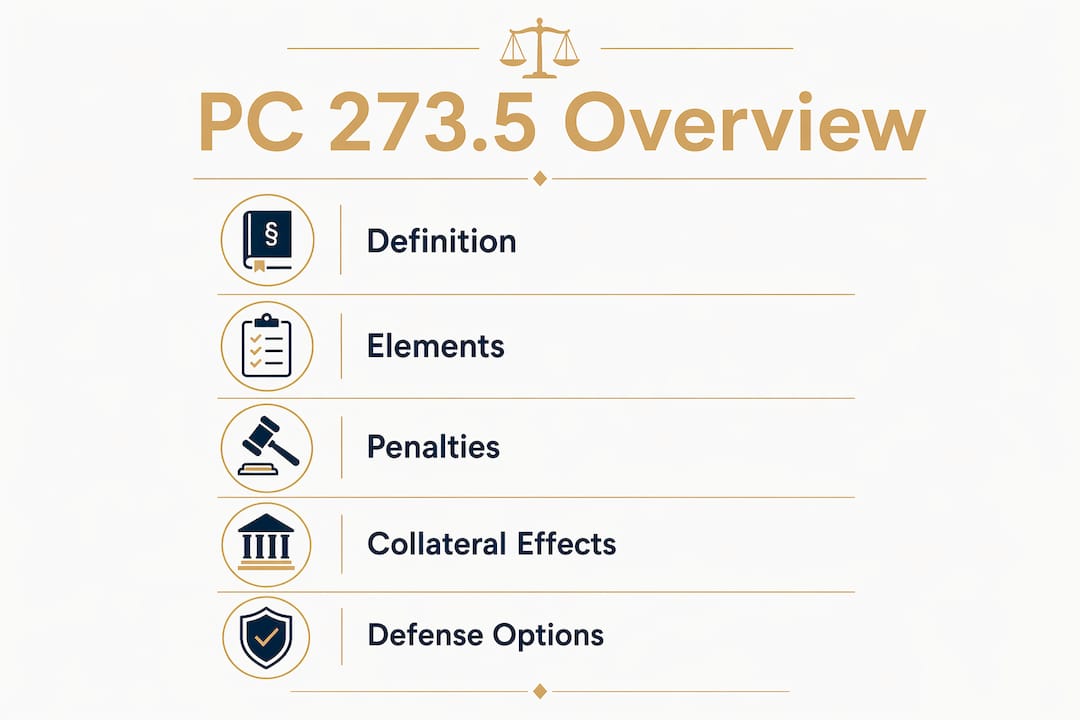
In plain English: if you intentionally do something physical that causes any wound or injury to a qualifying intimate partner, you can be charged with a felony. The statute does not require that you intended to injure the person, only that you intended to do the act that caused the injury. FindLaw's annotated copy of the statute is a useful secondary reference for defendants reviewing the text alongside their attorney.
What the prosecution must prove to convict you
Prosecutors carry the burden of proving every element beyond a reasonable doubt. Understanding where that burden is hardest to meet is where a defense begins.
The four elements of a PC 273.5 conviction:
- Willful act. You intentionally performed the physical act. Willfulness does not require intent to injure, only intent to do the act itself.
- Corporal injury. The act caused a physical injury, not merely emotional distress or property damage.
- Traumatic condition. The injury produced a wound or external or internal injury caused by physical force, including minor injuries like bruises.
- Qualifying victim relationship. The person injured was your spouse, former spouse, cohabitant, dating partner, or the parent of your child.
Willfulness is often the most contested element. If you pushed someone while trying to get away and they fell, the question is whether the push was intentional even if the fall was not. Causation works the same way: the traumatic condition must be a direct and natural consequence of your act, not an intervening accident.
Scenario that likely meets the elements: You grab your partner's arm during an argument, leaving visible bruising. The act was intentional, the injury is physical, and the relationship qualifies.
Borderline scenario: You are moving furniture and accidentally knock into your cohabitant, who bruises. No willful act directed at the person, so the element fails.
What "traumatic condition" means under the statute
This is the element that surprises most defendants. People assume a charge requires a serious injury. It does not.
The phrase "whether of a minor or serious nature" is the operative language. A single bruise, a scratch, redness from grabbing, or swelling from a push can all satisfy the statutory definition. Strangulation, defined in the statute as impeding normal breathing or blood circulation by applying pressure to the throat or neck, is explicitly included and tends to result in felony filing regardless of visible injury.
What does not qualify: purely emotional harm, property damage, or threats without physical contact. Medical evidence, including ER records, photographs taken at the scene, and clinician observations, carries significant weight because it documents the condition at a specific point in time. Even a small injury documented within hours of an incident can be decisive at trial.
Penalties and wobbler status: misdemeanor vs. felony
PC 273.5 is a wobbler, which means the prosecutor decides at filing whether to charge it as a misdemeanor or a felony. That decision turns on the severity of the injury, your prior record, and the facts of the incident.
| Charge Level | Custody Range | Fine | Notes |
|---|---|---|---|
| Misdemeanor | Up to 1 year county jail | Up to $6,000 | Prosecutor discretion; typically for minor injury, no priors |
| Felony (base) | Multiple years in state prison | Potential fines | Standard filing for significant injury or prior record |
| Felony with prior (within 7 years, §273.5(f)(1)) | Multiple years in state prison | Potential fines | Prior qualifying conviction under related domestic violence statutes |
| With prior PC 243(e) (within 7 years, §273.5(f)(2)) | Multiple years in state prison | Potential fines | Prior domestic battery conviction |
The seven-year enhancement window is measured from the date of the prior conviction to the date of the current acts, not the arrest date. Prosecutors consider injury severity, strangulation, weapon use, and the presence of children when deciding felony versus misdemeanor.
If probation is granted, the court must impose conditions consistent with PC 1203.097, which includes the mandatory 52-week batterer's intervention program, regular probation reporting, and restitution. Courts retain discretion on ability-to-pay findings for fines, but the program itself is mandatory.
Collateral consequences that outlast the sentence
A conviction does not end when you leave the courthouse. The non-sentence consequences of a PC 273.5 conviction are often what defendants underestimate most.
Protective orders. An emergency protective order is typically issued at arrest. A criminal protective order can follow at arraignment and remain in place through the case and beyond, up to 10 years after conviction. Violating a protective order is a separate criminal offense.
Mandatory batterer's intervention program. The 52-week program runs weekly and typically costs $25–$75 per session, totaling roughly $1,300–$3,900 out of pocket for the year, plus court-ordered fees. Missed sessions are among the most common triggers for probation violations, which can result in jail time even after you have otherwise complied.
Firearms prohibition. A felony conviction triggers a lifetime state and federal firearm ban. A misdemeanor conviction under PC 273.5 also triggers a 10-year state prohibition and a federal lifetime ban under 18 U.S.C. §922(g)(9). Restoration is rarely automatic and requires separate legal proceedings.
Custody and visitation. California family courts treat a domestic violence conviction as a rebuttable presumption against awarding custody to the convicted parent. The impact on custody rights can be more lasting than the criminal sentence itself.
Professional licensing. Convictions appear on background checks and can trigger licensing board investigations for healthcare workers, teachers, attorneys, and others in regulated professions.
Immigration. Non-citizen defendants face potential removal, inadmissibility, or denial of adjustment of status. A PC 273.5 conviction can be classified as a crime involving moral turpitude or, in some contexts, an aggravated felony under federal immigration law. Consult immigration counsel before entering any plea.
Statistic callout: The mandatory batterer's intervention program alone typically costs $1,300–$3,900 in session fees over the program year, separate from fines, restitution, and court costs.
How prosecutors build a 273.5 case against you
Prosecutors rarely rely on a single piece of evidence. They build a narrative from multiple sources, and understanding that narrative is how a defense attorney finds the gaps.

Medical records and ER documentation establish the traumatic condition with timestamps and clinical language. An ER note describing "contusion consistent with blunt force" carries more weight than a photograph alone because it comes from a neutral professional.
Photographs taken by responding officers or the alleged victim immediately after the incident capture the condition at its most visible. Defense counsel will scrutinize the timestamp, lighting, and whether the injury is consistent with the alleged mechanism.
911 recordings are often the most damaging evidence because they capture the incident in real time, before anyone has had a chance to reconsider their account. Tone, words used, and background sounds all become part of the prosecution's story.
Officer observations at the scene, including notes on demeanor, visible injuries, and spontaneous statements, support probable cause and often appear in the police report that drives the charging decision.
Digital evidence including text messages, social media posts, and call logs can establish relationship context, prior incidents, or communications that contradict a later account.
Pro Tip: If you are the person charged, preserve every text message, voicemail, and photograph you have from around the time of the incident. Defense counsel needs this material early. Once it is deleted or a phone is replaced, it is gone.
Defenses that can work in a PC 273.5 case
Defense strategy in a 273.5 case usually starts with two questions: Was the act willful? Did it actually cause the traumatic condition? If the answer to either is genuinely in dispute, there is a defense to develop.
Self-defense. California law permits the use of reasonable force to protect yourself from imminent harm. The key words are "reasonable" and "imminent." If the alleged victim was the initial aggressor and you responded proportionally, self-defense applies. Defense counsel will look for prior incidents of aggression by the alleged victim, 911 calls they made in the past, and any witnesses who observed the dynamic.
Accidental injury. If the act was not willful, the charge fails on its first element. Accidental contact during a struggle, a fall caused by an unrelated factor, or an injury that occurred in a way the defendant did not intend can all negate willfulness. Medical experts can sometimes testify that an injury pattern is inconsistent with the alleged mechanism.
False allegations. Domestic disputes frequently involve contested accounts, and false allegations do occur, particularly in the context of custody battles or contentious separations. Defense counsel will examine the alleged victim's prior statements for inconsistencies, review their motive to fabricate, and look for evidence that contradicts the timeline.
Lack of traumatic condition. If the injury does not meet the statutory definition, the charge fails. A defense attorney will scrutinize medical records, photograph quality, and the clinical basis for any injury finding.
Pro Tip: Ask your attorney about retaining a forensic medical expert early. In cases where the injury is minor or the mechanism is disputed, an expert who can testify about alternative causes of the injury can be the difference between a conviction and a dismissal.
What the criminal process looks like from arrest to resolution
-
Arrest and booking. Police respond, make an arrest based on probable cause, and book the defendant. An emergency protective order is typically issued at this stage. Bail is set according to the county schedule, though a judge can modify it at arraignment.
-
Arraignment (within 48–72 hours of arrest). You appear before a judge, hear the formal charges, and enter a plea. This is also when the court addresses bail and any protective orders. Most defendants enter a not-guilty plea at arraignment.
-
Early case assessment and discovery (weeks 2–8). Defense counsel requests the police report, 911 recordings, medical records, and any body-camera footage. This is when the defense begins identifying weaknesses in the prosecution's evidence.
-
Pretrial motions (months 2–4). Motions to suppress evidence, challenge the protective order, or dismiss for insufficient evidence are filed here. Early motion practice can significantly narrow what the prosecution can use at trial.
-
Plea negotiations. Most domestic violence cases resolve through negotiation. Prosecutors in DV cases often require participation in a batterer's program as part of any plea deal, even for reduced charges. The strength of the defense's evidence directly affects what the prosecution will offer.
-
Trial (if no plea). A jury trial on a felony PC 273.5 charge typically takes two to five days. The prosecution presents its evidence, the defense cross-examines and presents its own witnesses, and the jury deliberates.
-
Sentencing. If convicted, the court imposes sentence at a separate hearing. Probation with PC 1203.097 conditions is common for first-time offenders; custody time increases with priors or injury severity.
Diversion. PC 273.5 is a violent offense, which limits diversion eligibility. Mental health diversion under PC 1001.36 may be available in narrow circumstances. Defendants with military service may qualify for military diversion under PC 1001.80 if the offense is connected to a service-related condition. Standard drug diversion does not apply to domestic violence charges.
Immigration consequences non-citizens cannot afford to ignore
For non-citizen defendants, a PC 273.5 charge is not just a criminal matter. It is a potential immigration catastrophe. USCIS guidance and immigration practice resources consistently flag domestic violence convictions as high-risk for removal and inadmissibility findings.
A conviction, even at the misdemeanor level, can be classified as a crime involving moral turpitude. In certain contexts, particularly where the sentence imposed is one year or more, it can be treated as an aggravated felony under the Immigration and Nationality Act. Either classification can trigger removal proceedings, bar adjustment of status, and make you inadmissible to the United States.
The federal firearm prohibition under 18 U.S.C. §922(g)(9) applies to misdemeanor domestic violence convictions and interacts with state law to create overlapping restrictions. Both matter independently.
Pro Tip: Never accept a plea offer without first consulting an immigration attorney. A plea that looks minor on the criminal side, such as a misdemeanor with probation, can be treated as an aggravated felony by immigration authorities. Immigration consequences are often irreversible, and the criminal defense attorney and immigration attorney need to coordinate before any plea is entered.
What to do in the first 72 hours if you are charged
Do:
- Invoke your right to remain silent immediately. Provide your name and ID if required, then stop talking.
- Request an attorney before any questioning. This applies at the scene, at the station, and in any follow-up contact.
- Preserve all photographs, text messages, voicemails, and social media communications from around the time of the incident.
- Write down the names and contact information of any witnesses while your memory is fresh.
- Comply with any protective order, even if you believe it is unjust. Violating it is a separate criminal charge.
Do not:
- Contact the alleged victim, even to apologize or explain. Any contact can be charged as a protective order violation.
- Post about the incident on social media.
- Speak to the alleged victim's family or friends about what happened.
Regarding protective orders: if a temporary restraining order has been issued, you can contest it or seek modifications through the court. An attorney can file a motion to modify the order to allow, for example, contact for co-parenting purposes where appropriate and safe.
Pro Tip: Your attorney's first moves will be to get the police report and 911 recording, advise you on bail, and assess whether any evidence was obtained unlawfully. The earlier counsel is retained, the more options remain open.
Key Takeaways
PC 273.5 is a wobbler with felony exposure up to four years in state prison, mandatory collateral consequences, and immigration risks that can outlast any criminal sentence.
| Point | Details |
|---|---|
| Wobbler with serious exposure | PC 273.5 can be charged as a misdemeanor or felony, with potential custody time and fines. |
| Minor injuries count | "Traumatic condition" includes bruises and scratches; the injury does not need to be serious to support a charge. |
| Collateral consequences are severe | Firearm bans, mandatory 52-week batterer's program ($1,300–$3,900 in fees), custody presumption against you, and licensing impacts follow conviction. |
| Non-citizens face removal risk | Even a misdemeanor conviction can trigger removal or inadmissibility; consult immigration counsel before any plea. |
| Logancriminaldefense | The Law Offices of Logan Noblin, APC handles PC 273.5 defense in San Diego, including protective order contests, diversion guidance, and immigration-aware plea strategy. |
The defense strategy most attorneys miss in PC 273.5 cases
Most people charged under this statute assume the case is about whether something happened. The smarter question is whether what happened legally constitutes a traumatic condition caused by a willful act. Those are two different inquiries, and collapsing them is where defendants get hurt.
Prosecutors file PC 273.5 charges quickly, often within days of an arrest, because the statute is politically sensitive and DV cases move fast. That speed works against defendants who do not have counsel in place early. By the time discovery is complete and the prosecution's theory is locked in, the window for early intervention has closed.
The cases that resolve most favorably tend to share one characteristic: defense counsel got involved before the preliminary hearing and before the prosecution committed to a theory. Early motion practice, a well-timed expert consultation on the injury, or a credible alternative explanation for the physical evidence can shift the entire trajectory of a case. Waiting until trial to raise these arguments is almost always too late.
The collateral consequences deserve equal attention from day one. A defendant who avoids prison but loses custody of their children, their professional license, and their right to own a firearm has not won. A complete defense strategy accounts for all of it, not just the criminal exposure.
How Logancriminaldefense defends PC 273.5 charges in San Diego
Facing a PC 273.5 charge in San Diego means navigating one of the most aggressively prosecuted areas of California criminal law. The Law Offices of Logan Noblin, APC brings former "Attorney of the Year" recognition and a record of not-guilty verdicts and dismissals to every domestic violence case the firm handles.

What a consultation with Logancriminaldefense looks like: a direct review of your charges, immediate advice on what not to say to police, an assessment of the evidence against you, and a clear explanation of your options, including diversion, plea negotiation, and trial. The firm handles the full scope of what a PC 273.5 charge touches: domestic violence defense, restraining order contests, custody consequence strategy, immigration-aware plea advice, and diversion program eligibility.
If you have been arrested or are under investigation for corporal injury in San Diego, contact the Law Offices of Logan Noblin now for a prompt consultation. The earlier you have counsel, the more options remain on the table.
Authoritative sources and further reading
The sources below are the primary references for the legal claims in this article. Verify any statutory text against the official California Legislative Information site, as the legislature amends statutes periodically.
Primary sources:
- California Penal Code §273.5 — Official statutory text, definitions, and penalty ranges (California Legislative Information)
- California Penal Code §1203.097 — Probation conditions and batterer's intervention program requirements
- FindLaw: PC §273.5 — Annotated secondary copy of the statute, useful for quick reference
- Justia: PC §273.5 — Additional statute copy with legislative history references
- USCIS — Immigration consequences of criminal convictions
Firm resources:
- Domestic violence defense in San Diego — Practice page covering PC 273.5 and related charges
- Diversion program options — Overview of diversion eligibility and process
- Custody rights and domestic violence charges — How a PC 273.5 charge affects family court proceedings
This article is general legal information, not legal advice for your specific situation. Consult a qualified criminal defense attorney and, if applicable, an immigration attorney before making any decisions about your case.