
A single DUI does not automatically revoke a California nursing license. The Board of Registered Nursing reviews each case individually, and the Department of Motor Vehicles runs a separate process that can suspend your driving privileges within days if you miss a strict deadline. What happens next depends on three things you control almost immediately: requesting a DMV hearing, retaining counsel who understands both criminal and licensing law, and documenting any rehabilitation steps you take.
TL;DR:
- The Board of Registered Nursing acts only if a DUI is connected to patient care or affects nursing skills, but impaired judgment often constitutes a substantial connection.
- The DMV gives a strict 10-day window to request an Administrative Per Se hearing after arrest, and missing it results in automatic license suspension regardless of criminal court outcomes.
- Factors such as high blood alcohol concentration, accidents with injury, or prior offenses increase the risk of license revocation, while completion of treatment and sobriety support probation.
- Early documentation of rehabilitation efforts and engaging with the Board proactively often lead to softer discipline, including probation instead of revocation.
- Handling criminal and licensing cases separately and with coordinated legal support improves prospects for license retention and proper case management.
Table of Contents
- How the Board of Registered Nursing Investigates a DUI and Nursing License in California
- Reporting Rules and the DMV's 10-Day Deadline You Cannot Miss
- What Pushes a DUI Case Toward Revocation Instead of Probation
- Your First 10 and 30 Days After a DUI Arrest
- The BRN Intervention Program as a Path Around Formal Discipline
- Attorney Perspective: Running the Criminal Case and the Licensing Case Together
- How Employer Checks, Renewals, and Public Records Fit Together
- Can You Renew Your Nursing License After a DUI Conviction?
- Support Resources Beyond the BRN Intervention Program
- What Happens After a Second or Third DUI Conviction
- How to Appeal or Contest a BRN Disciplinary Action Tied to a DUI
- Practicing Compliantly During a License Suspension
- A Short Take on Priorities That Actually Protect Your License
- How Logan Noblin Coordinates Your DUI and Nursing License Defense
- Where to Read the Official Rules Yourself
- Sources
- FAQ
How the Board of Registered Nursing Investigates a DUI and Nursing License in California
The BRN doesn't discipline nurses for conduct that has nothing to do with patient care. It acts under the "substantial relationship" standard, meaning the offense has to connect logically to the skills, judgment, or trust required to practice nursing safely. A DUI usually clears that bar because impaired judgment and substance use touch directly on fitness to practice.
Once the Board learns of an arrest or conviction, typically through fingerprint-based reporting to the Department of Justice it can request your driving record, court documents, and treatment history. In more serious cases, it may file a formal Accusation, which starts a legal process similar to a civil case. The Board rarely hides how it reaches decisions: its own conviction guidance spells out how it evaluates rehabilitation and defines what counts as a reportable conviction, including no-contest pleas and even some deferred judgments.
Outcomes vary widely depending on the facts:
- No action when the case is minor, isolated, and well-documented with rehabilitation evidence.
- Public letter of reprimand or citation for lower-risk cases with no aggravating conduct.
- Stayed revocation with probation, the most common outcome for first-time DUI cases, allowing you to keep working under supervision and conditions.
- Suspension, a temporary bar from practice tied to specific violations.
- Outright revocation, reserved for repeat offenses, patient endangerment, or noncompliance with probation.
Early engagement with the Board and a documented recovery record consistently produce softer outcomes than silence or denial.
Reporting Rules and the DMV's 10-Day Deadline You Cannot Miss
California law requires nurses to report a criminal conviction to the BRN, and license renewal applications ask directly about convictions since 1990. Skipping that disclosure is often worse than the DUI itself. Failing to respond to a Board Accusation can result in a default decision, which frequently means revocation without you ever presenting your side.
Separately, and on a much tighter clock, the DMV gives you a strict, limited window after an arrest to request an Administrative Per Se hearing. Miss it, and your license is automatically suspended regardless of what happens in criminal court. Nurses who drive to clinical sites, home health visits, or hospital shifts often underestimate how disruptive this suspension can be to their livelihood before any conviction is even entered.
Here's the sequence that protects you:
- Call the DMV or your attorney within 10 days to request an in-person or telephonic APS hearing.
- Preserve your right to argue the stop, the testing, or the arrest at that hearing, separate from the criminal case.
- Track both cases independently since a criminal dismissal doesn't automatically reverse a DMV suspension.
One deadline, two consequences: the 10-day APS window is often the single most actionable early step in the entire process because it's procedurally distinct from the criminal case and moves faster than almost anything else, according to guidance from CredibleLaw. Expunged or set-aside convictions still generally must be disclosed to the Board, since the BRN's own definition of "conviction" for reporting purposes includes many dismissed or deferred outcomes.
What Pushes a DUI Case Toward Revocation Instead of Probation
The Board doesn't treat every DUI the same, and the difference between a stayed revocation with probation and an outright license loss usually comes down to a short list of aggravating or mitigating facts.
Aggravating factors that raise risk:
- A very high blood alcohol concentration at the time of arrest
- An accident involving injury to another person
- Conduct occurring while on duty or immediately before a shift
- Refusing a chemical test
- A prior DUI or other substance-related conviction
- Any evidence connecting the DUI to diversion of controlled substances from a workplace
Mitigating evidence that helps your case:
- Completed or ongoing substance abuse treatment
- Participation in the BRN Intervention Program
- Documented, sustained sobriety over time
- Supportive statements from an employer or supervisor
- Meaningful time elapsed since the incident with no further issues
Legal resources tracking BRN discipline note that aggravating and mitigating factors like these consistently shape whether a case ends in probation or something harsher.
Pro Tip: Probation violations, not the original DUI, are the most common reason nurses eventually lose their license. A missed drug test, a late report, or an unapproved job change can convert a stayed revocation into an active one without a new hearing.
Your First 10 and 30 Days After a DUI Arrest
The choices you make in the first month often matter more than anything that happens in the courtroom later.
Within 10 days:
- Request a DMV Administrative Per Se hearing, in person or by phone, to contest the automatic suspension.
- Contact an attorney who handles both DUI defense and professional licensing, since these are different legal skill sets.
- Avoid discussing the case with your employer or the Board until you understand your reporting obligations.
Within 30 days:
- Complete a substance abuse assessment if one is recommended, even before it's required.
- Gather medical, therapy, or treatment records that show you're addressing the underlying issue.
- Begin building a mitigation file: employer references, character letters, proof of any completed classes.
Pro Tip: Start your mitigation file the same week as the arrest, not after you're charged. The BRN gives real weight to voluntary, early rehabilitation steps taken before any Board involvement, according to LegalClarity's review of common outcomes.
The BRN Intervention Program as a Path Around Formal Discipline
The BRN Intervention Program exists for nurses whose practice may be impaired by substance use, and it offers something formal discipline doesn't: a confidential alternative to public Board action. Eligible nurses typically undergo an assessment, agree to a treatment plan, and accept ongoing monitoring, which can include random testing and check-ins.
- Confidentiality generally protects your public record while you're compliant.
- Removal from the program for noncompliance usually triggers the formal disciplinary process you were trying to avoid.
- Eligibility isn't automatic. The Board's own Intervention Program FAQs note that many nurses arrested for a single DUI have benefited from the program, but candidacy depends on the specifics of the case.
If you've held a diversion agreement in another state, verify how California treats that record before assuming it transfers. Transfer rules are inconsistent, and relying on an out-of-state agreement without confirmation is a common and costly mistake.
Attorney Perspective: Running the Criminal Case and the Licensing Case Together
Handling a DUI charge and a BRN complaint as separate, uncoordinated problems is one of the most common mistakes nurses make. A plea that looks favorable in criminal court can create admissions that hurt you in front of the Board, and a Board submission written without knowledge of the criminal strategy can undercut both cases at once.
The nurses who come out of this with their license intact are almost never the ones who "won" their DUI case outright. They're the ones who built a consistent record, treatment compliance, monitoring, timely disclosure, that told the Board they weren't a current risk. That record matters more than the plea deal.
How Employer Checks, Renewals, and Public Records Fit Together
A DUI conviction doesn't stay quietly in a court file. It shows up in places that affect your employability long after the case closes.
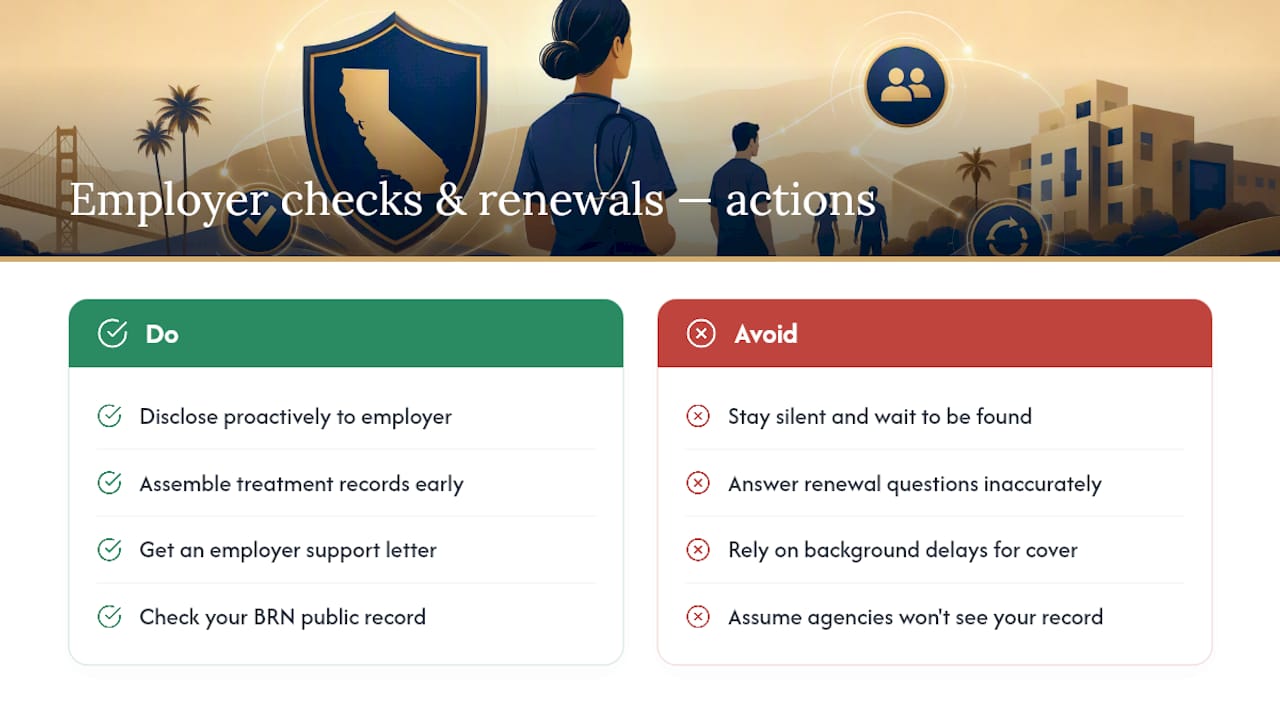
Hospitals and staffing agencies routinely run background checks before hiring or renewing contracts, and many check license status directly through the BRN's public license lookup. If the Board has taken any formal action, including a citation or probation, that information typically becomes part of your public license record, visible to any employer who searches your name. Travel nurse agencies and per diem staffing companies are often stricter than hospitals about license history, since they're placing you with facilities they don't directly control.
License renewal applications also ask about convictions, and answering inaccurately can create a separate disciplinary problem even if the original DUI would have resulted in minimal action. The Board treats a false answer on a renewal application as its own violation, sometimes more serious than the underlying offense.
This is where timing and coordination matter. A nurse who discloses proactively, with a treatment record and employer support letter in hand, presents a very different picture than one whose conviction surfaces through a routine background check months later with no context attached. Employers and the Board both tend to read silence as something to worry about, even when the underlying facts aren't severe. Building your documentation early gives you control over how, and when, that story gets told.
Can You Renew Your Nursing License After a DUI Conviction?
Yes, in most cases, but the process isn't always simple. A DUI conviction doesn't automatically block renewal, though it does trigger closer scrutiny if the Board hasn't already reviewed the case.
If your DUI has already gone through the BRN's investigative process and resulted in probation, your renewal will typically need to reflect ongoing compliance with probation terms. Missing a renewal deadline while under a Board order can complicate matters further, since it may look like an attempt to avoid oversight rather than an administrative oversight.
For nurses whose DUI hasn't yet come to the Board's attention, the renewal application itself often becomes the reporting mechanism. California's renewal forms ask directly about criminal history since the last renewal cycle, and answering that question honestly, backed by documentation of any rehabilitation steps, is almost always the safer path. An inaccurate answer discovered later carries its own disciplinary weight independent of the original offense.
Nurses who complete probation successfully generally return to full, unrestricted renewal status once all conditions are met and the Board formally closes the case. That said, the underlying disciplinary history typically remains part of the public record permanently, even after probation ends. Renewal eligibility and a clean public record are two different things, and it's worth understanding that distinction before assuming a completed probation period erases the case entirely.
Support Resources Beyond the BRN Intervention Program
The Intervention Program isn't the only avenue available to a nurse dealing with substance use, and it's often not the first stop. Many nurses pursue outside treatment before or alongside any Board involvement, which strengthens the mitigation record regardless of whether they ultimately enter the formal program.
Options worth exploring include outpatient or residential treatment programs licensed by the state, counseling through an Employee Assistance Program if your employer offers one, and peer support groups specifically for healthcare professionals managing recovery while continuing to practice. Some hospital systems maintain internal wellness or peer-support committees separate from any Board process, which can provide documentation of engagement without triggering formal reporting on their own.
The value of pursuing help outside the Intervention Program is flexibility. Nurses who aren't eligible for the program, or who prefer not to enter a monitored agreement, still benefit from showing the Board a consistent, independently verified treatment history. A private treatment record, paired with sustained sobriety and employer support, often carries nearly as much weight as formal Intervention Program participation when the Board evaluates rehabilitation.
Whatever path you choose, consistency matters more than the specific program name. A single treatment episode followed by silence reads very differently than an ongoing, documented commitment to recovery.
What Happens After a Second or Third DUI Conviction
Consequences escalate sharply with each additional offense, and the Board's tolerance for repeat conduct drops fast. A first DUI with no aggravating factors often results in probation or a lesser sanction. A second DUI signals a pattern, and the Board typically responds with longer probation terms, stricter monitoring conditions, or outright suspension rather than a stayed revocation.
A third offense, or a second offense involving injury, refusal, or an extremely high BAC, moves the case much closer to outright revocation. At that point, the Board is weighing not just the nurse's history but the credibility of any rehabilitation claims, since repeated relapse undermines the argument that treatment has resolved the underlying risk.
Probation itself compounds the problem for repeat offenders. A violation while already on probation from an earlier DUI can convert a stayed revocation into an active one without the extended hearing process a first-time Accusation would require. Nurses in this position often face compressed timelines and far less room for negotiation than someone facing a first offense.
The practical lesson is that the second DUI is rarely treated as an isolated event. The Board reads it against the full record, and any gaps in treatment or compliance since the first incident get scrutinized closely.
How to Appeal or Contest a BRN Disciplinary Action Tied to a DUI
Nurses served with a formal Accusation have the right to contest it, but the process runs on strict timelines that don't leave room for delay. You typically have a limited window to file a Notice of Defense after receiving an Accusation, and missing that deadline can result in a default decision, often revocation, without any hearing at all.
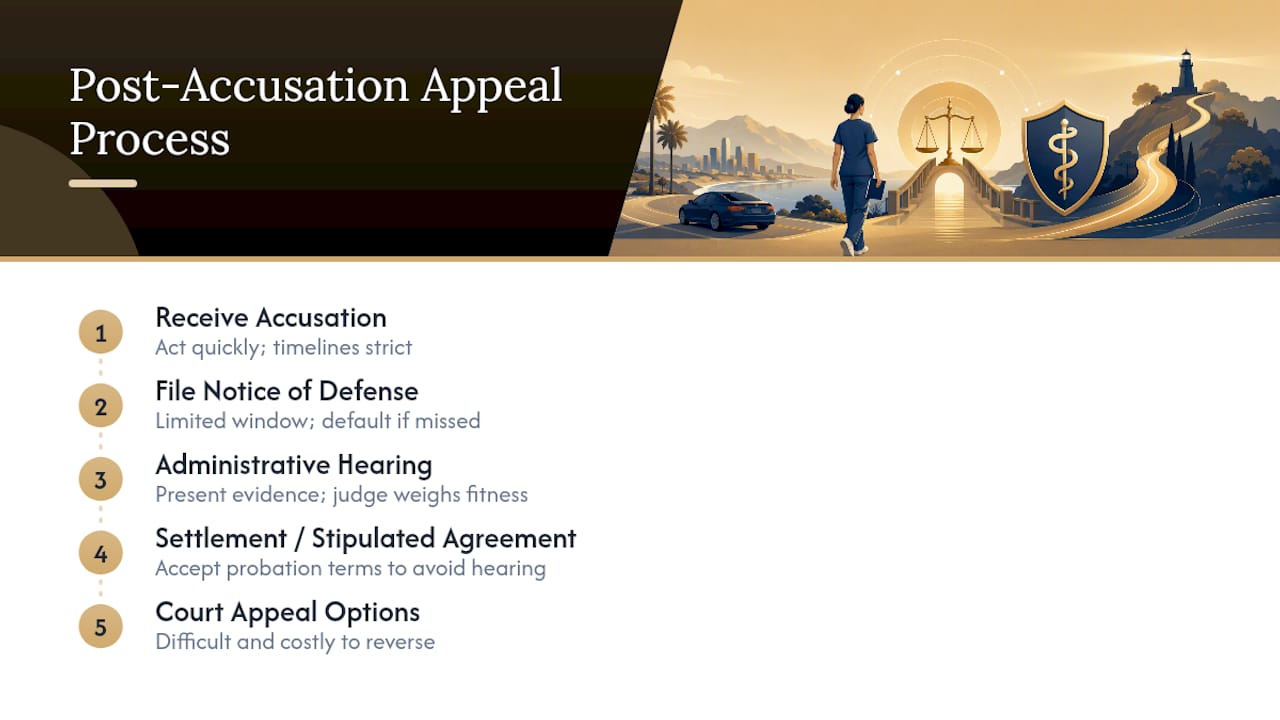
Once a Notice of Defense is filed, the case proceeds toward an administrative hearing before an administrative law judge, where you can present evidence, call witnesses, and challenge the Board's findings directly. This is where a documented mitigation record, treatment history, employer support, sustained sobriety, becomes central to the outcome, since the judge is weighing current fitness to practice, not just the facts of the original arrest.
Settlement negotiations often happen before a hearing ever takes place. Many DUI-related cases resolve through a stipulated agreement, where the nurse accepts specific probation terms in exchange for avoiding a contested hearing and its unpredictable outcome. This route tends to work best when the mitigation case is strong enough that both sides see a hearing as unnecessary.
If the Board issues a decision after a hearing, further appeal options exist through California's court system, though reversing a Board decision on appeal is difficult and expensive. Acting early, well before any Accusation is filed, gives you far more leverage than trying to undo a decision after the fact.
Practicing Compliantly During a License Suspension
A suspension doesn't leave you with informal options. Practicing as an RN, LVN, or NP while your license is suspended is itself a violation that can escalate a temporary suspension into permanent revocation, regardless of how minor the original DUI case was.
During a suspension period, you cannot perform any duties that require an active nursing license, including duties your employer might informally ask you to cover in a pinch. Some nurses attempt to shift into unlicensed roles temporarily, administrative work, non-clinical positions, but this requires clear communication with both your employer and, in some cases, formal Board notification depending on your probation terms.
Compliance during suspension usually involves specific, enforceable conditions: completing required evaluations, attending scheduled monitoring appointments, submitting to random testing, and avoiding any lapse in reporting requirements. Missing a single scheduled check-in can be treated as a probation violation even if unintentional, so treating every deadline as fixed and non-negotiable protects you far more than assuming minor lapses will be overlooked.
The nurses who return to full practice fastest after a suspension are typically the ones who treat every condition as mandatory from day one, document their compliance thoroughly, and stay in regular contact with counsel throughout the suspension period rather than waiting until reinstatement is due.
A Short Take on Priorities That Actually Protect Your License
Protect your ability to work first: request the DMV hearing, notify your employer only with counsel's guidance, and get triage counseling started immediately. Then focus long term on documented rehabilitation and clean probation compliance. Specialist counsel early on shapes both outcomes more than anything else you'll do.
— Jake
How Logan Noblin Coordinates Your DUI and Nursing License Defense
Fighting a DUI charge and defending your nursing license require different legal strategies running on different clocks, and handling them separately is how nurses lose ground they didn't have to. Logan Noblin's practice covers both sides at once: DUI defense in criminal court, DMV Administrative Per Se hearings to protect your driving privileges, and coordination with your BRN mitigation strategy from the same legal team.

At an initial consultation, expect a direct conversation about your DMV deadline status, the facts of your arrest, and what documentation you should start gathering immediately for any future Board review. If your case involves prior offenses, the firm's multiple DUI defense experience factors directly into how the licensing side gets approached. For nurses further along who need to clear an old conviction from their record entirely, the firm's expungement services address that separately. Reach out through the firm's website to schedule a consultation before your DMV deadline passes.
Where to Read the Official Rules Yourself
- BRN conviction and discipline guidance
- BRN Intervention Program FAQs
- DMV DUI hearing guide
This article is general information, not a substitute for advice from a qualified lawyer. Consult a qualified legal professional about your own circumstances before acting on anything here.
Sources
- License Discipline and Convictions — California Board of Registered Nursing
- Intervention Frequently Asked Questions — California Board of Registered Nursing
- What Happens If a Nurse Gets a DUI in California? - LegalClarity
- Nurse DUI Defense California | Your Nursing License After a DUI — CredibleLaw
FAQ
Can You Still Be a Nurse With a DUI in California?
Yes. A DUI alone doesn't automatically disqualify you from nursing, and many nurses continue practicing through probation or after a stayed revocation. The Board's decision depends on the specific facts, any aggravating factors, and how strong your rehabilitation record is by the time the case is reviewed.
How Long Does a DUI Stay on Your Record in California?
A DUI conviction stays on your criminal record permanently unless you obtain an expungement, and it can remain part of your BRN disciplinary history even after probation ends. Logan Noblin's team handles DUI record clearing for clients looking to limit the long-term visibility of a past conviction.
Is a DUI a Felony in California?
Most first and second DUIs in California are charged as misdemeanors. A DUI becomes a felony when it involves injury to another person, a prior felony DUI conviction, or a fourth DUI within ten years, and felony convictions carry substantially higher risk of BRN suspension or revocation.
Should You Report a DUI Arrest or Only a Conviction to the Board?
California generally requires nurses to report convictions, not arrests alone, though renewal applications ask about convictions since your last renewal. Because the Board often learns of arrests independently through fingerprint reporting, proactive disclosure once a conviction occurs is almost always safer than waiting for the Board to find out first.