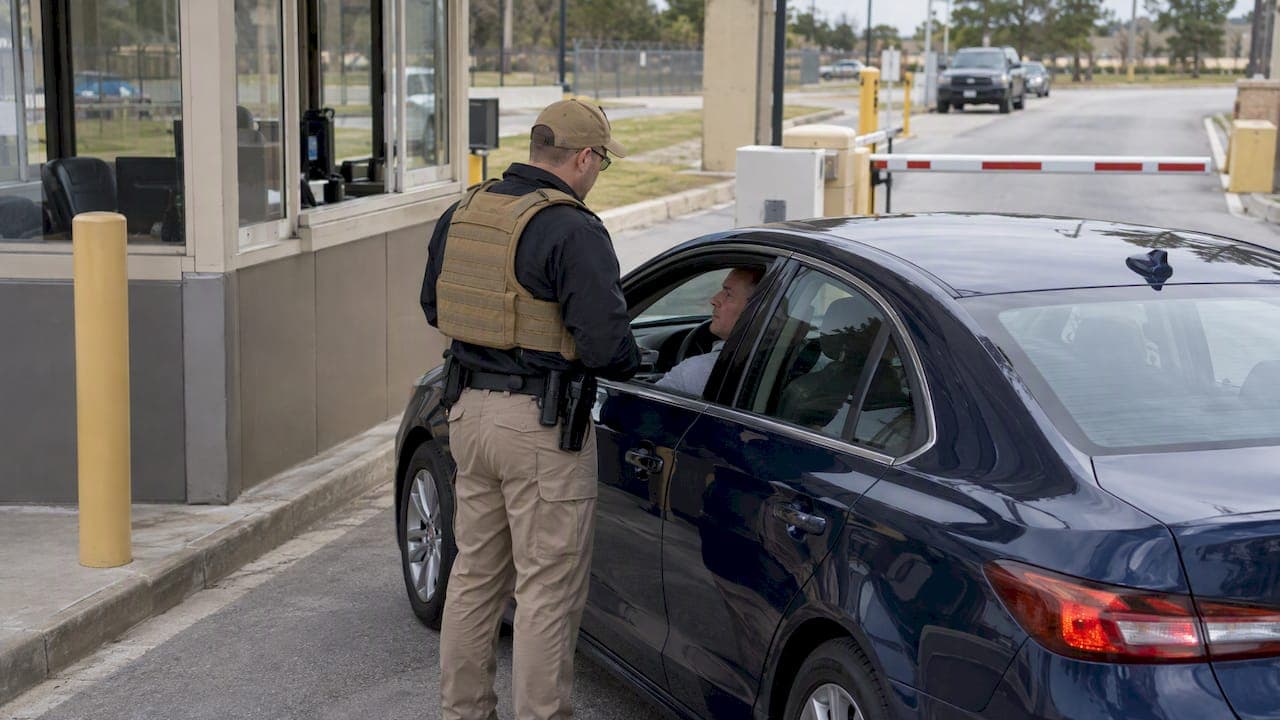
A DUI on a military base is usually not handled like a DUI on a city street. Many installations sit on federal land, so a civilian can end up in federal magistrate court instead of a county courthouse. A service member can face that case and separate action from their command. Both can lose base driving privileges whatever the court decides.
This guide explains who prosecutes the case, what law applies, what the military can do on its own, and what to do in the first days. We are a San Diego criminal defense firm, so we use San Diego examples where they help. The federal framework applies nationwide.
TL;DR
- A DUI on a base is often prosecuted in federal court under the Assimilative Crimes Act, which borrows the state's DUI law. The courtroom changes, and the definition of the offense stays tied to the state where the base sits.
- Service members can face federal or civilian charges and military consequences, such as Article 15 punishment, a reprimand or administrative separation. The command can act even if the court case ends well.
- Losing on-base driving privileges for a year or more is a separate penalty. It can follow a conviction or a refused chemical test.
- A JAG officer cannot defend you in civilian or federal magistrate court, so you need your own civilian lawyer.
- Early decisions matter: what you say to your command, what you sign, and whether you act on deadlines.
Table of Contents
- Why a base DUI goes to federal court
- Civilian arrested on base versus service member
- Losing your base driving privileges
- What to do in the first days
- Defenses that matter on a base
- Security clearances and professional licenses
- Our perspective
- Help with a DUI on or near a San Diego base
- FAQ
- Sources
Why a base DUI goes to federal court
Federal law covers crimes committed on federal property. The Oklahoma Bar Association's journal notes that the federal government has exclusive jurisdiction over crimes committed on any military reservation or base in the situations it examines, and that includes DUI. Not every acre of every installation is the same legally, so the type of jurisdiction at the exact spot of the arrest matters. In practice, a stop at a gate or on a base road often leads to a citation into the federal system.
There is no general federal DUI statute for civilians. Instead, the Assimilative Crimes Act, 18 U.S.C. § 13, fills the gap. As the Tenth Circuit explained in a Fort Carson DUI appeal, the federal court had jurisdiction because the offense happened on the military reservation, and the act adopts the DUI law of the state where the base is located.
What that means for you:
- The elements of the offense follow state law. A DUI on a base in San Diego County is measured against California's DUI statutes, not Colorado's or Georgia's.
- The court is federal. Usually that means a federal magistrate judge and a federal prosecutor, with federal procedure and a different set of local rules.
- The paperwork differs. On-base citations are often written by military police or security forces, and the case can begin with a violation notice rather than a state complaint.
The first surprise for many people is the courthouse. The second is that options common in county courts may not be offered the same way in federal court. The Oklahoma journal article describes civilians in federal court as facing a more rigid system than service members who can benefit from command discretion. That is one author's view of one state's practice, but it is why the forum matters when you plan a defense.
Civilian arrested on base versus service member
The base does not check your ID before it applies federal law. A civilian visiting, delivering, working as a contractor or driving through is in the same jurisdiction question as a soldier. What differs is the second track.
| Civilian | Service member | |
|---|---|---|
| Where the criminal case goes | Typically federal magistrate court under the Assimilative Crimes Act | Federal magistrate court for on-base offenses, state court for off-base arrests, or the military system |
| Military discipline | None | Article 15, reprimand, Unfavorable Information File, possible court-martial or separation |
| Base access | Installation commander can bar or suspend driving privileges | Driving privileges suspended; career consequences added |
| Who can defend you | A private criminal defense attorney | A civilian attorney for civilian or federal court; military counsel for UCMJ matters |
What happens to civilians
A civilian on a base faces the criminal case and, in practice, a loss of access. If you work on the installation, a driving suspension or access restriction can threaten your job even before the case is decided. If you hold a commercial license, a DUI has its own consequences, which is why our CDL DUI defense page is a separate resource.
First offense or not, a federal misdemeanor still creates a record. If you are weighing a plea, ask how the conviction will affect your job, professional license, immigration situation, security clearance and insurance before you agree to anything.
What happens to service members
The UCMJ has its own drunk driving offense. Article 113 covers drunken or reckless operation of a vehicle, aircraft or vessel by anyone subject to the code. In reality, many DUIs by troops are charged under state or assimilated law instead, and the military response runs alongside.
FindLaw's overview of military DUI says an arrest can bring both civilian court proceedings and separate military disciplinary action. Commanders have a wide menu:
- Non-judicial punishment (Article 15). This can include loss of rank, forfeiture of pay, restriction and extra duty.
- A reprimand. Often a written reprimand placed in a file that boards read later.
- An Unfavorable Information File or similar flag. This can block promotion, schools and reenlistment.
- Administrative separation processing. This is the one that ends careers.
- Court-martial. Less common for a standard first DUI, but possible with aggravating facts such as an accident or injury.
Commanders may act before the court case ends. A dismissal or acquittal in court does not necessarily bind the command, because the military standard and process are different. This is why we treat the military side as part of the case from day one, not an afterthought.
Losing your base driving privileges
This is the penalty people forget until they cannot get to work. DoD installation traffic rules call for suspension or revocation of driving privileges after a DUI conviction or a refusal to take a chemical test. The Air Force Safety Center, in a piece on DUI checkpoints at Peterson Space Force Base, reminds readers that a charge alone has life-altering effects, including license revocation and jail time.
The Marine Corps order on motor vehicle traffic supervision, MCO 5110.1D, lists conviction by court-martial or civilian court, or non-judicial punishment, for drunk driving as grounds for action, and it also reaches refusal of a breath, blood or urine test on or off the installation when there was reasonable belief of DUI. The Army's regulation on driving records and traffic points appears in the Code of Federal Regulations at 32 CFR part 634, subpart E. Each service sets its own periods, and a given command may apply them differently. Check the current regulation for your branch and installation rather than relying on a general rule. Our summary: a year is a common minimum in the sources above, and longer periods can apply to repeat or compounded offenses.
This matters if you live on base, commute through a gate every day, or work there as a civilian. Ask your lawyer early whether the suspension can be challenged or limited, and whether a hardship arrangement is available. Do not assume you have none.

What to do in the first days
These steps come from what we see go wrong in real cases. They are general information, not advice for your specific facts.
1. Be careful about what you say
Be polite and identify yourself. Do not argue the facts at the roadside or at the provost marshal's office. Anything you say to military police, security forces or a command representative can be used in the criminal case and in military proceedings.
2. Do not assume you must self-report right away
Service members often believe they must tell their chain of command at once about a civilian arrest. Reporting duties vary by branch, clearance level and local command policy. Read your service's regulation and talk to a lawyer before you volunteer a statement unless your orders clearly require one. If a report is required, a lawyer can help you keep it factual and limited.
3. Hire a civilian attorney
A JAG officer cannot represent you in civilian or federal magistrate court on a DUI. Military defense counsel can help with UCMJ proceedings, but the criminal case in federal or state court needs private counsel. Pick a lawyer who handles both the court case and the command fallout, or who will coordinate with military counsel.
4. Write down the details while they are fresh
Note where you were stopped, which gate or road, which agency stopped you, the time, what you ate and drank, what tests were given and what you were told about refusing. Location and the type of jurisdiction can shape the case.
5. Track every deadline
A federal violation notice carries a court date. Missing it can turn a misdemeanor problem into a warrant problem. Keep every notice, including any base-access or driving-privilege letter, because those have their own deadlines to respond.
Defenses that matter on a base
Base DUI cases rest on the same questions as any DUI, plus a few that are specific to federal property.
- Was the stop lawful? Gate checks and base checkpoints are not the same as roving patrols. The legal basis for the stop, and what happened after it, deserve a close look.
- Was the jurisdiction right? The type of federal jurisdiction at the exact location is a real question in some cases, not a technicality.
- How were the tests administered? Field sobriety tests, breath devices and blood draws all depend on proper procedure, calibration and timing.
- What does the state law require? Because the Assimilative Crimes Act uses the state statute, the defenses available under that state's DUI law may carry over.
- What are the collateral consequences of a plea? In some cases a different outcome on paper protects a clearance, a license or a career better than a quick plea.
For active-duty personnel arrested off base in California, there is also a diversion path. Our guide on whether active-duty service members can still use military diversion to dismiss a DUI covers it, and our PC 1001.80 military diversion page explains who may qualify. Diversion is a state court tool, so it does not automatically apply to a case sitting in federal court. Which court has your case is the first question to settle.
Security clearances and professional licenses
A clearance holder does not need a conviction to have a problem. An arrest can trigger a reporting duty and a review. We wrote about this in DUI and security clearance risk for San Diego residents. If you hold a clearance, talk to your lawyer before you talk to your security officer.
Professionals such as nurses, pilots, attorneys and contractors have their own licensing boards and reporting rules. The outcome of the court case and what you say to the board are connected, so plan both together.
Our perspective
We see a base DUI as three cases at once: the criminal case, the command or access case, and the future-record case. People usually focus on the first and lose ground on the other two.

The main error we see is treating a federal magistrate court like a traffic court because the charge is a misdemeanor. It is still a federal prosecution with a federal record. Equally, the main error among service members is to wait for the court outcome before thinking about the command. The command is often moving first.
Our approach is to build a personal narrative for the client, not just a file of lab numbers. Logan Noblin comes from a background as a published writer and journalist, and he applies it to explain who the client is to a judge, a prosecutor or a board. We also look for pre-charge intervention where it is possible, because the strongest moment to affect a case is often before formal charges are filed. We handle DUI, on-base federal misdemeanors and military matters, so one team can look at the whole picture. We cannot promise an outcome, and no honest lawyer can, but we can make sure you know your options before a deadline closes them.
— Logan Noblin
Help with a DUI on or near a San Diego base
San Diego County has a heavy military presence, and many of our clients are service members, veterans, contractors and civilians who were stopped on or near an installation. If you were arrested, start with our page on military DUI defense in San Diego. If the citation came from a federal property, our federal misdemeanor and on-base defense page explains how those cases run. For a first arrest, see our first-time DUI defense page. You can also reach the firm through our main site to ask for a consultation. Bring your citation, any base-access or command paperwork, and your notes.
FAQ
What happens if a civilian gets a DUI on a military base?
A civilian is typically prosecuted in federal court under the Assimilative Crimes Act, which applies the DUI law of the state where the base is located. The installation can also restrict your driving or access to the base. Hire your own criminal defense attorney, because no military lawyer will represent you.
Will I be charged in state court or federal court?
If the arrest was on federal land such as a base, expect federal court, usually a magistrate judge. If it was off base, the state court usually handles it, even for a service member. Jurisdiction can be more complicated at certain locations, so confirm which court issued your citation.
Can I get kicked out of the military for a DUI?
Yes, it is possible. Commanders can pursue administrative separation, and they can act regardless of how the civilian case ends. Outcomes depend on rank, record, branch, the facts of the arrest and command policy. A lawyer who understands both the court case and the command process can help you plan a response.
Do I have to tell my command about a DUI arrest?
Not always. Reporting rules vary by branch, clearance level and local command policy. Review your service's regulation and speak with a lawyer before making a statement unless your orders plainly require one.
Can a JAG officer defend me in federal magistrate court?
No. JAG officers generally cannot represent you in civilian or federal magistrate court on a DUI. You need a private civilian attorney for that case, while military counsel may help with UCMJ proceedings.
Sources
- Tenth Circuit opinion on a Fort Carson DUI prosecution
- 10 U.S.C. § 913, Article 113 UCMJ
- FindLaw: What happens if you get a DUI in the military
- Air Force Safety Center: Peterson SFB DUI checkpoints
- MCO 5110.1D, Motor Vehicle Traffic Supervision
- 32 CFR part 634, subpart E: Driving records and the traffic point system