A DUI can absolutely threaten your security clearance, but it is not an automatic disqualifier. Adjudicators evaluate alcohol-related incidents under Guideline G (Alcohol Consumption) of the Adjudicative Guidelines, weighing BAC level, frequency, treatment history, and whether the incident signals impaired judgment. They also apply Guideline E (personal conduct) if your SF-86 disclosures are inconsistent or incomplete. A single, isolated DUI followed by documented rehabilitation is frequently mitigated. What sinks clearances more often than the DUI itself is a reporting error or a candor problem.
Key facts to know right now:
- A DUI triggers review, not automatic revocation, under a "whole person" standard
- Reporting obligations vary by agency — blanket self-reporting without counsel can create a candor issue that is harder to fix than the underlying arrest
- Continuous Evaluation databases flag criminal arrests quickly, so the government may already know
- Preserve all records immediately: police report, breath/blood test results, court documents, and DMV notices
- Do not give statements to investigators or security officers before speaking with a clearance-aware DUI attorney
Pro Tip: Contact the Law Offices of Logan Noblin, APC in San Diego before you file anything with your security officer. The reporting decision itself is often the highest-stakes move you will make.
Table of Contents
- How does the clearance appeal process work after a DUI denial?
- Does clearance level change how a DUI affects you?
- What are the long-term career consequences of a clearance denial?
- How long does the clearance review process take?
- What costs should you expect after a DUI with clearance implications?
- Military service members face a different set of rules
- Key Takeaways
- The part most cleared professionals get wrong
- Facing clearance risk after a DUI? Logan Noblin defends San Diego clients who can't afford to get this wrong
- Useful sources and official guidance
How does the clearance appeal process work after a DUI denial?
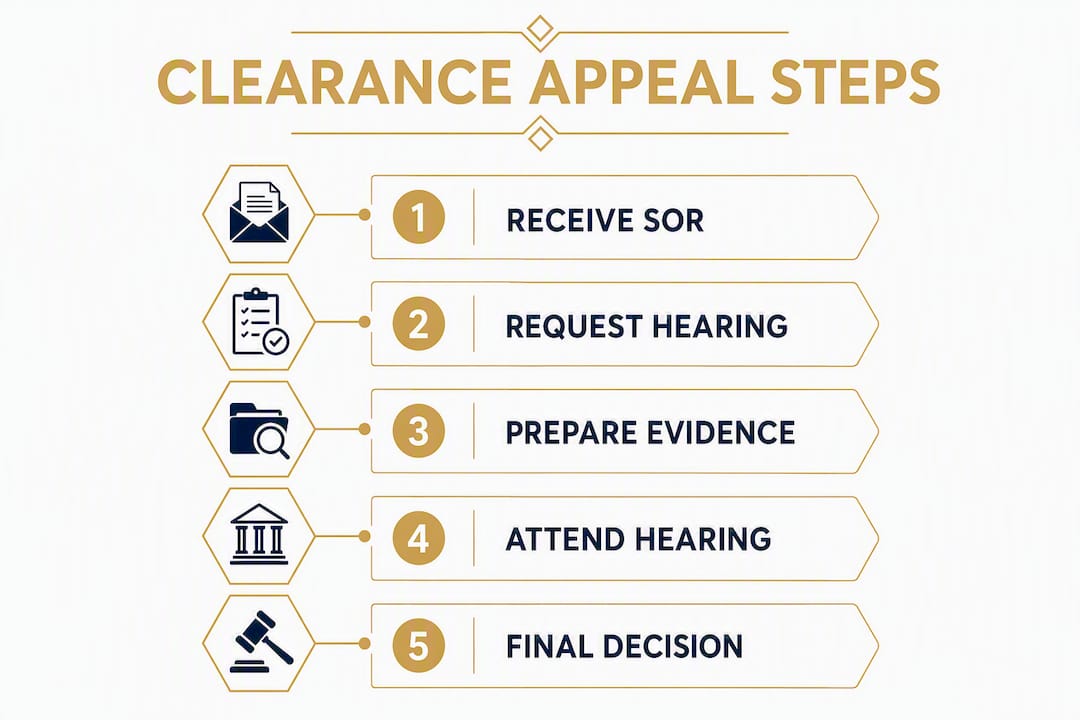
A clearance denial or revocation typically arrives with a Statement of Reasons (SOR), a formal document listing the government's specific concerns. An SOR is not a final career-ending step — it is the opening of a structured, evidence-driven response process with defined deadlines.
You generally have 20 days to request a hearing before a Defense Office of Hearings and Appeals (DOHA) judge, or 60 days to submit a written response without a hearing. Miss those windows and you forfeit your best mitigation opportunity. A strong SOR response addresses each allegation directly with documentation: court-completion certificates, treatment records, character letters from supervisors or clinicians, and evidence of behavioral change. Emotional statements alone rarely move adjudicators. If DOHA rules against you, you can appeal to the Personnel Security Appeals Board (PSAB), and from there to federal court in limited circumstances.
Does clearance level change how a DUI affects you?
Yes, though perhaps not in the way most people expect. A DUI does not automatically disqualify you from a Confidential or Secret clearance, and it does not automatically disqualify you from a Top Secret clearance either. What changes is the scrutiny.
Top Secret and Sensitive Compartmented Information (TS/SCI) adjudications apply a stricter "clearly consistent with national security" standard. A single DUI with strong mitigation may survive a Secret review but draw a formal SOR at the TS level. Multiple incidents, a high BAC, or a DUI combined with other Guideline concerns (financial, foreign contacts) compound the risk at every level. The whole-person review means adjudicators weigh the totality of your record, so a clean history everywhere else genuinely helps.
What are the long-term career consequences of a clearance denial?
Losing a clearance over a DUI can end a federal career or defense-contractor position outright. Many cleared roles have no non-cleared equivalent inside the same organization, so revocation often means separation, not reassignment.
A denial is also on record. Future clearance applications at other agencies will surface the prior denial, and you must disclose it on the SF-86. That said, a denial is not permanent. Time, documented rehabilitation, and a clean record can support a successful reapplication — but the waiting period and the burden of proof are real. DUI expungement in California does not erase the incident from federal background checks, but it can demonstrate legal rehabilitation and is worth pursuing as part of a broader mitigation package.
How long does the clearance review process take?
Initial investigations after a DUI-related flag typically run three to twelve months, depending on the agency, clearance level, and backlog. Continuous Evaluation can surface an arrest within days. An SOR response and DOHA hearing process adds another six to eighteen months on top of that. Access is usually suspended during review, which means you may be unable to perform your job while the process runs.
What costs should you expect after a DUI with clearance implications?
The financial exposure is significant across multiple fronts. California DUI fines and court assessments commonly reach several thousand dollars. DMV fees, ignition interlock requirements, and license reinstatement add more. Alcohol education programs required by courts run hundreds of dollars. Attorney fees for criminal DUI defense in San Diego vary based on case complexity, and adding clearance-specific mitigation strategy, SOR response drafting, and DOHA hearing representation increases that figure. Knowing how to protect your license at the DMV hearing is its own fight with its own deadline — ten days from arrest to request a DMV hearing in California.
Military service members face a different set of rules
Active-duty personnel in San Diego face both civilian criminal proceedings and military administrative processes simultaneously. A DUI can trigger a commander's inquiry, a Letter of Reprimand, or separation proceedings alongside the civilian case. The good news: military diversion programs may be available to dismiss the charge, which carries significant weight in both the criminal record and the clearance adjudication. Coordinating civilian defense strategy with military administrative outcomes is not optional — a plea that resolves the civilian case cleanly can still create a military record that damages the clearance picture if handled without that coordination in mind.
Key Takeaways
A DUI threatens but does not automatically end a security clearance — how you respond in the first days determines more than the incident itself.
| Point | Details |
|---|---|
| DUI is not automatic disqualification | Adjudicators apply a whole-person review; isolated incidents with documented rehabilitation are frequently mitigated. |
| Candor outweighs the incident | Inconsistent SF-86 disclosures or premature self-reporting under Guideline E can cause more damage than the DUI itself. |
| SOR deadlines are hard | You have 20 days to request a DOHA hearing; missing the window forfeits your strongest mitigation opportunity. |
| Military cases need dual strategy | Service members must coordinate civilian defense and military administrative outcomes simultaneously to protect both record and clearance. |
| Logancriminaldefense offers local help | The Law Offices of Logan Noblin, APC handles DUI defense, SOR strategy, DMV hearings, expungement, and military diversion in San Diego. |
The part most cleared professionals get wrong
The conventional wisdom says "report everything immediately and cooperate fully." That instinct is understandable, and candor genuinely matters. But the timing and framing of that candor is where cases are won or lost — and most people get it wrong because they conflate moral honesty with legal strategy.
Reporting obligations are not uniform. Some agencies require disclosure of an arrest within a set number of days; others require disclosure only upon conviction or at the next periodic reinvestigation. Mistimed self-reporting can trigger an adverse review before you have any mitigation evidence assembled. Worse, an inaccurate or incomplete disclosure made in haste becomes a Guideline E problem layered on top of the Guideline G problem. Two strikes instead of one.
The other thing people underestimate: adjudicators are not looking for perfection. They are looking for a pattern. A single DUI followed by treatment, court compliance, and years of responsible conduct tells a coherent story. What they distrust is evasion, minimization, or a pattern of incidents. Build the right narrative from day one, with counsel who understands both the criminal case and the clearance implications, and the outcome is far more manageable than it looks at 2 AM in a holding cell.
Facing clearance risk after a DUI? Logan Noblin defends San Diego clients who can't afford to get this wrong
When your career depends on keeping your clearance, a standard DUI defense is not enough. The Law Offices of Logan Noblin, APC brings together criminal DUI defense, DMV hearing representation, military diversion advocacy, and clearance-specific mitigation strategy under one roof in San Diego. Logan Noblin, a former Attorney of the Year, has secured not-guilty verdicts and dismissals for clients whose livelihoods depended on the outcome.
When you call, have your arrest date and agency, court case number, DMV notice, and current clearance level ready. The first conversation focuses on records preservation and whether, when, and how to report — the decisions that shape everything that follows. Reach out to the San Diego criminal defense team at the Law Offices of Logan Noblin, APC to schedule your consultation.
Useful sources and official guidance
These primary sources cover the rules, timelines, and mitigation criteria that cleared personnel and their counsel need to consult directly.
| Source | What it covers | Best used for |
|---|---|---|
| Adjudicative Guidelines — Guideline G | Alcohol-related disqualifying and mitigating conditions | Understanding what adjudicators weigh |
| ClearanceJobs — DUI waiting periods | Timelines for reapplying after a DUI conviction | Planning reapplication strategy |
| LegalClarity — SOR process | SOR response structure and mitigation evidence | Preparing a DOHA response |
| Federal Career Lab — self-reporting | Continuous Evaluation and SF-86 disclosure guidance | Deciding when and how to report |
| Logan Noblin — military diversion | Military diversion eligibility and civilian coordination | Active-duty DUI defense strategy |
| Logan Noblin — DUI expungement | California expungement eligibility and process | Long-term record and clearance restoration |
| Logan Noblin — DMV hearings | California DMV hearing representation | Preserving driving privileges and license records |
For post-arrest evidence preservation steps applicable across jurisdictions, the criminal defense blog at MPC Law covers general procedural checklists worth reviewing alongside California-specific guidance.
This article provides general legal information, not legal advice. Clearance adjudication rules, reporting deadlines, and California DUI law change frequently. Consult a qualified attorney and verify current requirements with your agency's security officer or the relevant primary source before taking any action.