
Match level of care to clinical need. That is the core rule, and it comes from the ASAM Criteria, the nationwide clinical framework clinicians use to place patients on the right rung of the treatment ladder. Inpatient residential care is typically the right call when someone faces high withdrawal risk, an unstable or unsafe home, a severe co-occurring psychiatric disorder, or a history of repeated relapse. Outpatient options, including Intensive Outpatient Programs (IOP) and Partial Hospitalization Programs (PHP), work well for mild-to-moderate substance use disorder with stable housing and social support, or as step-down care after residential treatment.
Three clinical profiles cover most decisions:
- High-risk withdrawal or medically complex: Inpatient or medically managed detox first, then residential care.
- Moderate severity, stable environment: PHP or IOP, often compatible with work or school.
- Mild SUD or post-inpatient step-down: Standard outpatient (ASAM Level 1.0) or continued IOP.
Cost and work obligations are real factors. They should inform logistics, not override a clinical assessment. The Mental Health Parity and Addiction Equity Act (MHPAEA) requires most U.S. insurance plans to cover the full spectrum of treatment levels, and NIDA research consistently links 90 or more days of combined care to the best long-term outcomes.
Pro Tip: Before you call a facility, ask your primary care doctor or an addiction medicine specialist for an ASAM-based clinical assessment. That single document will guide placement, speed insurance pre-authorization, and give you a defensible starting point if legal issues are involved.
Table of Contents
- What inpatient and outpatient rehab actually mean, and how ASAM levels map to each
- Pros and cons of inpatient vs outpatient rehab: the honest tradeoffs
- What inpatient and outpatient rehab cost, and how U.S. insurance typically covers each
- Who should choose inpatient, and who is a better fit for outpatient care
- What daily life looks like in inpatient vs outpatient settings
- How to choose a program: the questions that actually matter
- Step-down care and aftercare: why continuity matters more than the initial setting
- When substance use treatment intersects with criminal charges
- Key Takeaways
- The part most rehab guides leave out
- Facing DUI or drug charges in San Diego? Here is how Logancriminaldefense can help
- Useful sources for further reading
What inpatient and outpatient rehab actually mean, and how ASAM levels map to each
The terms "inpatient" and "outpatient" describe a spectrum, not a binary. Clinicians use the ASAM Criteria's six dimensions to place patients at the right intensity: withdrawal potential, biomedical conditions, emotional and cognitive conditions, readiness to change, relapse potential, and recovery environment.
Here is how the levels break down:
| ASAM Level | Program Type | Typical Hours/Week | Common Duration | Clinical Indication |
|---|---|---|---|---|
| — | Medically Managed Inpatient (Detox) | 24/7 | 3–10 days | Severe withdrawal risk (alcohol, benzo, opioid) |
| — | Residential / Inpatient | 24/7 | 30–90 days | Unstable environment, severe SUD, co-occurring disorders |
| — | Partial Hospitalization (PHP) | 30–40 hrs | 2–6 weeks | Medically stable but high psychosocial need |
| — | Intensive Outpatient (IOP) | 9–20 hrs | 2–4 months | Moderate SUD, stable housing, work/school obligations |
| 1.0 | Standard Outpatient | 1–7 hrs | 3–6 months | Mild SUD or ongoing maintenance after higher care |
Duration ranges come from RehabHive's treatment comparison data and RehabFlow's program schedules.
The step-down continuum in practical terms:
- Detox stabilizes the body and clears acute withdrawal safely.
- Inpatient/residential provides structured therapy, 24/7 supervision, and removal from triggers.
- PHP bridges the gap: near-full-time programming without overnight stays.
- IOP allows someone to live at home while attending structured sessions several days a week.
- Standard outpatient maintains progress through weekly or biweekly counseling.
- Aftercare (MAT, peer support, sober living) sustains recovery long-term.
The ASAM Criteria uses six clinical dimensions rather than patient preference to determine placement. That distinction matters in practice because many people underestimate their own withdrawal risk or overestimate their home environment's stability.
Pros and cons of inpatient vs outpatient rehab: the honest tradeoffs
Neither setting is universally superior. The right choice depends on clinical profile, not willpower or preference.

Inpatient residential care
Pros:
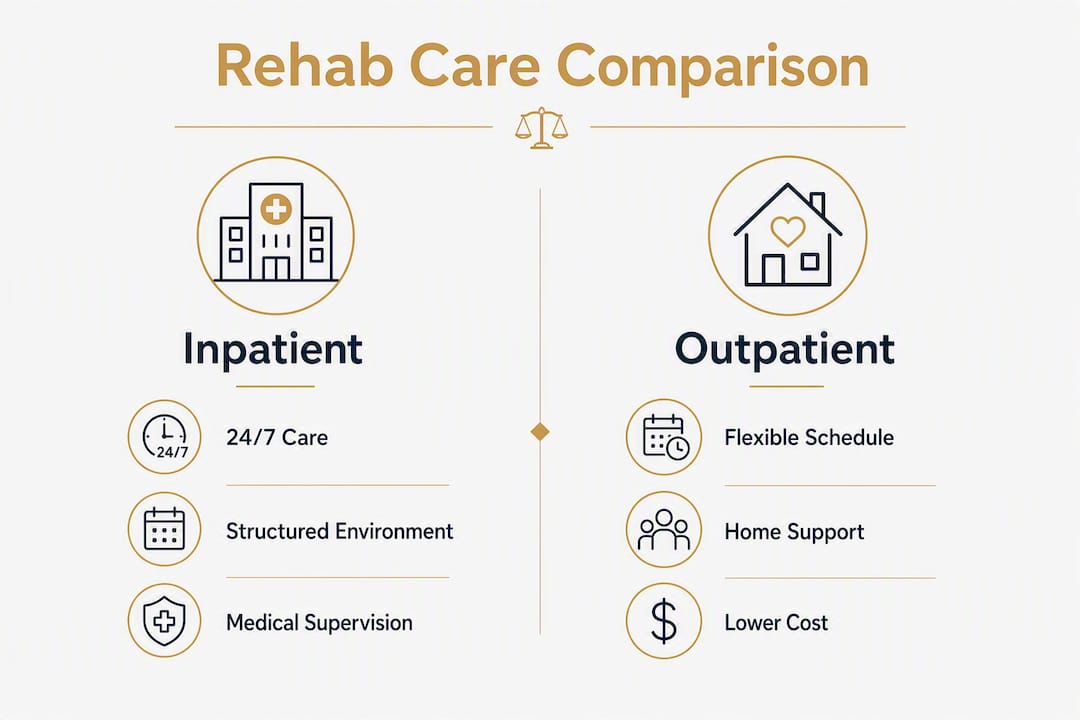
- 24/7 medical supervision and immediate access to staff during a crisis
- Physical removal from people, places, and substances that trigger use
- Structured daily schedule that eliminates idle time and decision fatigue
- On-site medically managed detox when withdrawal risk is present
- Immersive therapeutic environment: group therapy, individual counseling, and recreational therapy in one place
- Protective for people with active-use partners or unsafe housing
Cons:
- Significant disruption to work, school, parenting, and family life
- Higher cost, typically $15,000–$30,000 for a 30-day program at mid-tier facilities
- Privacy concerns: employer or family may notice an extended absence
- Recovery skills are practiced in an artificial environment, not real life
- Clinical research shows that inpatient's long-term advantage diminishes without step-down supports after discharge
Outpatient care (IOP, PHP, standard)
Pros:
- Allows people to maintain employment, attend school, and stay with family
- Recovery skills are practiced in the real world, which can reinforce long-term habits
- Lower cost across all levels
- IOP evening and telehealth options make scheduling flexible
- PHP provides near-residential intensity without overnight stays
- Easier to maintain medication-assisted treatment (MAT) continuity
Cons:
- Continued exposure to triggers and using peers at home
- Less medical supervision; not appropriate for high withdrawal risk
- Requires a stable, supportive home environment to be effective
- Motivation and attendance depend heavily on the individual's readiness
A common misconception is that outpatient treatment is "less effective" across the board. For mild-to-moderate substance use disorder with stable supports, evidence-based IOP and PHP programs produce outcomes comparable to residential care. The key variable is clinical matching, not setting prestige.
What inpatient and outpatient rehab cost, and how U.S. insurance typically covers each
Cost is one of the most searched questions in any rehab program comparison, and the ranges are wide.

Representative national mid-tier cost ranges vary widely depending on program type and duration, with inpatient/residential programs generally being the most expensive and standard outpatient courses costing less.
These figures come from RehabHive's cost comparison data and represent mid-tier programs. Out-of-pocket exposure depends heavily on insurance.
Coverage reality: Under MHPAEA, most U.S. insurance plans must cover substance-use treatment across the full spectrum of ASAM levels, from detox through standard outpatient. Prior authorization and medical-necessity documentation are standard requirements for residential admissions.
Immediate steps to manage insurance:
- Call your insurer's behavioral health line and ask specifically which ASAM levels are covered under your plan.
- Request pre-authorization for inpatient or PHP before admission, not after.
- Ask whether the facility is in-network; out-of-network residential care can trigger much higher cost-sharing.
- Confirm whether your plan has annual limits on inpatient behavioral health days.
- Insurers commonly require ASAM-based documentation for residential claims; get that assessment in writing before you call the facility.
Pro Tip: When submitting for pre-authorization, ask the treating clinician to document all six ASAM dimensions explicitly. Vague clinical notes are the most common reason insurers deny residential admissions on first review.
Who should choose inpatient, and who is a better fit for outpatient care
The ASAM Criteria's six dimensions are the standard clinical framework, but here is how those dimensions translate into practical decision points.
Clinical factors that typically point toward inpatient:
- Alcohol, benzodiazepine, or opioid dependence with significant withdrawal risk (seizure or delirium history)
- Active co-occurring psychiatric disorder (psychosis, severe depression, active suicidality)
- Unstable or unsafe housing, including homelessness or a home with active substance use
- Two or more prior treatment attempts that ended in relapse
- Court-ordered placement requiring residential documentation
- No reliable transportation or social support for outpatient attendance
Clinical factors that typically support outpatient (IOP or PHP):
- Mild-to-moderate SUD without significant withdrawal risk
- Stable housing and a supportive, sober household
- Strong motivation and no prior failed outpatient attempts
- Employment or caregiving responsibilities that cannot be paused
- Medical stability with no acute psychiatric crisis
- Post-inpatient step-down with a written aftercare plan
Two compact examples illustrate how this plays out. Someone with severe opioid use disorder, no stable address, and a history of two prior outpatient attempts that ended in relapse is a strong candidate for residential care followed by sober living. Someone with a steady job, mild alcohol misuse meeting three DSM-5 criteria, and a supportive spouse at home is well-matched to IOP, especially evening sessions that preserve employment.
Pro Tip: If you are medically stable but your home environment is chaotic or your psychosocial needs are high, PHP is often the right middle ground. It provides near-full-time structure without requiring you to leave your job permanently.
What daily life looks like in inpatient vs outpatient settings
Knowing what to expect reduces the anxiety that often delays treatment.
A typical inpatient day runs on a structured schedule: morning medical check-in, individual therapy, group sessions (CBT, DBT, or 12-step facilitation), meals, recreational or experiential therapy in the afternoon, and an evening group or psychoeducation session. Unsupervised leave is limited, especially in the first two weeks. Family contact is usually permitted through scheduled calls or visits, often beginning after a brief blackout period of 3–7 days. Most programs allow family therapy sessions, which are distinct from casual visits.
IOP and PHP schedules are built around real life. IOP typically runs 9–20 hours per week, with many programs offering evening cohorts that start after 5 PM. PHP runs closer to 30–40 hours per week, essentially a full-time schedule without overnight stays. Telehealth IOP has expanded significantly and allows people in rural areas or with transportation barriers to attend from home. Both levels commonly integrate MAT (buprenorphine, naltrexone) alongside counseling.
Typical durations by level:
- Detox: 3–10 days
- Inpatient/residential: 30–90 days
- PHP: 2–6 weeks
- IOP: 2–4 months
- Standard outpatient: 3–6 months
Practical checklist for families:
- Confirm visitation rules and the blackout period before admission day.
- Ask what items are permitted (clothing limits, phone policies, books).
- Clarify how money or personal items can be sent to the patient.
- Plan for childcare or eldercare coverage for the duration of residential stay.
- Schedule your own family therapy session early; most programs welcome it.
How to choose a program: the questions that actually matter
Getting an ASAM-based clinical assessment is step one. Everything else flows from that document.
- Confirm the assessment is ASAM-based. Ask directly: "Do you use the ASAM Criteria for placement?" A facility that cannot answer that question clearly is a red flag.
- Verify detox capability. If withdrawal risk is present, confirm the facility has on-site medical detox or a formal transfer agreement with a hospital.
- Ask about evidence-based therapies. Cognitive Behavioral Therapy (CBT) and Medication-Assisted Treatment (MAT) have the strongest evidence base. Ask which modalities are used and how often.
- Check staff credentials. Licensed counselors (LCSW, LCDC), addiction medicine physicians, and psychiatrists should be on staff, not just peer support workers.
- Request outcome data and accreditation. Look for CARF or Joint Commission accreditation. Ask for 30-day and 90-day completion rates if the facility will share them.
- Verify insurance pre-authorization process. Ask who handles insurance verification and whether the facility will submit pre-auth on your behalf.
- Ask about the aftercare plan. A program that cannot describe your step-down pathway before you admit is not planning for your long-term success.
Red flags to walk away from:
- Guarantees of sobriety or specific outcome promises
- No licensed medical staff on site
- Cash-only intake with pressure to decide immediately
- Vague or evasive answers about accreditation
- No written aftercare or step-down plan offered at discharge
Pro Tip: Request a written aftercare plan and step-down pathway before you sign any admission agreement. Programs that build step-down care into the discharge plan from day one produce measurably better sustained outcomes than those that address it only at the end of a stay.
Step-down care and aftercare: why continuity matters more than the initial setting
NIDA research consistently shows that 90 or more days of combined treatment produces the best long-term recovery outcomes. The initial setting, inpatient or outpatient, matters far less than what happens next.
The full continuum looks like this: medical detox stabilizes acute withdrawal, inpatient residential builds the foundation, PHP maintains intensity while reintroducing daily life, IOP sustains structure while the person returns to work or family, standard outpatient provides ongoing counseling, and MAT or sober living extends support into the months and years that follow.
Returning directly to an unchanged, trigger-filled home environment after inpatient treatment is one of the most reliable predictors of early relapse. Step-down supports break that pattern.
Evidence-based aftercare options worth knowing:
- Peer recovery support: — Certified peer specialists and mutual aid groups (AA, NA, SMART Recovery) provide community accountability.
Three practical steps for a solid relapse-prevention plan: identify your highest-risk triggers before discharge, confirm medication continuity with a prescriber before you leave the facility, and schedule your first outpatient or MAT appointment before your discharge date. That last step alone significantly reduces the gap between levels of care where relapse most often occurs.
When substance use treatment intersects with criminal charges
Treatment decisions carry legal weight. For people facing DUI charges, drug possession, or diversion eligibility, the type of program you enter and how you document it can directly affect plea negotiations, sentencing, and probation terms.
Concrete ways treatment affects legal outcomes:
- Court-ordered inpatient placement: Judges in high-risk DUI or drug cases sometimes order residential treatment as a condition of bail, probation, or a plea agreement. An ASAM assessment that documents medical necessity strengthens the argument for treatment over incarceration.
- Diversion program compliance: California's diversion programs often accept IOP or PHP as compliant treatment. Outpatient attendance records become legal evidence of participation.
- Mitigation at sentencing: Documented enrollment and completion of a treatment program is one of the most persuasive mitigation tools available. Judges respond to evidence of genuine effort.
- Probation conditions: Many probation terms require ongoing outpatient counseling or drug testing. A written treatment plan from a licensed facility satisfies those conditions and creates a paper trail.
An ASAM assessment and a written treatment plan are not just clinical documents. In a criminal case, they become evidence of medical need, which can support diversion eligibility, reduce custody time, or shift a judge's perception of the defendant's trajectory.
If you are facing drug-related charges and considering drug crime defense options, or if you are dealing with a drug-related DUI in San Diego, the timing of treatment enrollment relative to your court dates matters. Entering treatment before arraignment or sentencing carries more weight than entering after a conviction.
For readers whose charges involve probation violations and immediate custody concerns, understanding bail for probation violations is a practical parallel step while treatment planning proceeds.
Pro Tip: Coordinate your treatment intake paperwork directly with your attorney before you enroll. Bring proof of enrollment, your ASAM assessment, and any completion certificates to every court appearance and probation check-in. That documentation can be the difference between a diversion outcome and a conviction.
Key Takeaways
Clinical matching to ASAM level of care, not cost or convenience, is the single most important factor in choosing between inpatient and outpatient rehab.
| Point | Details |
|---|---|
| ASAM-led placement | Use the ASAM Criteria's six dimensions to match care intensity to clinical need, not personal preference. |
| Insurance parity under MHPAEA | Most U.S. plans must cover all ASAM levels; get pre-authorization and document medical necessity before admission. |
| Typical cost ranges | Inpatient 30-day programs run $15,000–$30,000; IOP runs $5,000–$15,000; standard outpatient runs $1,000–$8,000. |
| 90+ days of combined care | NIDA research links 90 or more days of combined treatment to the best long-term recovery outcomes. |
| Logancriminaldefense | For San Diego clients with pending DUI or drug charges, coordinating treatment documentation with your attorney can support diversion eligibility and sentencing mitigation. |
The part most rehab guides leave out
The conventional framing of inpatient vs outpatient rehab treats the choice as primarily a lifestyle decision: can you afford to take 30 days off? That framing is backwards, and it leads people into the wrong level of care in both directions.
The more common mistake is not choosing inpatient when outpatient would have worked. It is choosing outpatient because it is cheaper or less disruptive, when the clinical picture clearly calls for residential care. Alcohol withdrawal can be fatal without medical supervision. Returning to a home where a partner is actively using is not a neutral variable. These are not lifestyle preferences; they are clinical risk factors, and underweighting them because of cost or work obligations is how people end up in crisis within weeks of discharge.
The other side of that coin is equally real. Plenty of people with mild-to-moderate SUD get pushed toward 30-day residential programs by facilities with financial incentives to fill beds. IOP with evening sessions and MAT integration is a legitimate, evidence-based treatment for a large portion of people seeking help. It is not a consolation prize.
The honest answer to "which rehab is better" is that neither is better in the abstract. An ASAM assessment by a licensed clinician who has no financial stake in the outcome is the only reliable way to answer that question for a specific person. Everything else, including this article, is a framework for asking better questions.
Facing DUI or drug charges in San Diego? Here is how Logancriminaldefense can help

If substance use is part of your legal situation, the treatment decisions you make now can shape your case outcome. Logancriminaldefense, the Law Offices of Logan Noblin, APC, works with clients facing drug-related DUI charges, drug offenses, and diversion program eligibility in San Diego. The firm helps clients coordinate treatment documentation, including ASAM assessments and enrollment records, so that evidence of genuine clinical need reaches the court at the right moment. Logan Noblin, a former "Attorney of the Year," has secured not-guilty verdicts and case dismissals by building narratives that reflect each client's real circumstances, including the medical reality of addiction. Contact the Law Offices of Logan Noblin to discuss your case and how treatment planning fits into your defense strategy.
This article provides general information about substance-use treatment options and is not a substitute for professional medical or legal advice. Consult a licensed clinician for treatment placement and a qualified attorney for legal guidance specific to your situation.
Useful sources for further reading
These are the primary and authoritative sources behind the clinical guidance in this article. Bring them to a clinical intake or share them with your attorney if legal coordination is relevant.
- NIDA: Principles of Drug Addiction Treatment: The federal gold standard on evidence-based treatment principles, including duration research.
- SAMHSA Treatment Locator: The Substance Abuse and Mental Health Services Administration's national directory for finding accredited treatment programs.
- SAMHSA.gov: Federal guidance on MHPAEA, ASAM levels, and behavioral health policy.
- NCBI Clinical Review on Inpatient vs Outpatient Outcomes: Peer-reviewed evidence on comparative effectiveness and the role of step-down care.
- RehabHive Treatment Comparison: Practical comparison of ASAM levels, program types, and duration ranges.
- SMART Recovery: Evidence-based, non-12-step mutual aid program widely used as an aftercare support.
- Mental Health America: Inpatient Care: Consumer-focused overview of inpatient behavioral health care and what to expect.