
A wet reckless charge is defined as a negotiated plea that reduces a DUI to reckless driving involving alcohol under California Vehicle Code 23103.5. It is not a charge prosecutors file on day one. It is a deal reached during plea bargaining, and understanding the difference between wet reckless vs DUI can shape every major consequence that follows, from fines and probation to insurance rates and future sentencing.
What legal differences exist between wet reckless and DUI charges?
A DUI is charged under California Vehicle Code 23152, which covers driving under the influence of alcohol or drugs. A wet reckless plea reduces that charge to reckless driving under Vehicle Code 23103.5, with an alcohol notation attached. That notation is what separates a wet reckless from a standard or "dry" reckless driving charge.
The reduction only happens through plea bargaining. Prosecutors offer it when the evidence has weaknesses, when a defendant's blood alcohol concentration (BAC) is close to the legal limit of 0.08%, or when it is a first offense with no aggravating factors. The court and the DMV treat the two charges differently, but not as differently as most people expect.
Key factors that typically make someone eligible for a wet reckless offer:
- BAC at or just above 0.08%
- No prior DUI or alcohol-related driving convictions
- No accident, injury, or property damage involved
- Credible challenges to the stop, the field sobriety test, or the breathalyzer result
- Cooperation with law enforcement and no aggravating conduct
Pro Tip: The DMV hearing and the criminal court case run on separate tracks. Even if you accept a wet reckless plea in court, you must still fight the administrative license suspension at your DMV hearing, which has its own deadline, typically within 10 days of arrest.
What are the penalties for wet reckless versus DUI?
Wet reckless penalties are meaningfully lighter than DUI penalties, but they are not trivial. Wet reckless fines typically range from $500 to $1,500 inclusive of assessments. A standard first-offense DUI can cost several thousand dollars in fines and fees once court assessments are added. That gap matters when you are already paying for an attorney.

Probation for wet reckless typically lasts 1–2 years, compared to 3–5 years for a first DUI. The alcohol education program is usually a 12-hour course for wet reckless, while a DUI conviction typically requires a 3-month or longer program. Jail time is rarely imposed for a wet reckless on a first offense, whereas a DUI conviction carries a mandatory minimum of 48 hours in jail or 48 hours of community service in California.
| Consequence | Wet reckless | First-offense DUI |
|---|---|---|
| Court fines | $500–$1,500 | Several thousand dollars |
| Probation length | 1–2 years | 3–5 years |
| Alcohol education | 12-hour program | 3-month minimum program |
| Jail time | Rarely imposed | 48-hour minimum |
| License suspension | No automatic state suspension | Automatic suspension |
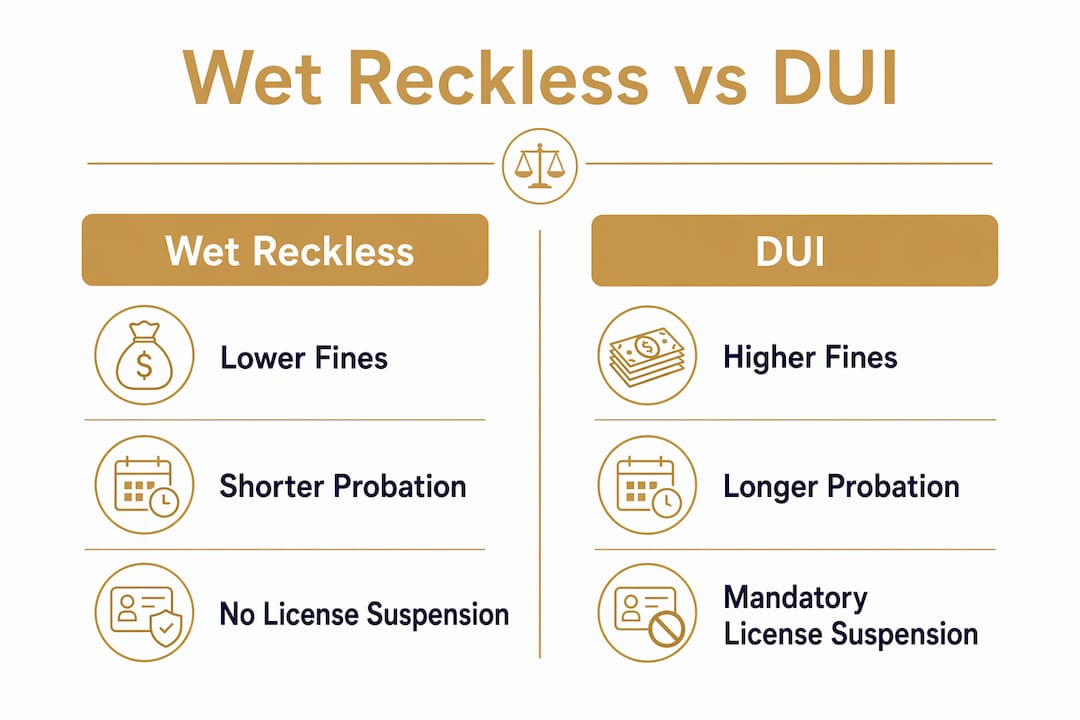
Pro Tip: A wet reckless plea avoids the automatic state-mandated license suspension that comes with a DUI conviction. However, the DMV can still impose an administrative suspension based on the original DUI arrest, independent of the court outcome.
How do wet reckless and DUI convictions affect insurance and future offenses?
Both a wet reckless and a DUI add two points to your California driving record. That matters because the DMV can suspend your license for accumulating 4 points in 12 months, 6 points in 24 months, or 8 points in 36 months. If you already have points on your record, even a wet reckless can push you into negligent operator territory.
Insurance consequences are severe either way. Auto insurance premiums rise significantly after a wet reckless conviction, often in the same range as a DUI because insurers see the alcohol notation and the driving record points. Many insurers also require an SR-22 certificate after a wet reckless, which signals high-risk status and keeps your premiums elevated for years.
The most underestimated consequence is priorability. A wet reckless counts as a prior DUI for 10 years under California law. That means if you are arrested for DUI within a decade of your wet reckless conviction, you face second-offense DUI penalties, which include mandatory jail time, longer license suspension, and a required 18-month alcohol program.
"Many defendants underestimate that a wet reckless conviction carries a 10-year legal memory. It counts as a prior DUI for future sentencing, and expungement does not erase that status for enhancement purposes."
Expungement of a wet reckless can reduce visibility on employment background checks. It does not erase the alcohol-related prior for DUI sentencing enhancements within that 10-year window. That distinction catches people off guard years after they thought the case was behind them.
What practical factors should you weigh before accepting a wet reckless plea?
Accepting a wet reckless plea is not automatically the right move. The decision depends on the specific facts of your case, your personal circumstances, and your long-term priorities. A skilled defense attorney reviews the evidence before advising you to accept or reject any offer.
Situations where a wet reckless plea tends to be strategically sound:
- Your BAC was at or just above 0.08%, making a DUI conviction at trial uncertain.
- The arresting officer made procedural errors during the stop or the chemical test.
- You have no prior DUI or alcohol-related driving history.
- You are not a commercial driver or professional license holder where any alcohol offense triggers review.
- The prosecution's evidence is weak enough that a wet reckless is the best realistic outcome short of dismissal.
Situations where you should think carefully before accepting:
- You hold a commercial driver's license (CDL). A wet reckless can still trigger CDL disqualification and licensing board review.
- You hold a professional license in medicine, law, nursing, or another regulated field. Alcohol-related driving offenses trigger licensing board scrutiny regardless of the reduced charge.
- You already have a prior wet reckless or DUI on your record within the past 10 years.
- The evidence against you is weak enough that a dry reckless or outright dismissal is achievable.
Pro Tip: A wet reckless retains the alcohol notation, which limits long-term relief despite lighter penalties. Always ask your attorney whether a dry reckless or a motion to suppress evidence is a realistic path before agreeing to any plea.
How does wet reckless compare to dry reckless and a full DUI conviction?
A dry reckless is a reckless driving conviction under Vehicle Code 23103 with no alcohol notation attached. It is the best realistic plea outcome in most DUI cases because it carries no priorable DUI status, no alcohol notation, and lesser long-term stigma. The problem is that dry reckless pleas are rarely offered. Prosecutors typically require significant evidence flaws, such as an illegal stop or a compromised breath test, before agreeing to remove the alcohol notation entirely.
Here is how the three outcomes compare across key consequences:
| Factor | Dry reckless | Wet reckless | Full DUI |
|---|---|---|---|
| Alcohol notation | None | Yes | Yes |
| Priorable as DUI | No | Yes, 10 years | Yes, 10 years |
| License suspension | No automatic suspension | No automatic suspension | Automatic suspension |
| Insurance impact | Moderate increase | Significant increase | Significant increase |
| Future offense enhancement | No | Yes | Yes |
The practical takeaway is clear. A dry reckless is the superior outcome, but it requires strong defense work to achieve. A wet reckless is the middle ground, carrying lighter immediate penalties than a DUI but sharing the same 10-year priorability and similar insurance consequences. A full DUI conviction carries the most severe penalties across every category.
Key distinctions that matter most for long-term planning:
- A dry reckless does not count as a prior DUI under any circumstance.
- A wet reckless counts as a prior DUI for 10 years, even after expungement.
- A full DUI conviction triggers automatic license suspension, mandatory minimum jail time, and longer alcohol programs.
- Both wet reckless and DUI convictions add two points to your driving record, while a dry reckless adds only one point.
If your attorney can identify a genuine path to a dry reckless or a dismissal, that path is worth pursuing aggressively. Understanding whether a DUI is a felony in your specific case also shapes how much leverage you have in plea negotiations.
Key Takeaways
A wet reckless conviction is lighter than a DUI in immediate penalties but shares the same 10-year priorable status, similar insurance consequences, and driving record points, making legal strategy critical before accepting any plea.
| Point | Details |
|---|---|
| Wet reckless definition | A negotiated plea under Vehicle Code 23103.5, not an original charge, reducing DUI to alcohol-noted reckless driving. |
| Penalty differences | Wet reckless fines run $500–$1,500 and probation lasts 1–2 years, compared to thousands in fines and 3–5 years probation for DUI. |
| 10-year priorability | A wet reckless counts as a prior DUI for a full decade, affecting sentencing on any future DUI arrest. |
| Insurance and SR-22 | Both wet reckless and DUI convictions raise premiums significantly and often trigger SR-22 requirements. |
| Dry reckless is better | A dry reckless carries no alcohol notation and no priorable status, but prosecutors rarely offer it without strong evidence flaws. |
What I've learned from watching clients accept wet reckless pleas too quickly
The wet reckless looks like a win on paper. Lower fines, shorter probation, no automatic license suspension. Clients often feel relieved when the offer comes in. That relief is understandable, but it can lead to a decision made without fully understanding what comes next.
The 10-year priorability is the detail that haunts people. I have seen clients who accepted a wet reckless in their late twenties, moved on with their lives, and then faced a second-offense DUI in their mid-thirties with mandatory jail time and an 18-month alcohol program. They had no idea the clock was still running. That outcome was preventable in some of those cases, either through a dry reckless negotiation or a stronger challenge to the original evidence.
The insurance reality is also underestimated. Carriers see the alcohol notation. They see the two driving record points. The premium increase after a wet reckless is often nearly as painful as after a DUI conviction. Clients who expected a moderate bump are sometimes shocked when their renewal arrives.
My honest view is this: a wet reckless is sometimes the right outcome, but it should never be accepted without a thorough review of the evidence, the stop, the chemical test, and the realistic alternatives. Every case has a specific set of facts. Those facts determine whether a wet reckless is a genuine win or a shortcut that costs you more in the long run.
— Jake
Facing a DUI or wet reckless charge in San Diego?
The difference between a wet reckless and a DUI conviction can follow you for a decade. Logancriminaldefense, the Law Offices of Logan Noblin, APC, has built a track record of not guilty verdicts and charge reductions for clients across San Diego facing exactly these situations.

Logan Noblin, a former "Attorney of the Year," reviews every case for evidence flaws, procedural errors, and realistic paths to reduction or dismissal. Whether you are weighing a plea offer or preparing to fight a DUI at trial, the firm's San Diego DUI defense team works to protect your license, minimize penalties, and give your case the individualized attention it deserves. Contact Logancriminaldefense for a free consultation and get a clear picture of your options before making any decision.
FAQ
What is a wet reckless charge in California?
A wet reckless is a reduced plea under California Vehicle Code 23103.5, converting a DUI charge to reckless driving with an alcohol notation. It is a negotiated outcome, not a charge prosecutors file at the start of a case.
Is wet reckless better than a DUI conviction?
A wet reckless carries lower fines, shorter probation, and no automatic license suspension, making it better in the short term. However, it shares the same 10-year priorable status as a DUI and causes similar insurance premium increases.
Does a wet reckless count as a prior DUI in California?
Yes. A wet reckless conviction counts as a prior DUI offense for 10 years under California law, meaning a subsequent DUI arrest within that period triggers enhanced second-offense penalties.
What is the difference between wet reckless and dry reckless?
A dry reckless carries no alcohol notation and does not count as a prior DUI, making it the superior outcome. A wet reckless retains the alcohol notation and shares DUI priorability for 10 years, though both avoid automatic license suspension.
Can a wet reckless affect my professional license?
Yes. Any alcohol-related driving offense, including a wet reckless, can trigger a licensing board review for holders of professional or commercial driver's licenses, potentially resulting in disciplinary action or license restrictions.