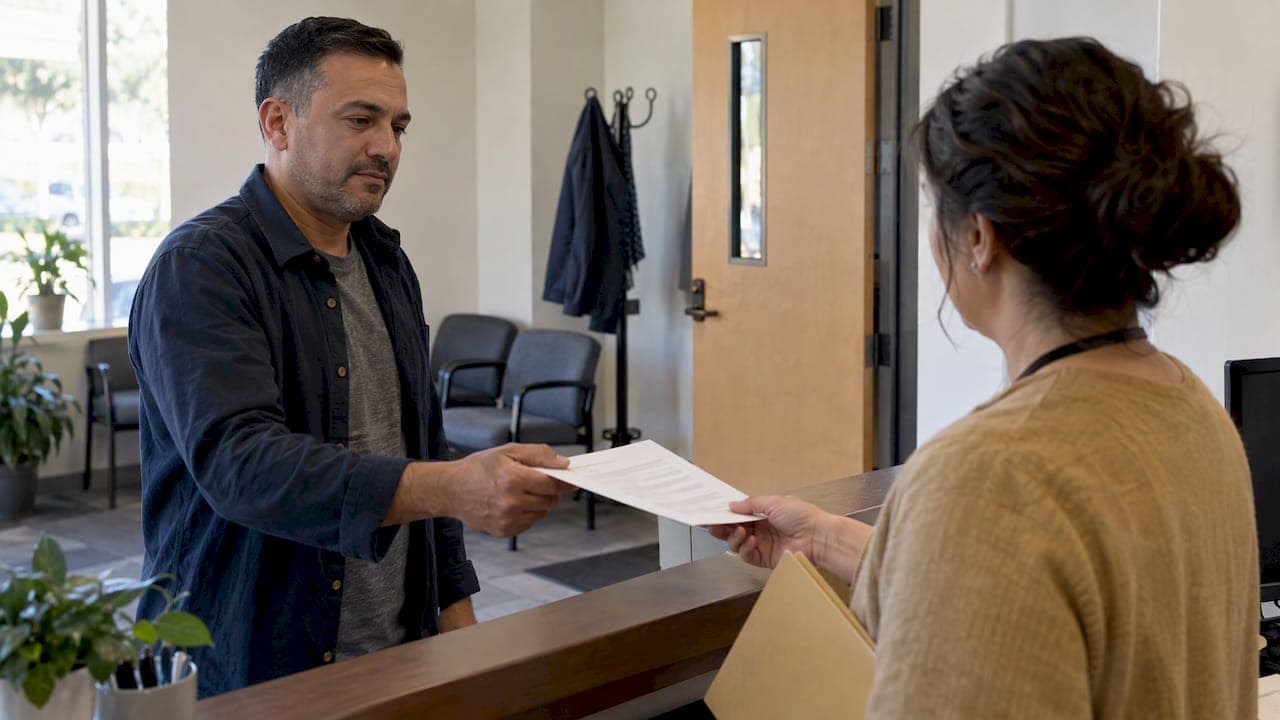
A 52-week domestic violence program, formerly known as a batterer's intervention program, is a court-ordered series of weekly two-hour group sessions that totals 104 hours over one year. The single most urgent requirement is enrolling before your deadline and attending every week, because providers report attendance directly to probation, and California law anchors this mandate in Penal Code 1203.098.
TL;DR:
- Attendance must be continuous and reported in real-time, as unexcused absences can lead to probation violations and potential revocation hearings.
- Providers must be officially approved by the county probation department and confirm their reporting procedures, with any unapproved programs risking invalid completion.
- The program involves 52 weekly sessions of at least two hours each, combining models like Duluth and cognitive-behavioral techniques, with no shorter alternatives permitted by law.
- Proper documentation of enrollment, attendance logs, and completion certificates are essential for legal proof and resolving disputes if issues arise.
- Evidence indicates that while longer programs may lower recidivism, they do not guarantee behavioral change, so compliance is primarily a legal obligation rather than a success metric.
Table of Contents
- Program structure: what weekly sessions actually look like
- The legal basis that makes 52-week BIP mandatory
- Attendance, make-up classes, and what happens if you fall behind
- Finding and verifying an approved program in your county
- When program compliance becomes a legal issue
- Who gets screened into the program and how admission works
- Counseling and victim support services alongside the program
- Your rights and responsibilities as a participant
- How programs adapt to different participants and backgrounds
- What the weekly curriculum actually covers
- Does completing the program actually reduce reoffending?
- Where to start this week
- How we help you stay in compliance and protect your probation status
- FAQ
- Sources
Program structure: what weekly sessions actually look like
Courts in California almost always order the same format: 52 consecutive weekly sessions, each running a minimum of two hours, adding up to at least 104 hours of group instruction. There is no shortcut version. A judge cannot substitute a shorter online course or a handful of private counseling sessions for the statutory structure once probation has been conditioned on completion.
Most providers build their curriculum around a mix of approaches rather than a single method. You will typically encounter elements of the Duluth model, which frames abusive behavior around power and control dynamics, alongside cognitive-behavioral techniques that target thought patterns linked to anger and conflict. Some facilitators also use motivational interviewing, a conversational style meant to build genuine engagement rather than passive compliance, which can make sessions feel less like a lecture and more like structured group discussion.
Each class usually opens with a check-in, moves into a topic-driven discussion or exercise, and closes with some form of accountability reflection. Expect homework between sessions in many programs, such as journaling or worksheets tied to the week's theme.
Documentation matters as much as attendance. A properly run program should provide:
- An enrollment confirmation letter you can show the court or probation officer.
- Weekly or monthly attendance logs tracking your sessions.
- A certificate of completion once you finish all 52 weeks.
- Written notices of any missed or rescheduled sessions.
Keep copies of everything yourself. Providers sometimes change administrative staff or lose paperwork, and your own file is the fastest way to resolve a dispute before it becomes a probation issue.
The legal basis that makes 52-week BIP mandatory
California courts derive their authority to order this program from Penal Code section 1203.098, which sets the 52-week, 104-hour, two-hour-per-week framework as the baseline for batterer's intervention when a judge conditions probation on completion. This is not a suggestion a judge can waive informally. Once probation includes this condition, finishing the program becomes a legal obligation tied directly to your probationary status, and noncompliance can trigger a violation hearing.
Batterer intervention evaluations remain genuinely mixed on long-term outcomes. A special report from the National Institute of Justice reviewed experimental studies, including programs in Broward County and Brooklyn, and found inconsistent results on reoffense rates, with some research pointing to lower recidivism in longer or higher-hour formats while other findings showed little measurable difference. That inconsistency is part of why compliance, not just participation, carries so much legal weight: courts treat documented completion as the enforceable standard regardless of how researchers debate therapeutic impact.
Counties administer this oversight at the local level. Probation departments typically publish lists of approved providers and require those providers to report attendance back to the referring probation office or court, which is how a missed class becomes visible to the system almost immediately. Requirements can differ somewhat by state, but California's statutory structure offers a clear, well-documented example of how the obligation is built and enforced.

Attendance, make-up classes, and what happens if you fall behind
Providers track attendance session by session, and most operate a limited make-up policy rather than an open one. A single excused absence, often tied to illness, work conflict, or a documented emergency, may be rescheduled within the same month, but policies vary by provider and should be confirmed in writing at intake.
If you anticipate missing a class or already have, take these steps in order:
- Notify your provider immediately, by phone and in writing if possible.
- Notify your probation officer before the missed session whenever you can, not after.
- Request a written good-cause determination rather than relying on a verbal assurance.
- Keep copies of every email, text, or letter related to the absence.
- Reschedule within whatever make-up window your provider allows.
Pro Tip: Always get absence approvals in writing, even a one-line email confirmation, because a verbal "that's fine" from a provider carries no weight at a revocation hearing.
Probation departments have flagged inconsistent absence reporting as a recurring problem, which is exactly why proactive communication between you, your provider, and your officer matters more than most participants realize. A pattern of unreported or unexcused absences can lead to a formal notice to the court, a probation revocation hearing, additional jail time, or an extension of the full 52-week clock. If you are already facing a reported violation, contact an attorney promptly and gather every piece of documentation you have before your next hearing date. Our probation violation defense team regularly steps in at exactly this stage.
Finding and verifying an approved program in your county
Not every program advertising "batterer intervention" classes is actually approved by your county's probation department, and enrolling in the wrong one wastes months you cannot get back. Start with your county probation department's website or call the clerk's office directly to request the current approved-provider list, since Riverside County and most other California counties maintain and publish one.
Before committing to intake, ask the provider these questions directly:
- Are you currently on the county's approved-provider list for batterer intervention?
- How often do you report attendance to probation, and in what format?
- What is your specific make-up policy for excused absences?
- Do you offer a sliding fee scale, and what documentation do you need to apply it?
- Can you provide written proof of enrollment the same day I register?
Treat hesitation on any of these as a warning sign. A legitimate provider will confirm approval status in writing without resistance and will have a clear, repeatable process for reporting to probation. A provider who cannot explain how or when they report attendance is a liability you do not want attached to your case.
When program compliance becomes a legal issue
Most participants never need a lawyer involved in their weekly sessions, but the moment a missed class gets reported or a provider flags a compliance problem, the stakes shift from administrative to legal. Early attorney involvement at that point can mean the difference between a quiet correction and a full revocation hearing.
A missed class is a logistics problem until probation files it as a violation. At that point it becomes a legal problem, and the documentation you kept in the first place is often what resolves it.
Specific actions taken when clients call about a compliance issue include pulling enrollment and attendance records directly from the provider, negotiating a grace period or short extension with the supervising probation officer, and appearing on their behalf at a revocation hearing if one is scheduled. For clients who complete their full 52 weeks successfully, that record also becomes useful later when petitioning for early termination of probation. We also handle related domestic violence defense matters when the underlying case itself is still open.
Who gets screened into the program and how admission works
Enrollment typically begins with an intake assessment rather than automatic admission, even when a judge has already ordered participation. Providers usually review the court order or probation referral to confirm the exact program length and conditions, then conduct a screening interview covering your criminal history, any substance use concerns, and basic risk factors tied to the underlying offense.
Some providers screen for immediate safety concerns, including active restraining orders or recent escalation, which can affect whether you are placed in a standard group or referred elsewhere first. Language needs, scheduling conflicts with work, and prior program attempts also factor into placement decisions. If you were previously terminated from a different batterer intervention program, expect that history to come up directly during intake, since many counties require disclosure of prior attempts as part of the approved-provider process.
Eligibility is rarely about whether you qualify in a competitive sense. It is about whether the provider can accommodate your court-ordered timeline and whether any disclosed risk factors require additional coordination with probation before your first session. Being upfront at intake tends to prevent delays that could otherwise look like noncompliance to the court.
Counseling and victim support services alongside the program
A 52-week batterer intervention program addresses your behavior, but it does not replace other support many participants and their families need during the same period. Many providers maintain referral relationships with individual counselors for participants dealing with underlying issues like substance use, anger outside the specific dynamics addressed in group sessions, or co-occurring mental health conditions.
Victim support services operate separately and independently of the batterer intervention program itself, which is an intentional structural separation meant to protect the safety and privacy of the other party. If a protective order is active in your case, any contact restrictions remain fully in force regardless of your program enrollment or progress, and completing your weekly sessions does not modify those terms on its own.
If your case involves children or custody matters connected to the underlying charge, coordinating with family law resources alongside your criminal case is often necessary, since the two tracks move independently but can affect each other. Ask your provider at intake what referral resources they maintain, since a program with established counseling partnerships can often get you connected faster than searching independently.
Your rights and responsibilities as a participant
You retain specific rights throughout the 52 weeks, even though attendance is mandatory. You are entitled to written confirmation of your enrollment, clear disclosure of the program's fee structure and any sliding-scale options, and a transparent explanation of how and when attendance gets reported to probation. You also have the right to request a good-cause review in writing if an absence is disputed, rather than having a provider's internal decision stand unchallenged.
Your responsibilities run in the other direction. Attending every scheduled session, arriving on time, and participating in good faith are baseline expectations, not optional extras. Providers also expect honest disclosure during intake and ongoing sessions, since the entire structure depends on accountability rather than passive attendance. Falling behind on fees, when a sliding scale has not been requested, can itself become a compliance issue in some programs, so raising financial hardship early rather than letting payments lapse protects your standing.
Keeping your own attendance records, confirmation letters, and any written correspondence with your provider is both a practical safeguard and effectively part of your responsibility as a participant, since probation will expect you to produce proof if a dispute arises.
How programs adapt to different participants and backgrounds
Batterer intervention programs serve a wide range of participants, and providers increasingly build in adaptations to make the curriculum land for different groups rather than applying one script to everyone in the room. Language access is one of the most common adaptations, with many counties requiring or encouraging providers to offer sessions in Spanish or to provide interpretation services for participants with limited English proficiency.
Some providers offer groups tailored to specific populations, including programs designed with LGBTQ+ participants in mind or groups that address cultural dynamics within particular immigrant communities, since power-and-control patterns can present differently across cultural and family structures. Military and veteran-specific considerations sometimes come into play as well, particularly where trauma history intersects with the behavior that led to the charge.
If you believe a standard group setting will not address relevant cultural or identity factors in your case, raise it directly with the provider during intake or with your attorney before enrollment, since approved-provider lists sometimes include multiple options within the same county with different specializations.
What the weekly curriculum actually covers
While exact session plans vary by provider, most 52-week curricula move through a recognizable sequence of themes over the year. Early weeks typically focus on defining abusive behavior broadly, covering physical, emotional, financial, and psychological forms, and introducing the power-and-control framework that underlies the Duluth model.
Middle weeks generally shift toward skill-building: recognizing anger triggers, practicing de-escalation techniques, and examining how cognitive distortions, meaning the thought patterns that justify or minimize harmful behavior, show up in daily conflict. Communication skills, including nonviolent communication strategies and active listening exercises, often get dedicated sessions. Many curricula also address the impact of abuse on children and family systems, even when children are not direct subjects of the underlying case.
Later weeks tend to focus on relapse prevention, accountability planning, and sometimes relationship-specific exercises if participants are preparing to reunify with a partner or co-parent. Expect repetition by design. Facilitators generally return to core concepts like accountability and the power-and-control wheel multiple times across the year, since the goal is behavioral change over time rather than one-time comprehension.
Does completing the program actually reduce reoffending?
The honest answer is that the evidence is mixed, and anyone promising a guaranteed outcome is overstating what the research supports. The NIJ special report on batterer intervention evaluations reviewed controlled studies, including experiments in Broward County and Brooklyn, and found inconsistent results: some data suggested longer or higher-hour formats correlated with lower recidivism in certain studies, while other findings showed no significant difference between program completion and reoffense rates, with researchers citing methodological limitations throughout.
What this means practically is that completion should be treated primarily as a legal and compliance milestone rather than a guaranteed behavioral cure. Courts order these programs because they represent the available structured intervention, not because the evidence proves a single clear mechanism of change. That distinction matters for how you approach the year: engaging seriously in the material may help you personally, but the immediate legal reality is that your probationary status, your record, and your path toward relief like early termination or expungement all depend on documented completion, not on researchers eventually agreeing on long-term outcome data.
Facilitators who build genuine rapport and use client-centered techniques tend to see better engagement and completion rates, even where longer-term outcome evidence stays inconsistent, which is one more reason the provider you choose matters beyond simple approval status.

Where to start this week
If you take nothing else from this, enroll before your deadline, keep your own copy of every document, and notify your probation officer the moment anything goes sideways. I have seen completed 52-week programs become strong evidence for early termination petitions and poor documentation turn a minor missed class into a revocation hearing. Call a lawyer the day you suspect a problem, not after probation files on it.
— Logan Noblin
How we help you stay in compliance and protect your probation status
A reported absence or a probation violation notice does not have to end in revocation, and we work directly with providers and probation officers to resolve these issues before they escalate into a hearing. Our domestic violence defense work includes pulling enrollment and attendance records, negotiating grace periods, and representing clients at revocation proceedings when a hearing is already scheduled.

If you completed your 52 weeks and want to explore early termination of probation or eventual expungement, we handle both as part of the same ongoing relationship, so your case file and documentation stay in one place. Reach out through our main consultation page to go over your specific probation terms and next steps.
This article is general information, not a substitute for advice from a qualified lawyer. Consult a qualified legal professional about your own circumstances before acting on anything here.
FAQ
What is a domestic violence treatment program?
A domestic violence treatment program, often called a batterer's intervention program, is a court-ordered series of weekly group sessions designed to address abusive behavior patterns and hold participants accountable. In California, it typically runs 52 weeks at a minimum of two hours per session under Penal Code 1203.098.
What is the 52-week batterer's intervention program in Riverside County?
Riverside County follows the same statutory framework as the rest of California: 52 weekly sessions totaling at least 104 hours, run through providers approved by the county probation department. Participants must enroll with a provider on the county's approved list and have attendance reported back to probation throughout the year.
How long are domestic violence classes in California?
California domestic violence classes, formally batterer's intervention programs, run for 52 weeks with sessions of at least two hours each, for a minimum of 104 total hours. This length and format is set out in Penal Code 1203.098 and applies when a court conditions probation on program completion.
What happens if I miss a class in my 52-week program?
A missed class should be reported to your provider and probation officer immediately, and you should request a written good-cause determination if the absence was excusable. Unreported or unexcused absences can lead to a probation violation notice, and in some cases a court appearance where additional consequences like a hearing or an extended program timeline are possible, as outlined in the probation violation defense process.
Do 52-week programs actually reduce domestic violence reoffending?
The evidence is mixed rather than conclusive. The NIJ evaluation of batterer intervention programs found inconsistent recidivism results across controlled studies, so completion is best understood as satisfying a legal requirement rather than guaranteeing a specific behavioral outcome.