
Domestic violence charges in California are criminal allegations involving abuse or harm between intimate partners, family members, or cohabitants, governed primarily by Penal Code 243(e)(1) and Penal Code 273.5. California's domestic violence laws cover physical violence, threats, stalking, harassment, and coercive control. The legal scope is broader than most people expect. Under Family Code 6211, protected relationships include spouses, former partners, cohabitants, dating partners, co-parents, and close relatives within the second degree. A conviction carries criminal penalties, mandatory protective orders, and long-term consequences that affect employment, custody, and immigration status.
What are domestic violence charges in California?
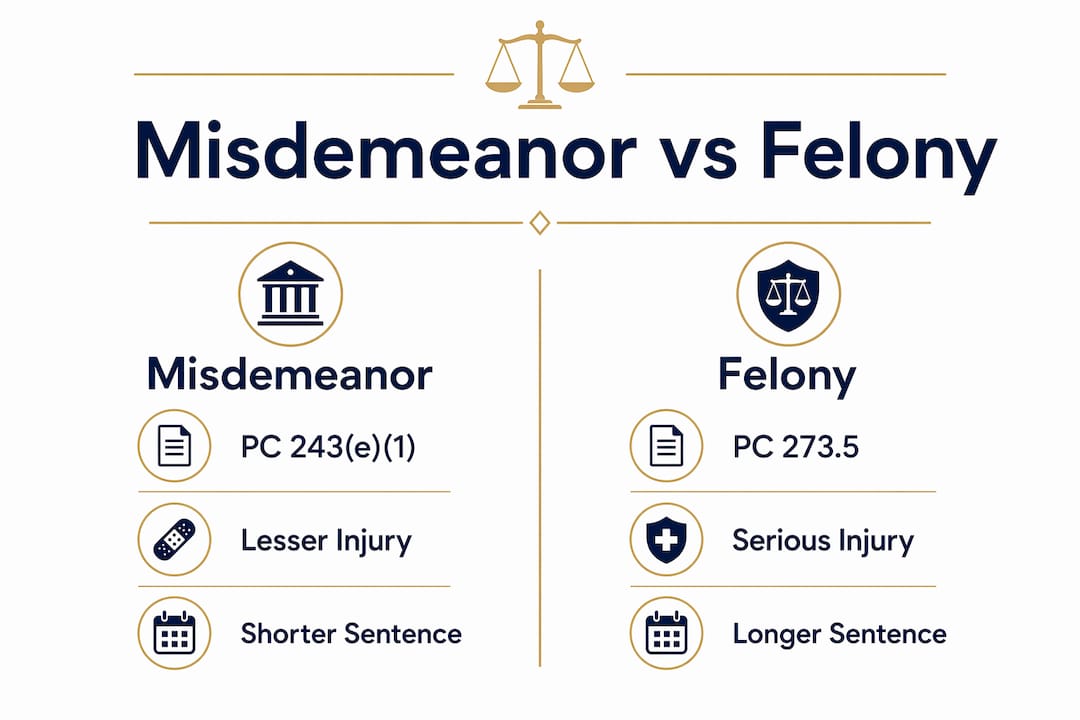
California law defines domestic violence through two primary statutes. Penal Code 243(e)(1) covers domestic battery involving minor or no visible injury. Penal Code 273.5 covers corporal injury that causes a traumatic condition and is a "wobbler" offense, meaning prosecutors can file it as either a misdemeanor or a felony.
Family Code 6203 defines abuse broadly to include non-physical actions that cause fear or disturb the peace. That definition matters because it means a threatening text message, a pattern of controlling behavior, or repeated harassment can all qualify as domestic violence under California law. Physical injury is not required for charges to be filed.
The relationships covered under these statutes are specific. The law applies to current and former spouses, cohabitants, dating partners, co-parents, and relatives within the second degree of consanguinity. If the alleged conduct occurred outside one of these defined relationships, domestic violence statutes may not apply, and the charge would fall under a different criminal category.

What are the differences between misdemeanor and felony domestic violence charges?
The distinction between a misdemeanor and a felony domestic violence charge carries enormous practical weight. A misdemeanor conviction under PC 243(e)(1) typically results in up to one year in county jail, fines, probation, and mandatory counseling. A felony conviction under PC 273.5 can result in two, three, or four years in state prison as a base sentence.
PC 273.5 is a wobbler. Prosecutorial discretion determines whether the charge is filed as a misdemeanor or felony based on injury severity, the strength of available evidence, and the defendant's criminal history. That decision happens before formal charges are filed, which is exactly why early legal intervention matters most.
Sentencing enhancements can dramatically increase exposure. A great bodily injury enhancement under PC 273.5 can push a total sentence to nine years in state prison. Use of a weapon or a prior domestic violence conviction also triggers enhancements that stack on top of the base sentence.
| Charge type | Statute | Typical sentence | Key factors |
|---|---|---|---|
| Misdemeanor domestic battery | PC 243(e)(1) | Up to 1 year county jail | Minor or no visible injury |
| Misdemeanor corporal injury | PC 273.5 | Up to 1 year county jail | Wobbler filed as misdemeanor |
| Felony corporal injury | PC 273.5 | 2–4 years state prison | Injury, prior record, evidence |
| Felony with GBI enhancement | PC 273.5 + GBI | Up to 9 years state prison | Great bodily injury documented |
Pro Tip: If you are contacted by law enforcement before charges are filed, do not make any statements without an attorney present. The pre-filing stage is the single best window to influence how a wobbler charge gets classified.
How do restraining orders intersect with domestic violence charges?
A domestic violence restraining order (DVRO) operates independently from the criminal case. Protective orders can be granted ex parte, meaning a judge issues them without the defendant present, based solely on the petitioner's declaration. The order takes effect immediately upon service.
Under Family Code 6320, a DVRO can restrain a wide range of behaviors, including:
- Physical contact or proximity to the protected person
- Harassment, threats, and surveillance
- Coercive control and disturbing the peace
- Contact through third parties
- Possession of firearms
The firearm surrender requirement is one of the most overlooked obligations. Defendants must surrender firearms within 48 hours of being served with a protective order and file proof of surrender with the court. Failure to do so is a separate criminal offense, regardless of how the underlying domestic violence case resolves.
Violating a restraining order is a criminal act on its own. A restraining order violation can result in additional charges, immediate arrest, and significant damage to your position in both the criminal and family court proceedings. The DVRO defense strategy must run parallel to, not after, the criminal defense strategy.
Pro Tip: Retain a DVRO defense attorney the moment you are served with a protective order. The hearing to contest the order typically occurs within 21 days, and that window closes fast.
What defense strategies are available against domestic violence charges?
A strong defense starts with understanding exactly what the prosecution must prove. For PC 273.5, the prosecutor must establish that the defendant willfully inflicted a traumatic condition on a person within a qualifying relationship. Each element is a potential point of attack.
The most common defense strategies include:
- Lack of intent. Domestic battery requires a willful act. If the contact was accidental, the charge fails on its face.
- Self-defense or defense of others. California law permits the use of reasonable force to protect yourself or another person from imminent harm. Documenting injuries on both parties is critical here.
- False allegations. Accusations made during contentious divorces or custody disputes are not uncommon. False domestic violence allegations require a defense built on inconsistencies in the accuser's account, witness testimony, and physical evidence.
- Unlawful arrest or evidence issues. If law enforcement violated Fourth Amendment protections during the arrest or evidence collection, that evidence may be suppressed.
- Relationship outside the statute. If the alleged victim does not fall within a qualifying relationship under Family Code 6211, domestic violence statutes do not apply.
One of the most persistent misconceptions is that a victim can drop the charges. Only prosecutors can dismiss domestic violence charges in California. Victim recantation rarely leads to dismissal because prosecutors treat it as a potential sign of intimidation. The case can and often does proceed without the victim's cooperation.
Mitigating factors do influence outcomes. The absence of visible injury, a clean prior record, voluntary enrollment in a batterer's intervention program, and demonstrated remorse all give prosecutors and judges reasons to reduce charges or impose lighter sentences. Early legal counsel is the most effective way to present those factors before the charging decision is made.
What are the long-term consequences of a domestic violence conviction?
A domestic violence conviction in California reaches far beyond the sentence itself. The criminal penalties are only the beginning of the impact on a defendant's life.
Under Penal Code 1203.097, probation for domestic violence convictions requires completion of a 52-week batterer's intervention program. Missing sessions constitutes a probation violation and can result in jail time. The program is not optional and cannot be substituted with general anger management counseling.
| Consequence | Details |
|---|---|
| Firearm prohibition | Federal law bans firearm possession after any domestic violence conviction |
| Professional licenses | Convictions can trigger review or revocation of medical, legal, and teaching licenses |
| Child custody | Courts apply Family Code 3044, creating a presumption against custody for convicted parents |
| Immigration status | Non-citizens face deportation risk; domestic violence is a deportable offense under federal law |
| Background checks | Convictions appear on criminal records and affect housing and employment applications |
The impact on child custody is particularly severe. California Family Code 3044 creates a rebuttable presumption that awarding custody to a parent convicted of domestic violence is detrimental to the child. Overcoming that presumption requires clear and convincing evidence, a high legal bar. Immigration consequences are equally serious. Domestic violence is classified as a crime of moral turpitude and a crime of violence under federal immigration law, making non-citizen defendants vulnerable to removal proceedings regardless of sentence length.
Key Takeaways
Domestic violence charges in California carry criminal penalties, mandatory protective orders, and collateral consequences that require immediate, experienced legal defense to address effectively.
| Point | Details |
|---|---|
| Two primary statutes | PC 243(e)(1) covers battery; PC 273.5 covers corporal injury and is a wobbler offense. |
| Enhancements increase exposure | A great bodily injury enhancement can push a PC 273.5 sentence to nine years in state prison. |
| DVROs operate independently | A restraining order takes effect immediately and requires firearm surrender within 48 hours. |
| Only prosecutors dismiss charges | Victim recantation does not drop a case; prosecutors control the charging decision entirely. |
| Collateral consequences are severe | Convictions affect firearm rights, professional licenses, child custody, and immigration status. |
What I've learned defending domestic violence cases in California
The single biggest mistake defendants make is waiting. They assume the victim will recant, the case will fall apart, or the situation will resolve itself. It rarely does. By the time formal charges are filed, the prosecution has already locked in its theory of the case, collected evidence, and documented injuries. The window to shape the narrative has closed.
Prosecutors in California treat domestic violence cases aggressively, and they are trained to anticipate victim recantation. When a victim stops cooperating, the prosecution often pivots to physical evidence, 911 recordings, and officer observations. A defense attorney who enters the case after charges are filed is always playing catch-up.
The other thing I see consistently is defendants underestimating the restraining order. They view it as a civil inconvenience rather than a criminal trap. Violating a DVRO, even accidentally, creates a new criminal charge and destroys credibility with the judge handling the underlying case. Compliance is not optional. It is a core part of the defense strategy.
Document everything from day one. Text messages, emails, photographs, and witness contact information all become critical later. Defendants who bring organized records to their first attorney meeting give their counsel a real advantage. Those who arrive empty-handed force their attorney to reconstruct a timeline from scratch.
The law in this area is genuinely complex. The relationship between criminal proceedings, family court, and restraining order hearings means three separate legal tracks are running simultaneously. Each one affects the others. Getting ahead of all three requires a defense attorney who handles domestic violence cases specifically, not just criminal cases generally.
— Jake
Facing domestic violence charges in San Diego
Logancriminaldefense, the Law Offices of Logan Noblin, APC, defends clients facing domestic violence charges throughout San Diego County. Logan Noblin, a former "Attorney of the Year," has secured multiple not guilty verdicts and case dismissals in domestic violence matters by building defense strategies that address the criminal case, the restraining order, and the collateral consequences simultaneously.

The firm intervenes at the pre-filing stage when possible, negotiates directly with prosecutors before charges are formally filed, and prepares aggressive trial defense when necessary. If you are facing a domestic battery or corporal injury charge, contact Logancriminaldefense for a consultation with a San Diego domestic violence lawyer who understands what is at stake and how to fight it. You can also review the full scope of criminal defense services available at the firm.
FAQ
What is the difference between PC 243(e)(1) and PC 273.5?
PC 243(e)(1) covers domestic battery with minor or no visible injury and is always a misdemeanor. PC 273.5 covers corporal injury causing a traumatic condition and is a wobbler that prosecutors can file as either a misdemeanor or a felony.
Can a victim drop domestic violence charges in California?
No. Only the prosecutor can dismiss domestic violence charges in California. Victim recantation rarely leads to dismissal because prosecutors treat it as a potential sign of intimidation and often proceed without victim cooperation.
How long does a domestic violence conviction stay on your record in California?
A domestic violence conviction remains on your criminal record permanently unless you successfully petition for expungement under Penal Code 1203.4. Expungement does not restore firearm rights or remove the conviction from certain background checks.
What happens if you violate a domestic violence restraining order?
Violating a DVRO is a separate criminal offense that can result in arrest, additional charges, and jail time. It also damages your credibility in both the criminal case and any related family court proceedings.
Does a domestic violence charge affect child custody in California?
Yes. Under Family Code 3044, a domestic violence conviction creates a rebuttable presumption that awarding custody to the convicted parent is detrimental to the child. Overcoming that presumption requires clear and convincing evidence presented in family court.