
If you're under 21 and got stopped for drinking and driving in California, you're facing California's zero-tolerance law — which means a BAC of just 0.01% triggers an automatic one-year license suspension under Vehicle Code §23136, even without a criminal conviction. Depending on your BAC and what the officer observed, you may also face charges under VC 23140 (the 0.05% rule) or the adult DUI statute, VC 23152. The single most urgent thing you can do right now: request a DMV hearing within 10 calendar days of your citation or arrest. Miss that window, and you forfeit your right to challenge the suspension entirely.
Here's what to focus on in those first 10 days:
- Keep all paperwork. The pink temporary license the officer gave you, the citation, any test results — hold onto everything.
- Write down every detail. Officer's name and badge number, what type of test was administered, the time of the stop, and anything said about your BAC reading.
- Contact a DUI attorney immediately. An attorney can file the DMV hearing request on your behalf and begin preserving evidence before it disappears.
This article is general legal information, not legal advice. Consult a qualified California attorney about your specific situation.
Table of Contents
- Which California statutes apply to under 21 DUI stops?
- What penalties can you expect for underage DUI offenses?
- How do the DMV process and criminal case work separately?
- How is BAC measured, and what happens if you refuse?
- What defenses work in underage DUI cases?
- What are the long-term consequences of an underage DUI?
- What should you do immediately after a stop or arrest?
- How long does this process take, and what will it cost?
- Key Takeaways
- Why speed matters more than people think
- Facing an underage DUI charge in San Diego? Here's how Logancriminaldefense can help
- Primary sources and further reading
Which California statutes apply to under 21 DUI stops?
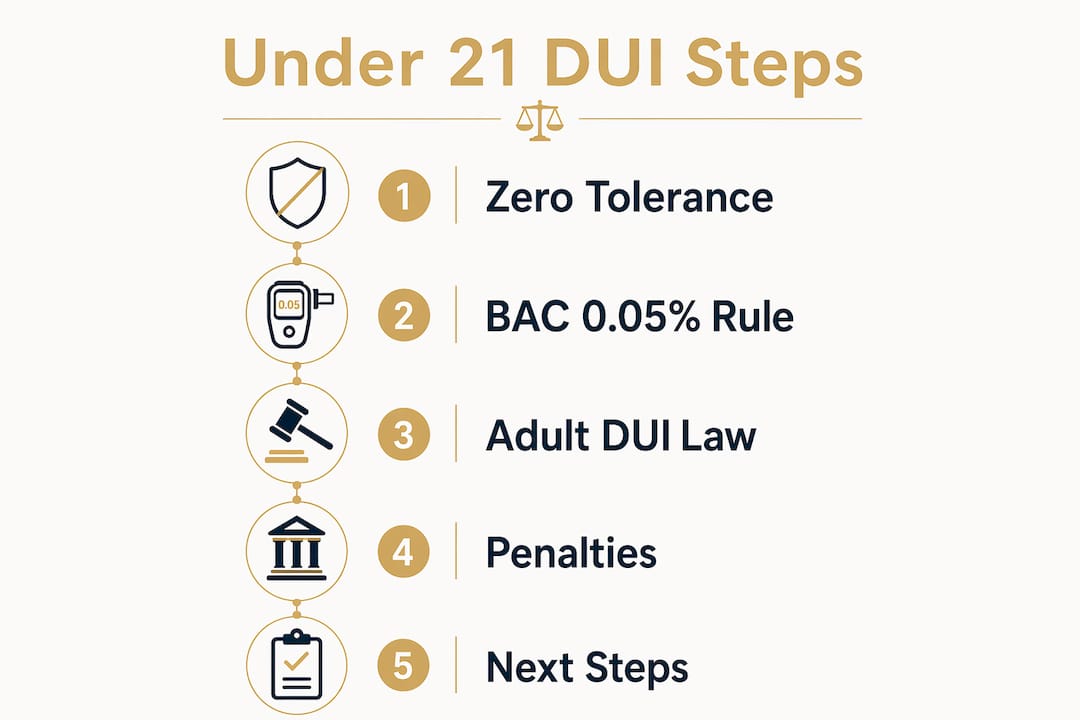
Three Vehicle Code sections commonly come into play when a driver under 21 is stopped for suspected DUI. They operate at different BAC thresholds and carry different legal consequences — and a single traffic stop can trigger more than one.
VC 23136: Zero tolerance (0.01% BAC)
California Vehicle Code §23136 makes it unlawful for any person under 21 to drive with a BAC of 0.01% or greater. This is a purely administrative violation — no criminal conviction required. A first offense carries a mandatory one-year driver's license suspension. The threshold is so low that even a small amount of alcohol from mouthwash or cold medicine could theoretically register.
VC 23140: The 0.05% rule
Vehicle Code §23140 targets under-21 drivers with a BAC of 0.05% or more. Unlike zero tolerance, this can lead to criminal DUI charges depending on the facts and testing. It sits between zero tolerance and the adult DUI standard, and it carries its own separate penalties on top of any administrative action.
VC 23152: Adult DUI statute
VC 23152 is the standard adult DUI law, and it applies to under-21 drivers just as it applies to anyone else when BAC reaches 0.08% or higher — or when the driver is impaired regardless of BAC. This is a criminal charge with steeper consequences: possible jail time, formal probation, mandatory DUI school, and a criminal record.
| Statute | BAC Threshold | Administrative vs. Criminal | Immediate Penalty | Restricted License Possible? |
|---|---|---|---|---|
| VC 23136 | ≥ 0.01% | Administrative only | 1-year license suspension | Generally no |
| VC 23140 | ≥ 0.05% | Can be criminal | Suspension + possible criminal charges | Limited circumstances |
| VC 23152 | ≥ 0.08% (or impaired) | Criminal | Arrest, booking, criminal record | Yes, with IID in some cases |
One stop can trigger all three. If your BAC comes back at 0.09%, the officer can cite you under zero tolerance, charge you under VC 23140, and book you under VC 23152 simultaneously. Each track has its own process and its own penalties.
Stat to know: Under California's zero-tolerance rule, even a 0.01% BAC reading — a level most adults would never notice — is enough to trigger a one-year administrative suspension for a driver under 21.
What penalties can you expect for underage DUI offenses?
Penalties vary by which statute applies and whether you refused chemical testing. Common outcomes include a one-year license suspension, fines, mandatory DUI education, possible vehicle impoundment, and criminal penalties if charged under VC 23152.
| Statute | License Action | Fines/Fees | Jail Risk | DUI Education | IID Required? |
|---|---|---|---|---|---|
| VC 23136 | 1-year suspension (first offense) | Administrative fees | None (civil/admin) | Not typically required | No |
| VC 23140 | Suspension + possible criminal | Fines vary | Possible | May be required | Possible |
| VC 23152 | 6 months–1 year suspension | $390 base fine (plus penalty assessments) | Up to 6 months (first offense) | 3–9 months required | Yes, in many cases |
Beyond the table, several additional consequences hit hard:
- Vehicle impoundment. The California DMV notes that under-21 drivers can face vehicle impoundment for up to 30 days — even for simply possessing alcohol in the vehicle.
- SR-22 insurance requirement. After a suspension, you'll need an SR-22 certificate filed with the DMV, which signals high-risk status to insurers and typically causes significant premium increases.
- Commercial license impact. If you hold a commercial driver's license, the consequences are more severe — a CDL DUI carries stricter federal standards and longer disqualification periods.
- Insurance rate spikes. A DUI on your record can follow you for years in the insurance market, often doubling or tripling premiums.
Age matters for how the case is handled. Drivers who are 18–20 are adults in the criminal system, so a VC 23152 conviction goes on an adult criminal record. Drivers under 18 are typically handled in juvenile court, where records are more likely to be sealed — but that protection is not automatic and depends on the offense and the court's discretion.
How do the DMV process and criminal case work separately?
DMV action is independent of the criminal case. You can win in criminal court and still lose your license if you never requested a DMV hearing. These are two parallel tracks, and both require your attention.
When an officer stops you for suspected DUI, they typically take your physical license and hand you a pink temporary driving permit. That document is valid for 30 days — and it contains the notice that triggers your 10-day clock. From the date of the citation or arrest, you have 10 calendar days to contact the DMV's Driver Safety Office and request an administrative hearing. Miss it, and the suspension becomes automatic.
What the DMV hearing actually decides:
- Whether the officer had lawful grounds to stop and detain you
- Whether you were properly advised of implied-consent obligations
- Whether your BAC was at or above the applicable threshold
- Whether the suspension should stand, be modified, or be set aside
The DMV hearing uses a preponderance of evidence standard — lower than the "beyond a reasonable doubt" bar in criminal court. That means the DMV can uphold a suspension even when a criminal jury would acquit. Conversely, winning at the DMV hearing does not mean the criminal case goes away.
DMV vs. criminal court at a glance:
- Burden of proof: DMV uses preponderance; criminal court uses beyond a reasonable doubt
- Decision-maker: DMV hearing officer (not a judge or jury)
- Outcomes: Suspension upheld, modified, or set aside; no jail at the DMV level
- Effect on the other track: DMV findings are not binding on the criminal court, but they can inform strategy
Pro Tip: File the DMV hearing request by phone, mail, or online — but get confirmation. Attorneys often file it the same day as the arrest so there's no risk of missing the deadline. The hearing itself may be weeks or months away, but the request must be in within 10 days.
Documents to bring to your DMV hearing: the citation and temporary license, any chemical test results or refusal documentation, proof of enrollment in school or employment (if arguing hardship for a restricted license), and any notes about officer conduct or test administration.
For a deeper look at contesting your suspension, the DMV hearing process at Logancriminaldefense covers what to expect and how representation changes outcomes.
How is BAC measured, and what happens if you refuse?
PAS is a preliminary breath screen used at the scene before arrest. Chemical tests — breath or blood — are administered after arrest and carry legal weight in both DMV and criminal proceedings. Refusing a post-arrest chemical test triggers an automatic one-year DMV suspension under California's implied-consent rules, separate from any DUI charge.
Here's how the three main testing methods compare:
- PAS (Preliminary Alcohol Screening) device. Handheld roadside breathalyzer. For drivers under 21, the California DMV notes that a PAS reading of 0.05% or higher triggers follow-up testing. PAS results are admissible at DMV hearings and can be used in criminal proceedings, but they're subject to accuracy challenges.
- Evidential breath test (e.g., Datamaster DMT). Administered at the station post-arrest. More accurate than PAS and the primary breath evidence used in court. Still subject to calibration and maintenance challenges.
- Blood test. Most accurate method. Blood is drawn and analyzed in a lab, and the sample can be independently retested by the defense. Chain-of-custody issues and lab protocol errors are the main attack points.
The 3-hour timing issue. California law presumes that a BAC test result reflects the driver's BAC at the time of driving if the test is taken within three hours of the stop. When there's a significant delay between the stop and the test, defense attorneys can challenge whether the result accurately reflects BAC while the person was actually driving — a concept called retrograde extrapolation. If BAC was rising at the time of driving (because alcohol hadn't fully absorbed yet), the actual BAC behind the wheel may have been lower than the test showed.
Refusal is rarely a good strategy for under-21 drivers. The automatic one-year suspension for refusal is the same length as the zero-tolerance suspension — but refusal can also be introduced as evidence of consciousness of guilt in a criminal trial. You lose the test result as a potential defense tool and gain an additional penalty.
Key figure: Under California's implied-consent law, refusing a post-arrest chemical test results in a one-year DMV suspension — the same length as a first-offense zero-tolerance suspension — with no restricted license option during that period.
What defenses work in underage DUI cases?
Common defenses focus on testing reliability, the lawfulness of the stop and detention, officer procedure errors, and the accuracy of BAC inference. A skilled attorney will investigate all of these before advising on strategy.
- Lack of reasonable suspicion or probable cause. If the officer had no lawful basis to pull you over or detain you, evidence gathered afterward may be suppressible. This applies to both the DMV hearing and the criminal case.
- Calibration and maintenance of the breath device. Breathalyzers must be regularly calibrated and maintained per California regulations. Defense counsel will subpoena calibration logs and maintenance records — a device out of spec can invalidate the result.
- Chain of custody and lab protocol errors. Blood samples must be handled, stored, and analyzed under strict protocols. Any break in the chain of custody or deviation from lab procedure is grounds to challenge the result.
- Retrograde extrapolation challenges. If there was a significant gap between driving and testing, an expert witness can testify that the BAC at the time of driving was lower than the test result suggests.
- PAS administration errors. Officers must follow specific procedures when administering a PAS test, including a 15-minute observation period. Failure to follow protocol can undermine the result's admissibility.
- Identity and possession issues. In some cases, particularly those involving possession charges, the prosecution must prove the alcohol was actually accessible to and possessed by the driver.
Defense counsel will move quickly to preserve dashcam and bodycam footage, subpoena officer records, and request independent blood retesting when applicable. Diversion programs are also a realistic outcome for first-time offenders with no prior record — particularly for under-21 defendants charged under VC 23140 rather than VC 23152. Understanding how the criminal defense process works from the start helps you make better decisions at every stage.
What are the long-term consequences of an underage DUI?
Underage DUI consequences often extend well beyond the immediate penalties and can affect college admissions, military enlistment, professional licensing, and background checks for years. Legal experts emphasize that early attorney intervention is one of the most effective ways to limit this long-term damage.
- College admissions and scholarships. Many applications ask about criminal convictions. A VC 23152 conviction may require disclosure, and some scholarship programs revoke awards upon conviction.
- Military enlistment. A DUI conviction can disqualify you from enlisting or require a waiver, depending on the branch and the severity of the offense. For active-duty service members or ROTC candidates, the stakes are even higher.
- Employment background checks. Most employers run background checks, and a DUI conviction — particularly under VC 23152 — shows up on a criminal record. Certain professional licenses (nursing, teaching, law) may be denied or delayed.
- Insurance rates. SR-22 requirements and the DUI designation on your driving record typically cause insurance premiums to spike significantly and remain elevated for years.
- Driving record visibility. A DUI conviction can remain on your driving record for 10 years in California. A DUI conviction or arrest may remain on a criminal record indefinitely unless the person pursues expungement or record-sealing where eligible.
Mitigation options worth knowing:
Drivers who are 18–20 may be eligible for expungement under Penal Code §1203.4 after completing probation, which dismisses the conviction from the public record — though it doesn't erase the DMV record or restore gun rights. Drivers under 18 handled in juvenile court have stronger record-sealing protections, but those aren't automatic. Diversion programs, where available, can result in dismissal without a conviction — the most protective outcome of all. A San Diego diversion lawyer can assess whether you qualify before you accept any plea.
What should you do immediately after a stop or arrest?
The single most important step is requesting your DMV hearing within 10 days. Everything else follows in priority order.
- Preserve all paperwork. The pink temporary license, the citation, any chemical test printouts — keep them together and don't lose them.
- Write down every detail while it's fresh. Officer's name, badge number, the time of the stop, what was said, what test was given, and the sequence of events. Memory fades fast.
- Request your DMV hearing. Call the DMV Driver Safety Office, request in writing, or have your attorney do it. Get confirmation. The deadline is 10 calendar days from the date of arrest or citation.
- Don't sign anything incriminating. You must cooperate with identification and booking requirements, but you are not required to answer questions about where you were drinking or how much you had. Politely decline and ask for an attorney.
- Contact a qualified DUI attorney right away. The earlier counsel gets involved, the more evidence can be preserved — dashcam footage, bodycam video, and calibration records all have retention limits.
- Preserve your own evidence. If you have phone video, photos, or witness contact information from the night of the stop, save it immediately and share it with your attorney.
Pro Tip: An attorney filing the DMV hearing request on day one also buys time — the temporary license stays valid until the hearing is resolved, which can extend your driving privileges by weeks or months while the case is pending. That alone is often worth the call.
Avoiding or shortening a suspension is far more likely when counsel is involved early. The guide to avoiding license suspension after a DUI in San Diego walks through the specific steps that make a difference at the DMV hearing level.
How long does this process take, and what will it cost?
DMV hearings are often scheduled weeks to months after the request is filed. Criminal cases commonly run several months to over a year, depending on whether the case resolves by plea or goes to trial.
Typical timeline milestones:
- Day of arrest. Officer issues citation, takes license, gives pink temporary permit. 10-day clock starts.
- Days 1–10. Request DMV hearing. Hire an attorney. Preserve evidence.
- Weeks 2–8. DMV schedules hearing (timing varies by county and caseload).
- Weeks 4–12. Arraignment in criminal court (first formal court appearance).
- Months 2–6. Pre-trial motions, discovery, plea negotiations.
- Months 6–18+. Trial (if no plea) or sentencing after a plea agreement.
Cost ranges to plan for:
The hidden costs of a first-time DUI in San Diego go well beyond the base fine. Here's what typically adds up:
- Base fines under VC 23152 start around $390, but California penalty assessments multiply that figure significantly — total court-imposed costs often reach several thousand dollars.
- DUI education programs (required for VC 23152 convictions) run 3–9 months and carry their own program fees.
- Vehicle impound fees accumulate daily and can reach hundreds of dollars for a 30-day hold.
- Ignition interlock device installation and monthly monitoring fees apply when required.
- SR-22 insurance filing fees and the resulting premium increases add ongoing annual costs.
- Attorney fees vary widely based on case complexity, but early representation typically reduces total costs by improving outcomes.
A VC 23136 zero-tolerance case handled purely at the administrative level costs less than a full VC 23152 criminal defense — but even administrative cases benefit from legal representation at the DMV hearing.
Key Takeaways
California's zero-tolerance law means any BAC at or above 0.01% triggers a one-year administrative suspension for drivers under 21, and missing the 10-day DMV hearing deadline makes that suspension automatic and unchallengeable.
| Point | Details |
|---|---|
| Zero-tolerance threshold | A BAC of just 0.01% triggers a one-year license suspension under VC 23136 for drivers under 21. |
| 10-day DMV deadline | You must request a DMV hearing within 10 calendar days of arrest or lose the right to challenge the suspension. |
| Refusal consequences | Refusing a post-arrest chemical test triggers an automatic one-year suspension under implied-consent law, with no restricted license option. |
| Adult DUI exposure | A BAC of 0.08% or higher can result in adult criminal charges under VC 23152, including possible jail time and a permanent criminal record. |
| Logancriminaldefense | Logancriminaldefense handles DMV hearings, criminal defense, and diversion applications for under-21 DUI cases in San Diego — contact the firm within the 10-day window for the best chance of preserving your license. |
Why speed matters more than people think
Most people who get stopped for an underage DUI spend the first few days in shock — embarrassed, scared, hoping it will somehow resolve itself. That delay is the single most damaging thing you can do to your own case.
The 10-day DMV deadline isn't a suggestion. It's a hard cutoff, and the DMV doesn't grant extensions for not knowing about it. Beyond the deadline, the evidence window closes fast, too: dashcam footage gets overwritten, officers' memories fade, and calibration records cycle out of retention. Every day without an attorney is a day the other side is building its case unopposed.
What I've seen consistently in DUI defense is that the clients who call immediately — before they've even fully processed what happened — end up with far better outcomes than those who wait a week to "see how things develop." The DMV hearing, in particular, is an opportunity most people don't realize they have. Win it, and you keep driving while the criminal case plays out. Lose it by default because you missed the deadline, and you're walking or relying on rides for a year regardless of what happens in court.
The criminal case matters too, obviously. But the license is often what people feel most immediately. Early action on both tracks is what separates a manageable situation from a year-long disruption to your life.
Facing an underage DUI charge in San Diego? Here's how Logancriminaldefense can help
When you're under 21 and facing a DUI charge in San Diego, the difference between a one-year suspension and keeping your license often comes down to what happens in the first 10 days. Logancriminaldefense, led by former "Attorney of the Year" Logan Noblin, handles exactly this: DMV administrative hearings, criminal defense under VC 23136, VC 23140, and VC 23152, and diversion program applications for eligible first-time offenders.

A first consultation typically covers your DMV hearing deadline and filing status, the specific charges you're facing and which statutes apply, realistic outcomes based on your BAC, test type, and prior record, and whether diversion or a reduced charge is a viable path. Logan's track record includes multiple not-guilty verdicts and case dismissals — and his team moves fast because the timeline demands it.
If you're within your 10-day window, don't wait. Request a consultation with Logancriminaldefense now and get the DMV hearing filed before the deadline closes your options.
Primary sources and further reading
The following sources were used in preparing this article. Primary legal texts are marked accordingly.
- California Vehicle Code §23136 (primary legal text) — Zero-tolerance law for drivers under 21; 0.01% BAC threshold and one-year suspension.
- California Vehicle Code §23140 (primary legal text) — The 0.05% rule for under-21 drivers and criminal DUI exposure.
- California DMV — Alcohol and Drugs (Drivers Under 21) (official government guidance) — PAS procedures, possession rules, impoundment, and suspension details.
- Justia — Underage DUI and Zero Tolerance Laws (legal explainer) — Overview of dual administrative and criminal tracks; 10-day hearing deadline.
- LegalClarity — Underage DUI: Laws, Penalties, and What to Expect (legal explainer) — Long-term consequences and the value of early legal intervention.
- How Long Does a DUI Stay on Your Record? (legal commentary) — Record duration, expungement eligibility, and sealing options.
- DUI Lawyers — The Law Office of John Vernon Moore, P.A. (industry resource) — Overview of DUI representation and why early counsel matters.