
California law defines self-defense as the right to use reasonable force against an imminent threat without any duty to retreat. Under self defense california law, a person who is not the initial aggressor may stand their ground in any location, public or private. Penal Code 198.5 extends this further inside the home, creating a legal presumption that a resident who uses deadly force against an unlawful intruder acted reasonably. Jury instructions CALCRIM No. 505 and No. 3470 codify these principles for every California jury. Understanding these rules before an incident occurs is the difference between a successful defense and a criminal conviction.
What are the essential legal criteria for a self-defense claim in California?
Self-defense in California requires meeting three distinct legal elements simultaneously. Courts and juries evaluate each element independently, and failing even one can defeat an otherwise valid claim.
The three required elements are:
- Reasonable belief of imminent danger. You must have genuinely believed you faced an immediate threat of death or great bodily injury. A future or speculative threat does not qualify. The belief must be one a reasonable person in the same situation would share.
- Reasonable belief that force was immediately necessary. You must have believed that using force right then was the only way to stop the threat. Waiting, calling for help, or other options must have appeared unavailable or insufficient at that moment.
- No more force than reasonably necessary. The force you used must match the level of threat you faced. Excessive or disproportionate force generally defeats self-defense claims entirely.
Proportionality is the element that trips up most people. A person who responds to a shove with a weapon has almost certainly used disproportionate force. Courts look at the totality of circumstances, including the size difference between parties, whether weapons were involved, and whether verbal threats accompanied physical action. The more clearly the force matches the threat, the stronger the claim.
California also recognizes the imperfect self-defense doctrine. If your belief in the need for deadly force was honest but unreasonable, a murder charge may be reduced to voluntary manslaughter. This doctrine does not result in acquittal, but it can significantly reduce criminal exposure when the facts are complicated.

How does the Castle Doctrine protect homeowners in California?
Penal Code 198.5 creates a rebuttable presumption that a homeowner who uses deadly force against an unlawful, forcible intruder acted out of reasonable fear. This shifts the burden of proof to the prosecution, which must then disprove the presumption beyond a reasonable doubt. That shift is a significant legal advantage.
Four conditions must all be present for Penal Code 198.5 to apply:
- The intruder is not a family member or someone with lawful permission to be in the home.
- The entry was both unlawful and forcible, meaning the intruder broke in rather than walking through an open door.
- You knew or reasonably believed the unlawful, forcible entry was occurring.
- You used deadly force against that intruder inside the residence.
The Castle Doctrine does not apply everywhere on your property. Areas like driveways, yards, or unenclosed porches do not carry the same presumption. Legal ambiguity exists around attached garages, and courts have not uniformly resolved that question. The doctrine applies strictly to the interior of the residence itself.
The presumption also disappears in certain situations. If the person you used force against had permission to be in the home, even informal permission, the doctrine does not apply. If you were engaged in criminal activity at the time, the presumption is also unavailable. Invited guests, even unwelcome ones who overstay, fall outside the doctrine's protection.
Pro Tip: If you own a home and are concerned about intruder scenarios, consult an attorney before an incident occurs. Knowing exactly where the Castle Doctrine applies on your property can prevent a catastrophic legal mistake.
What is California's stance on stand your ground and the duty to retreat?
California has no formal statutory stand your ground law. The right to stand your ground is established through decades of case law and jury instructions, not a single statute. The foundational precedent traces to People v. Estrada in 1923, and current jury instructions reflect that principle directly.
CALCRIM No. 505 and No. 3470 both state that a person who is not the initial aggressor has no duty to retreat before using force. This applies in public spaces, private property, and inside the home. The instructions tell jurors they may not penalize a defendant simply for failing to flee when retreat was possible.
The practical reality is more nuanced. Defense attorneys note that juries still consider whether a safe retreat was available when evaluating the reasonableness of using force. A person who could have walked away without risk but chose to fight instead may face a skeptical jury, even though no legal duty to retreat existed. The absence of a legal duty does not eliminate the practical weight of that choice in a juror's mind.
California's approach differs meaningfully from states with statutory stand your ground laws. States like Florida provide explicit statutory immunity from prosecution and civil suit when stand your ground applies. California provides no such immunity. A person who lawfully stands their ground in California can still be arrested, prosecuted, and sued civilly. The burden of proving self-defense falls on the defendant to raise the issue, and then on the prosecution to disprove it.
The no-duty-to-retreat rule also disappears entirely if you were the initial aggressor. Provoking a fight and then claiming self-defense when the other party responds is not a valid legal strategy in California.
What limits apply to the lawful use of force in California?
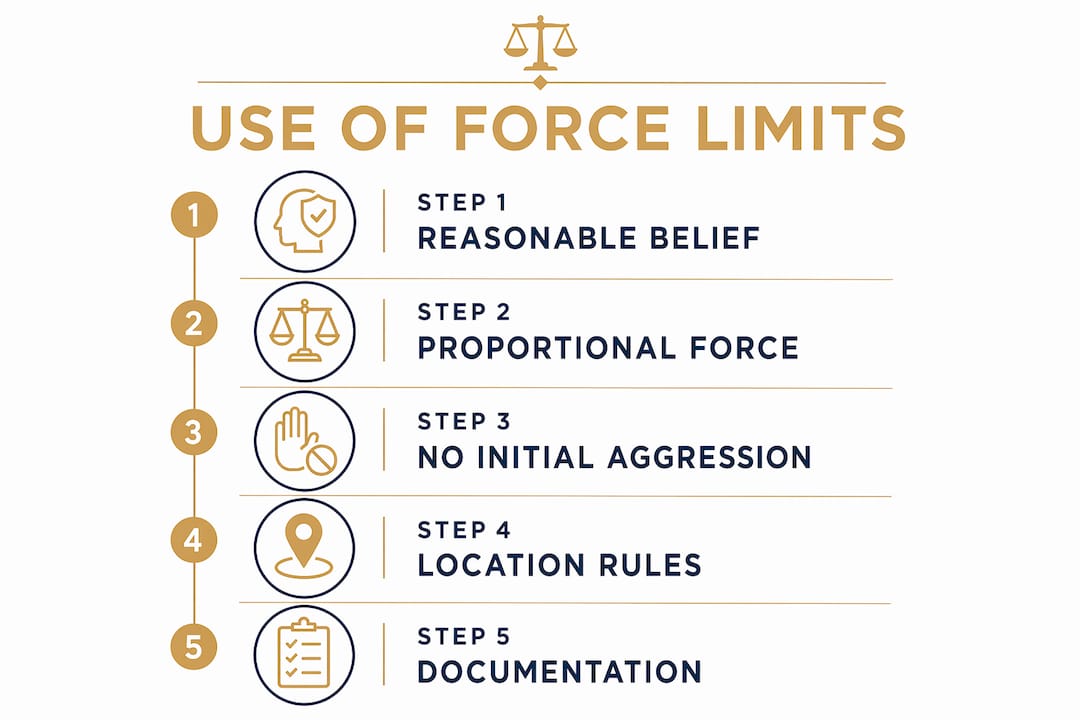
California self-defense rules impose firm boundaries on when and how force may be used. Crossing those boundaries converts a lawful act into a crime.
Key limitations include:
- Force must end when the threat ends. CALCRIM jury instructions are explicit: self-defense rights end the moment the threat disappears. Continuing to strike an attacker who is incapacitated, retreating, or no longer dangerous is a criminal act, not self-defense.
- Deadly force requires a deadly threat. Deadly force is only justified when facing death, great bodily injury, or a forcible felony. Using a firearm to stop a minor assault is disproportionate and will not be protected.
- Initial aggressors lose self-defense rights. An initial aggressor cannot claim self-defense unless they communicated a genuine, good-faith withdrawal from the fight, or the other party suddenly escalated to deadly force. Simply backing away is not enough. The withdrawal must be clear and communicated.
- No civil immunity exists. Criminal acquittal does not protect against a civil lawsuit. A person found not guilty of assault can still face a wrongful injury suit from the same incident. Civil cases use a lower burden of proof, making them a real and separate risk.
Two common pitfalls deserve specific attention. First, mistaken identity cases, where a person uses force against someone they wrongly believed was a threat, are evaluated on whether the mistake was reasonable. An unreasonable mistake defeats the claim. Second, using force after a threat has clearly ended is one of the most common reasons self-defense claims fail at trial.
Pro Tip: Document everything you can after an incident, including injuries, property damage, and witness information. This evidence directly supports the proportionality and timing elements of your claim.
How should you respond legally if you use force in self-defense?
The actions you take immediately after using force shape your legal outcome as much as the incident itself. Proper post-incident steps can heavily influence whether charges are filed and how a case proceeds.
Follow these steps:
- Call 911 immediately. Report the incident briefly and factually. State that you were attacked and used force to defend yourself. Do not narrate the full sequence of events on the call.
- Comply with police instructions. When officers arrive, follow their directions without resistance. Identify yourself and confirm you called for help.
- Request an attorney before making detailed statements. You have the right to counsel before answering substantive questions. Invoking that right is not an admission of guilt. Statements made without counsel present frequently become the most damaging evidence at trial.
- Do not alter the scene. Leave physical evidence exactly as it is. Moving objects, cleaning up, or repositioning anything can be interpreted as tampering and will damage your credibility.
- Secure experienced criminal defense representation promptly. Investigations can take weeks or months. Early involvement of qualified criminal defense counsel gives your attorney time to gather evidence, interview witnesses, and shape the narrative before charges are filed.
Understand that even a clearly justified use of force may result in an investigation. Police must determine what happened, and that process takes time. Patience and legal representation are your two most important assets in that period.
Key Takeaways
California self-defense law protects non-aggressors who use reasonable, proportionate force against imminent threats, but provides no blanket immunity from prosecution or civil suit.
| Point | Details |
|---|---|
| Three required elements | Reasonable belief of imminent danger, necessity of force, and proportionality must all be present. |
| Castle Doctrine scope | Penal Code 198.5 presumption applies only inside the residence, not yards, driveways, or porches. |
| No duty to retreat | Case law and CALCRIM instructions remove the duty to retreat, but juries still weigh retreat availability. |
| Force ends with the threat | Continuing force after an attacker is incapacitated or retreating is a criminal act under California law. |
| Civil liability survives acquittal | A criminal not-guilty verdict does not prevent a civil lawsuit from the same incident. |
Why California self-defense law rewards preparation, not assumptions
Most people who end up in a self-defense legal situation assumed they understood their rights. They had heard of the Castle Doctrine. They knew California was a no-duty-to-retreat state. What they did not know was the precise line between justified force and criminal assault, and that line is razor thin.
The Castle Doctrine is not a license to use deadly force against anyone who enters your property. It is a narrow presumption that applies under specific conditions inside your home. The no-duty-to-retreat rule does not mean juries ignore whether you could have walked away safely. These distinctions matter enormously when a prosecutor is building a case against you.
What I have seen consistently is that people who understand these rules before an incident occurs make better decisions in the moment. They stop using force when the threat ends. They call 911 first. They do not make detailed statements without counsel. Those decisions are the difference between a dismissed case and a felony conviction.
The other thing worth saying plainly: self-defense is not a get-out-of-jail-free card. Even a completely justified use of force can result in arrest, prosecution, and a civil lawsuit. The legal system requires you to prove your actions were reasonable. That proof requires evidence, witnesses, and skilled legal representation. Assuming the facts will speak for themselves is a mistake that costs people years of their lives.
Consult an attorney before you need one. Understand the specific rules that apply in your home, on your property, and in public. And if you ever use force in self-defense, treat the legal aftermath with the same seriousness as the physical incident itself.
— Jake
Facing a self-defense charge in San Diego?
Self-defense cases move fast. Prosecutors build their narrative from the first 911 call, the first police report, and the first statement you make. Having experienced legal counsel in your corner from the start changes the outcome.

Logancriminaldefense, the Law Offices of Logan Noblin, APC, handles San Diego criminal defense cases involving self-defense claims, assault charges, domestic violence allegations, and related offenses. Logan Noblin, a former "Attorney of the Year," has secured multiple not-guilty verdicts and case dismissals for clients across San Diego County. His team understands California self-defense rules at the trial level, where the details that matter most come out. Early consultation gives your case the best possible foundation.
FAQ
What are the three elements of self-defense in California?
California requires a reasonable belief of imminent danger of death or great bodily injury, a reasonable belief that force was immediately necessary, and use of no more force than reasonably necessary. All three elements must be present for a valid claim.
Does California have a stand your ground law?
California has no formal stand your ground statute. The right to stand your ground is established through case law dating to 1923 and reflected in jury instructions CALCRIM No. 505 and No. 3470, which state non-aggressors have no duty to retreat.
Where does the Castle Doctrine apply in California?
Penal Code 198.5 applies strictly inside the residence. Yards, driveways, and unenclosed porches do not carry the same legal presumption, and legal ambiguity exists around attached garages.
Can you be sued after a justified self-defense incident in California?
Yes. California provides no civil immunity for self-defense actions. A criminal acquittal does not prevent the other party from filing a civil lawsuit, which uses a lower burden of proof than a criminal trial.
What should you do immediately after using force in self-defense?
Call 911, comply with police instructions, and request an attorney before making any detailed statements. Do not alter the scene, and secure experienced criminal defense representation as quickly as possible.