
A California probation violation happens when you fail to follow a court-ordered condition, whether by missing a check-in, failing a drug test, or picking up a new arrest. You can be taken into custody, but California law also gives you a strong path to release and mitigation before your hearing. The single best move right now is to confirm whether a warrant exists and call a defense lawyer today.
TL;DR:
- Most probation violations in California are technical, such as missed check-ins or unpaid fines, which often do not lead to automatic revocation unless willful.
- Arrests for new offenses significantly increase the likelihood of stricter bail conditions or custody, especially if the new case involves violence or drugs.
- The prosecution only needs to prove a violation by a preponderance of the evidence, making swift, documented defenses crucial before the hearing.
- Possible judicial responses include reinstating probation, modifying conditions, extending supervision, or revoking to impose the original sentence; outcomes depend on prior compliance.
- Acting quickly to gather records and confirm warrants can prevent custody and improve chances of mitigating penalties before formal court action.
Table of Contents
- What Counts as a Probation Violation in California?
- How Do Probation Violations Get Discovered and Reported?
- What Happens at a Probation Revocation Hearing?
- What Penalties Can a Judge Impose for a Violation?
- How Do You Build a Defense Against a Probation Violation?
- How San Diego Attorneys Handle Probation Violation Cases
- Why Speed and Documentation Change Outcomes
- How Logan Noblin, APC Handles Warrants and Probation Cases
- Sources
- FAQ
What Counts as a Probation Violation in California?
California courts split violations into two categories, and the difference shapes everything about your case. A technical violation means you broke a rule of supervision without committing a new crime. A substantive violation means the new conduct is itself a criminal offense, which usually draws a harsher response from the judge.
Common technical violations include:
- Missing a scheduled check-in with your probation officer
- Failing or skipping a court-ordered drug or alcohol test
- Traveling outside the county or state without permission
- Falling behind on court-ordered classes, community service, or treatment
- Failing to pay fines or restitution
That last one deserves a closer look. Courts cannot revoke probation solely for nonpayment unless the failure to pay was willful, according to FindLaw's explainer on probation violations. If you lost your job or had a medical emergency, that is an ability to pay problem, not defiance, and a judge is required to consider the difference before ordering custody time over unpaid fines.
A new arrest is treated differently than a missed appointment. Judges tend to view an arrest for a new offense, especially a violent or drug-related one, as evidence you cannot be trusted on supervision, even before that new case is resolved.
How Do Probation Violations Get Discovered and Reported?
Violations surface in three main ways: a probation officer's routine report, a new police arrest, or a tip that reaches the court through victim or third-party reporting. Once a violation is alleged, California law gives officers real authority to act fast, and it gives you real protections in return.
- Rearrest without a warrant. Penal Code §1203.2 lets a probation officer or any peace officer rearrest you without a warrant if there's probable cause to believe you broke a condition of supervision. You do not need to be convicted of anything new for this to happen.
- Release standards apply immediately after arrest. Under Penal Code §1203.25, misdemeanor probationers generally must be released on their own recognizance unless the prosecution shows clear and convincing evidence that conditions are necessary. Felony probationers can be held only when no reasonable release conditions would protect the public or guarantee your appearance in court.
- New charges change the calculus. A fresh arrest tends to push judges toward stricter release conditions, since the court is now weighing both the alleged violation and a separate pending case.
Courts are required to make an individualized assessment of public safety and flight risk rather than applying a blanket rule, according to the release standards under §1203.25. That means your job, housing stability, and family ties genuinely matter at this stage. Before anything else, check the county court's online docket or call the clerk's office to confirm whether a bench warrant has actually been issued. Acting on rumor, or worse, doing nothing, wastes the narrow window you have to get ahead of the situation.
What Happens at a Probation Revocation Hearing?
A revocation hearing is not a criminal trial, and the rules are noticeably looser than what you'd expect from television courtroom drama. You'll typically receive written notice of the alleged violation and a hearing date, though timelines vary by county and by whether you're in custody.
The biggest procedural difference is the burden of proof. Prosecutors only need to prove a violation by a preponderance of the evidence, meaning "more likely than not," rather than the "beyond a reasonable doubt" standard used at trial, according to FindLaw. That lower bar makes revocation hearings genuinely harder to win outright, which is exactly why the evidence you bring matters so much.
At the hearing, expect the following:
- The probation officer or prosecutor presents reports, test results, or arrest records supporting the alleged violation.
- Hearsay evidence, like a written probation report, is often admissible in ways it would not be at a jury trial.
- You have the right to present witnesses, documentary proof, and to cross-examine the officer's evidence.
- Enrollment in treatment or a compliance program before the hearing can directly influence the judge's disposition.
Pro Tip: Bring your defense packet even to a preliminary or informal court date. Judges frequently make quick calls on whether to keep you in custody before the formal hearing, and documentation in hand can shift that decision immediately.
Because the standard of proof favors the prosecution, your strongest strategy is often not to argue the violation never happened, but to show context: a missed test caused by a documented medical appointment, a late payment caused by job loss, a technical slip that doesn't reflect a pattern of noncompliance.
What Penalties Can a Judge Impose for a Violation?
Judges have a wide menu of options once a violation is found, and revocation to jail time is the most severe, not the automatic, outcome. Rule 4.435 of the California Rules of Court directs judges to weigh the nature of the violation against your past performance on supervision before choosing a disposition.
Possible outcomes include:
- Reinstating probation on the same terms, often after a minor or first-time technical slip.
- Modifying conditions, such as adding more frequent testing, a curfew, or a treatment requirement.
- Extending the supervision period without sending you into custody.
- Revoking probation and imposing the underlying sentence, which can mean jail time that was originally suspended.
A judge weighing these options under Rule 4.435 will look closely at how you performed on probation before this incident. Someone with a clean record who missed one appointment due to a documented emergency stands in a completely different position than someone with three prior violations. Rule 4.414 lists the broader criteria, including your willingness to comply, your ties to the community, and whether the violation reflects a pattern.
Failure to pay fines or restitution, standing alone, generally cannot justify revocation unless the court finds the nonpayment was willful. That protection matters because financial hardship is one of the most common reasons people fall behind on court-ordered payments in the first place.
How Do You Build a Defense Against a Probation Violation?
Speed and documentation win these cases more often than clever legal arguments. The moment you learn about an alleged violation, or suspect one might be coming, start assembling proof that contradicts or explains it.
- Build a one-page timeline. List every check-in, test, payment, and class attendance date next to the actual court-ordered schedule, so gaps and compliance are both visible at a glance.
- Gather documentary evidence. Pull payment receipts, treatment or testing records, employer or school verification letters, and copies of your written probation conditions.
- Challenge administrative errors early. Missed notices, clerical mistakes, and mixed-up court dates happen more often than people expect, and they can invalidate the basis for a violation claim entirely.
- Show immediate corrective action. Enrolling voluntarily in treatment or catching up on payments before the hearing signals good faith to the judge.
- Move to recall the warrant when appropriate. If a warrant has been issued, your attorney can request a recall or seek release under §1203.25 rather than waiting for a formal arrest.
Pro Tip: Keep every piece of paperwork related to your probation in one folder from day one, not just after trouble starts. Reconstructing a compliance history after the fact is far harder than handing a judge a folder that already tells the story.
A defense packet built along these lines does two things at once: it makes an administrative mistake easy to spot, and it makes a genuine violation look like an isolated event rather than a pattern the court needs to punish.
How San Diego Attorneys Handle Probation Violation Cases
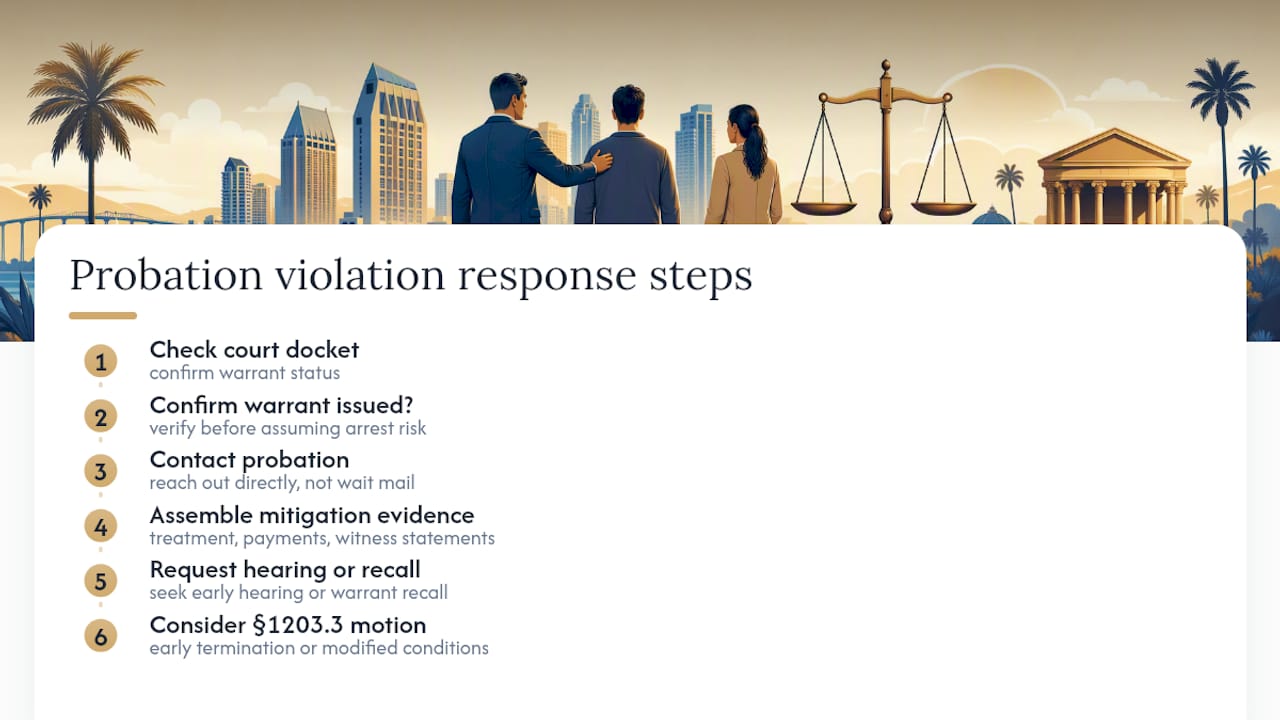
When someone calls about an alleged probation violation, the first move is always the same: check the docket and confirm whether a warrant has actually been issued, then contact the probation department directly. That single step often resolves confusion faster than waiting for a mailed notice.
From there, the work is assembling mitigation evidence quickly, treatment enrollment confirmations, payment records, witness statements, and requesting an early hearing or warrant recall before custody becomes an issue. When a client's compliance has been strong overall, filing a §1203.3 motion for early termination or modified conditions is often the better long-term move than simply fighting the current allegation. Logan Noblin has built this firm's DUI probation violation practice around exactly this kind of fast, documented response, and every consultation starts with a clear read on where the case actually stands.
Why Speed and Documentation Change Outcomes
Delay is the single biggest risk factor in a probation violation case. Every day between an alleged violation and your first documented response is a day the court sees no counter-narrative, only the officer's report.
Cases with the best outcomes almost always share one trait: the person showed up with proof, not excuses. A client who missed one drug test because of a documented ER visit, and who had that record in hand at the hearing, walked away with reinstated probation instead of a revocation. That gap between silence and a folder of receipts is often the entire case.
Preserve every record now, even if you think you'll never need it. Then call a lawyer before the court calls you.
— Jake
How Logan Noblin, APC Handles Warrants and Probation Cases
Getting a probation violation notice, or worse, finding out a warrant already exists, is the kind of problem that gets worse the longer it sits unaddressed. Logan Noblin, APC built its warrants and probation defense practice around the exact urgency this situation demands: same-day docket checks, direct contact with probation departments, and mitigation packets built to be in front of a judge before custody becomes the default outcome.

If you're facing an alleged violation, bring what you have to your first call: your case number, a copy of your written probation conditions, any notices you've received, and whatever treatment, testing, or payment records you can find. Extensive experience in DUI defense, drug crime cases, and diversion program advocacy provides insight into how these allegations progress from arrest through resolution, and how a well-documented response can influence a judge's decision. Reach out through the firm's main contact page to schedule a consultation and get a straight answer on where your case stands before your next court date.
Sources
The rules governing California probation violations come from a small set of statutes and court rules worth bookmarking directly. Penal Code §1203.2 covers rearrest and revocation authority. Penal Code §1203.25 governs release standards after arrest. Penal Code §1203.3 addresses modification and early termination. Rule 4.435 guides sentencing dispositions on revocation, and Rule 4.414 lists the criteria courts weigh when granting or continuing probation. For a plain-language overview, FindLaw's probation violation guide is a solid starting point before you talk to a lawyer.
This article is general information, not a substitute for advice from a qualified lawyer. Consult a qualified legal professional about your own circumstances before acting on anything here.
- California Penal Code §1203.2 — Legislative Information
- California Penal Code §1203.25 — Justia
- California Rules of Court, rule 4.435 — Judicial Branch of California
- Probation violation — FindLaw
FAQ
What Happens if You Violate Probation in California?
You can be rearrested without a warrant under Penal Code §1203.2, and a judge can continue, modify, extend, or revoke your probation at a hearing. The outcome depends heavily on whether the violation was technical or involved a new criminal offense, plus your history of compliance.
How Long Will I Go to Jail for Violating Probation?
There is no fixed jail term for every violation. If a judge revokes probation, they can impose the originally suspended sentence, but Rule 4.435 requires the court to weigh the violation's seriousness and your past supervision performance before deciding, and many violations result in modified conditions rather than custody at all.
Can You Get a Probation Violation Dropped?
Yes, especially when the violation stems from an administrative error, a documented emergency, or an inability to pay rather than willful noncompliance. Presenting a clear defense packet, timeline, records, and proof of corrective action, can lead a judge to dismiss the allegation or simply reinstate probation.
Do You Go Straight to Jail if You Violate Probation?
Not necessarily. Under Penal Code §1203.25, misdemeanor probationers are generally released on their own recognizance unless the prosecution shows clear and convincing evidence that conditions are needed, and felony probationers can only be held when no reasonable release conditions would work. Getting a probation violation attorney involved quickly gives you the best shot at avoiding custody before the formal hearing.