
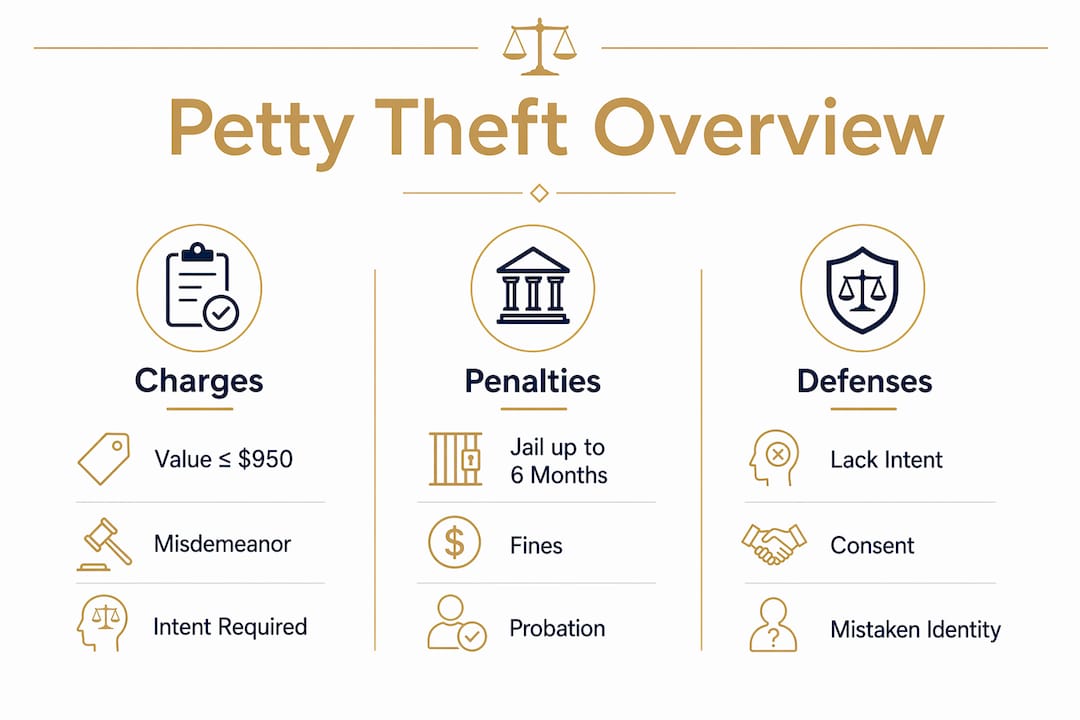
Petty theft in California is defined as the unlawful taking of property valued at $950 or less, classified as a misdemeanor under Penal Code 488. A conviction carries up to 6 months in county jail, fines up to $1,000, probation, and community service. What most people facing a petty theft charge do not realize is that the real danger is not the jail time. The lasting damage to your employment record, immigration status, and professional licenses can follow you for decades. Understanding the full scope of California theft laws is the first step toward protecting your future.
What are the legal criteria for petty theft in California?
Petty theft is not simply "taking something." California law requires the prosecution to prove four specific elements before a conviction is possible.
Under CALCRIM No. 1800, the standard jury instruction for theft by larceny, the prosecution must prove all of the following:
- You took property that belonged to someone else
- You did not have the owner's consent
- You intended to permanently deprive the owner of the property
- You moved the property, even a very short distance
Every element must be proven beyond a reasonable doubt. If even one element is missing, the charge cannot stand.
Common scenarios that lead to charges
Shoplifting is the most frequent basis for a petty theft charge in California. Other common situations include theft of services, such as skipping out on a restaurant bill, and minor employee theft, such as taking cash from a register. The value of what was taken determines whether the charge is petty theft or the more serious grand theft.

The fair market value at the time and place of the theft controls the calculation. If the total value of items taken in a single scheme exceeds $950, even across multiple incidents, prosecutors can aggregate those amounts and charge grand theft instead. That aggregation rule catches many defendants off guard, particularly in employee theft cases where small amounts were taken repeatedly over time.
Pro Tip: If you are accused of taking multiple items on separate occasions, speak with a California theft attorney immediately. Prosecutors often aggregate values to push a case into grand theft territory, which carries far harsher penalties.
What penalties can result from a petty theft conviction?
A petty theft conviction in California produces two categories of consequences: the direct sentence imposed by the court and the collateral consequences that follow you afterward.
Direct sentencing outcomes
The standard misdemeanor penalties for petty theft include:
- Up to 6 months in county jail
- Fines up to $1,000
- Informal probation, typically 1–3 years
- Community service hours
- Mandatory restitution to the victim
Judges have discretion in sentencing, and first-time offenders often avoid jail time. Repeat offenders face a different reality.
Enhanced penalties for repeat offenders
Multiple prior theft convictions can elevate a petty theft charge to felony theft. A felony conviction carries substantially longer jail or prison terms and permanently alters your legal status. This escalation is one of the most underappreciated risks in California theft law.
Collateral consequences that outlast the sentence
A petty theft conviction impacts employment, immigration status, and professional licensing long after the sentence ends. Employers routinely screen for theft convictions. Professional licensing boards for nursing, real estate, and law treat theft convictions as grounds for denial or revocation. For non-citizens, even a misdemeanor theft conviction can trigger deportation proceedings or denial of a green card. These consequences make avoiding a conviction far more important than minimizing jail time.
What defenses exist against a petty theft charge?
The strongest defenses attack the prosecution's ability to prove every required element. If the prosecution cannot establish intent, consent, or identity, the charge fails.
Lack of intent to permanently deprive
Prosecutors must prove intent beyond a reasonable doubt. Borrowing an item with the intention of returning it is not theft under California law. This defense applies when you genuinely believed you had permission to take the item temporarily. The key is establishing that your state of mind at the time did not include permanent deprivation.
Consent or permission
If the owner gave you permission to take the property, no theft occurred. Consent negates the charge entirely. This defense is most effective when there is a prior relationship between the parties, such as a coworker, family member, or employer, where permission was reasonably implied or explicitly granted.
Mistaken identity and property ownership disputes
Retail theft accusations sometimes involve misidentification by store employees or surveillance footage that is unclear. If you genuinely believed the property was yours, or if the identification is questionable, these are viable defense angles. A skilled San Diego theft attorney can challenge the evidence used to identify you as the person who took the property.
Pro Tip: Do not speak to law enforcement without an attorney present. Anything you say about your intent or actions can be used to fill gaps in the prosecution's case.
Why legal representation changes outcomes
Defenses to theft charges are highly fact-specific. The difference between a dismissed case and a conviction often comes down to how effectively your attorney challenges the prosecution's evidence. Logancriminaldefense has secured multiple not guilty verdicts and case dismissals in theft and property crime cases across San Diego.
How can a petty theft charge be mitigated or resolved?
Several legal pathways exist to reduce the impact of a petty theft charge or avoid a conviction entirely. The right option depends on your criminal history, the facts of the case, and how early you engage an attorney.
-
Plea bargain to a lesser charge. Prosecutors often agree to reduce a petty theft charge to an infraction or a non-theft offense, such as disturbing the peace, in exchange for a guilty plea. This avoids a theft conviction on your record entirely and eliminates most collateral consequences.
-
Diversion programs. California offers diversion programs for eligible defendants. Completing a diversion program, which typically includes theft awareness classes and community service, results in the charge being dismissed. No conviction appears on your record.
-
Restitution agreements. Paying restitution to the victim before sentencing signals accountability to the court. Judges frequently reduce sentences or grant probation in cases where full restitution has been made.
-
Theft awareness classes. Completing a theft prevention education course before sentencing demonstrates good faith. Courts treat this as a mitigating factor, particularly for first-time offenders.
-
Expungement after conviction. California allows eligible defendants to have misdemeanor theft convictions removed from their records under certain conditions. Eligibility requires completing your sentence and having no pending charges. Expungement does not erase the record entirely, but it allows you to legally state you were not convicted in most employment contexts.
Early legal counsel is the single most important factor in accessing these options. Plea negotiations and diversion eligibility close quickly once the case moves forward.
Key Takeaways
Avoiding a petty theft conviction in California requires understanding the charge, its consequences, and the defenses available before the case progresses.
| Point | Details |
|---|---|
| $950 value threshold | Property valued at $950 or less is petty theft; anything above becomes grand theft. |
| Four required elements | Prosecution must prove taking, lack of consent, intent to permanently deprive, and movement of property. |
| Collateral consequences | A conviction affects employment, immigration status, and professional licenses, often more than the sentence itself. |
| Repeat offender risk | Multiple theft convictions can elevate petty theft to a felony with significantly harsher penalties. |
| Mitigation options | Diversion programs, plea bargains, restitution, and expungement can reduce or eliminate the impact of a charge. |
What I have learned from watching defendants underestimate petty theft charges
Most defendants who walk into a petty theft case think the charge is minor. They assume a first offense means a slap on the wrist and that the whole thing will disappear. That assumption is the most expensive mistake they make.
The real risk in a petty theft case is not the 6 months of potential jail time. It is the theft conviction that sits on your record for life unless you take deliberate steps to remove it. I have seen nurses lose their licenses, non-citizens face deportation proceedings, and job applicants get screened out of positions they were otherwise qualified for, all because of a misdemeanor theft conviction they thought was behind them.
The other misconception I see constantly is that defendants wait too long to get an attorney. Diversion programs have eligibility windows. Plea negotiations happen early. By the time someone decides to take the charge seriously, the best options are already off the table. Getting a criminal defense attorney involved at the earliest stage is not about spending money. It is about keeping options open.
My honest advice: treat a petty theft charge with the same urgency you would treat a felony. The label says misdemeanor, but the consequences do not.
— Jake
Facing a petty theft charge in San Diego? Logancriminaldefense can help.
Logancriminaldefense, the Law Offices of Logan Noblin, APC, has built a track record of not guilty verdicts and case dismissals across theft and property crime cases in San Diego. Logan Noblin, a former "Attorney of the Year," brings both aggressive advocacy and a clear understanding of how to protect clients from the long-term consequences of a theft conviction.

Whether you are facing a first-time shoplifting charge or a more complex theft allegation, the firm offers personalized case evaluations and strategic defense planning from day one. The San Diego criminal defense team at Logancriminaldefense works to identify every available defense, diversion option, and mitigation strategy specific to your situation. Contact the firm to schedule your consultation and understand exactly where you stand.
FAQ
What is the difference between petty theft and grand theft in California?
Petty theft involves property valued at $950 or less and is charged as a misdemeanor. Grand theft applies to property worth more than $950 and carries significantly harsher penalties, including potential felony charges.
How long does a petty theft conviction stay on your record in California?
A petty theft misdemeanor stays on your record for life unless you petition for expungement. Expungement eligibility requires completing your sentence and having no pending criminal charges.
Can a petty theft charge affect my immigration status?
A petty theft conviction can trigger serious immigration consequences, including deportation or denial of a green card, even for a misdemeanor. Non-citizens facing theft charges should consult a California theft attorney immediately.
What happens if I am charged with petty theft for the second time?
Repeat theft convictions can result in enhanced penalties, and multiple prior convictions can elevate a petty theft charge to felony theft. A felony carries longer incarceration and far greater collateral consequences than a misdemeanor.
Can I avoid a conviction through a diversion program?
California offers diversion programs for eligible defendants that result in charge dismissal upon completion. Eligibility depends on your criminal history and the specifics of your case, so early legal counsel is critical to accessing this option.