
California Penal Code §273.6 makes it a crime to knowingly and intentionally violate a qualifying protective or restraining order. A single violation can result in arrest, criminal charges, and consequences that reach far beyond the courtroom.
Here is what happens immediately:
- Arrest and criminal charges. Police can arrest you on the spot, and the district attorney may file misdemeanor charges. In some circumstances, the charge carries mandatory minimum jail time.
- Elevated penalties for injury or repeat offenses. If the violation causes physical injury, or if you have a prior conviction within seven years, the penalties increase significantly, and felony sentencing becomes possible.
- Firearms, probation, and family-court fallout. A conviction can strip your right to own or possess firearms, trigger probation conditions under Penal Code §1203.097, and prompt a family court to modify custody or visitation.
The full statute text is available at the California Legislative Information page for §273.6. If you are charged, contact a criminal defense attorney before making any statements to police.
This article provides general legal information, not legal advice. Consult a qualified attorney for guidance specific to your situation.
Table of Contents
- What does PC 273.6 actually say?
- What must the prosecution prove to convict you?
- What are the penalties for a PC 273.6 conviction?
- What defenses work in PC 273.6 cases?
- How does enforcement typically unfold?
- Consequences beyond the criminal case
- What conduct actually counts as a violation?
- How does PC 273.6 differ from related statutes?
- What should you do immediately if you're accused?
- How experienced defense counsel approaches PC 273.6 cases
- Key Takeaways
- Why local criminal-defense counsel matters for these cases
- Facing a PC 273.6 charge? Here is how Logancriminaldefense can help
- Primary sources and further reading
What does PC 273.6 actually say?
Penal Code §273.6 is the statute California uses to criminally punish violations of protective and restraining orders. The core provision, subdivision (a), reads:
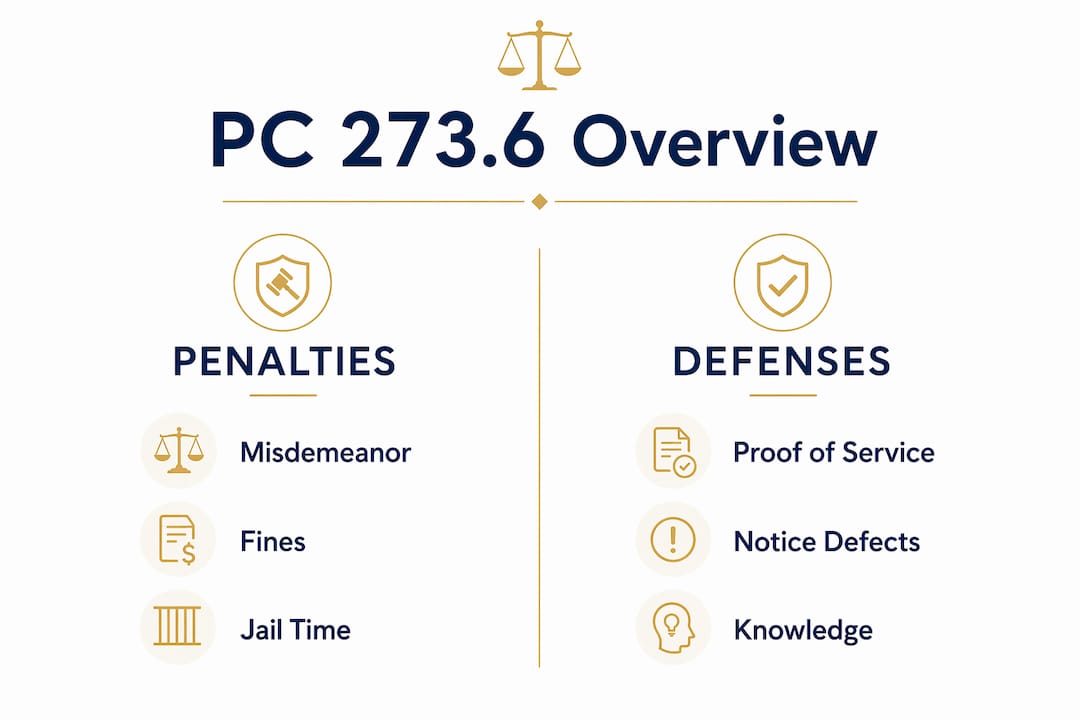
The subdivisions that follow layer on enhanced penalties, repeat-offense rules, and probation conditions. Here is how the key subdivisions break down:
| Subdivision | What it covers | Core consequence |
|---|---|---|
| (a) | Basic knowing, intentional violation | Misdemeanor; up to $1,000 fine and/or up to 1 year county jail |
| (b) | Violation resulting in physical injury | Up to $1,000 fine; 30-day minimum jail (up to 1 year); court may reduce if 48 hours served |
| (d) | Repeat conviction within seven years involving violence or credible threat | Up to 1 year county jail or felony sentencing under PC §1170(h) |
| (e) | Repeat conviction within 1 year where prior resulted in physical injury | 6-month minimum jail (up to 1 year) or felony; court may reduce if 30 days served |
| (g) | Owning, possessing, purchasing, or receiving a firearm while prohibited by the order | Punished under PC §29825 |
| (h)/(i) | Probation conditions and payment obligations | Payments up to $5,000 to DV shelter programs; restitution; ability-to-pay determination required |
Which orders qualify? Subdivision (c) specifies the covered orders:
- Orders issued under Family Code §§6320 or 6389 (domestic violence restraining orders)
- Orders excluding a party from a family dwelling or the other party's dwelling
- Orders enjoining specified behavior the court found necessary to effectuate the protective order
- Out-of-state orders recognized under Family Code Part 5 (§§6400 et seq.)
Civil harassment orders under Code of Civil Procedure §527.6, workplace violence orders under §527.8, school violence orders under §527.85, and elder or dependent adult abuse protective orders under Welfare and Institutions Code §15657.03 all fall within the statute's reach as well.
What must the prosecution prove to convict you?
CALCRIM No. 2701 sets out the elements the jury must find proven beyond a reasonable doubt. There are five:
- A written protective or stay-away order existed. The order must have been issued by a court with authority to issue it.
- The order was a qualifying order. It must fall within the categories listed in §273.6(c) or the other covered statutes.
- The defendant knew of the order. The prosecution does not need to prove you actually read it — only that you had the opportunity to read it or otherwise became familiar with its terms.
- The defendant had the ability to comply. If compliance was genuinely impossible, that is a defense.
- The defendant willfully violated the order. "Willfully" means you acted on purpose, not by accident.
How do those elements play out in real conduct? A few examples:
- Sending a text message to the protected person satisfies elements 1, 2, and 5 if you knew the order prohibited contact. The text itself is the violation.
- Driving past the protected person's home when the order includes a stay-away distance can satisfy element 5 even if you claim you were just passing through, because proximity to a prohibited location is treated as willful conduct.
- Asking a mutual friend to relay a message is indirect contact. Courts treat third-party contact as a violation when the defendant directed it.
When a violation involves an act of violence or a credible threat of violence, CALCRIM No. 2703 governs the additional jury findings the prosecution must establish to support enhanced sentencing.
What are the penalties for a PC 273.6 conviction?
The baseline is a misdemeanor. Most first-time violations with no physical injury land there. But the statute builds in several escalation points that can change the picture quickly.

| Scenario | Fine | Jail | Notes |
|---|---|---|---|
| Basic violation, no injury (subd. a) | Up to $1,000 | Up to 1 year county jail | Misdemeanor; probation possible |
| Violation with physical injury (subd. b) | Up to $1,000 | 30-day minimum, up to 1 year | Court may reduce below 30 days if 48 hours served |
| Repeat within seven years + violence/credible threat (subd. d) | Statutory | Up to 1 year or felony (PC §1170(h)) | Prior conviction triggers felony exposure |
| Repeat within 1 year + prior physical injury (subd. e) | Up to $1,000 | 6-month minimum, up to 1 year, or felony | Court may reduce below 6 months if 30 days served |
The court has discretion to reduce mandatory minimums under subdivisions (b) and (e), but only after the defendant has served a threshold amount of time (48 hours for subdivision (b), 30 days for subdivision (e)). The judge must state reasons on the record and weigh factors including the seriousness of the facts, the probability of future violations, victim safety, and whether the defendant is making progress in counseling.
Probation and payment conditions. When probation is granted, the court must impose conditions consistent with §1203.097. Those conditions can include payments of up to $5,000 to a domestic violence shelter-based program, restitution to the victim for counseling costs, and other program requirements. Critically, the court must assess the defendant's ability to pay before ordering shelter payments, and shelter payments cannot come before direct victim restitution or court-ordered child support.
Criminal vs. civil penalties. A §273.6 conviction is a criminal matter handled by the district attorney. Separately, a family court can hold a violating party in civil contempt, which carries its own sanctions. The Judicial Council's DV-530 guidance notes that civil contempt can result in up to five days in jail per violation. These are parallel tracks, and a single incident can trigger both.
Pro Tip: If the court is considering whether to reduce a mandatory minimum, documented progress in a certified batterers' intervention program or counseling can be decisive. Start that documentation early, before sentencing.
What defenses work in PC 273.6 cases?
Strong defenses attack one or more of the five prosecution elements. Here are the most common ones defense counsel investigates:
- Lack of knowledge or notice. If the order was never properly served and you had no other way to know its terms, the prosecution cannot establish element 3. This is the most frequently litigated defense.
- Improper service. California law requires proof of service (typically DV-130) before a criminal violation can be charged. Defects in service, wrong address, or service on the wrong person can undermine the prosecution's notice theory.
- No ability to comply. If compliance was genuinely impossible — for example, you encountered the protected person unexpectedly in a public place and left immediately — that goes to element 4.
- Mistake of fact. If you reasonably believed the order had expired, been modified, or been mutually waived, that belief (if genuinely held) can negate willfulness.
- Consent (limited relevance). The protected person's invitation does not legally excuse a violation, but it can be relevant to context and credibility, particularly when the prosecution's witness is the same person who initiated contact.
- Emergency or self-defense. If you approached the protected person to prevent imminent harm to yourself or a third party, that context matters to willfulness.
- Insufficient proof of willfulness. Accidental proximity, a misdirected message, or a technical breach without intent to contact can challenge element 5.
- Constitutional challenges. In narrow circumstances, overbroad order language or due-process defects in the underlying proceeding can be raised.
Pro Tip: Pull the proof-of-service (DV-130), the court minutes from the hearing where the order was issued, and the CLETS entry timestamp as early as possible. Restraining orders are entered into the California Law Enforcement Telecommunications System (CLETS), but database delays do occur. A gap between the order date and the CLETS entry can be significant if the alleged violation happened in that window.
How does enforcement typically unfold?
When a protected person believes the order has been violated, the standard first step is calling 911. The Judicial Council's DV-530 guidance instructs protected persons to report violations to police, who have authority to arrest on the spot. The district attorney then decides whether to file criminal charges.

The sequence generally looks like this:
Police respond and investigate. They document the DV-130 proof-of-service, interview witnesses, photograph any injuries, collect medical reports, review text and call logs, and check the CLETS database to confirm the order's existence and terms. If probable cause exists, they can arrest immediately or issue a citation to appear.
The DA reviews the arrest report and decides whether to file. Charging decisions turn on the strength of the evidence, the nature of the violation, the defendant's history, and the victim's cooperation. Not every reported violation results in a filed case, but many do.
After charges are filed, the defendant is arraigned, enters a plea, and the court addresses bail. In domestic violence cases, the court may issue a criminal protective order at arraignment that runs parallel to any existing family-court order.
"Courts can also modify custody or order sanctions in civil family proceedings" following a restraining-order violation, per Judicial Council DV-530 guidance — meaning a single incident can produce consequences in two separate court systems simultaneously.
The California Courts self-help guidance recommends that protected persons carry a paper or digital copy of the order and the proof-of-service, because CLETS access delays can affect real-time enforcement. For the defense, those same documents are the starting point for any notice challenge.
Consequences beyond the criminal case
A §273.6 conviction rarely stays contained to the criminal docket. The collateral consequences often outlast the sentence itself.
- Custody and visitation. A family court can modify existing custody arrangements or order supervised visitation after a restraining-order violation. The court treats the violation as evidence of the violating parent's willingness to disregard court orders generally. Understanding how a domestic violence charge can affect custody is critical before any plea decision.
- Firearms prohibition. Subdivision (g) of §273.6 prohibits owning, possessing, purchasing, or receiving a firearm while subject to a qualifying protective order. A conviction under §29825 carries its own penalties.
- Immigration consequences. For noncitizens, a domestic-violence-related conviction can trigger deportability grounds under federal immigration law. Consult immigration counsel immediately if this applies to you.
- Professional licensing and employment. Many licensed professions in California (nursing, law, teaching, contracting) require disclosure of criminal convictions. A §273.6 conviction can trigger a licensing board investigation or result in suspension.
- Criminal record. Even a misdemeanor conviction appears on background checks and can affect housing applications, employment, and future criminal proceedings where prior convictions matter.
When custody is at stake, coordinating San Diego DVRO defense with a family-law attorney is not optional. The two proceedings feed each other, and a statement made in one can surface in the other. If a co-parent is violating a court order on the other side, resources like co-parent court-order violation guidance can help you document the situation properly.
What conduct actually counts as a violation?
Courts read restraining orders broadly. These are the categories of conduct that most commonly result in charges:
- Direct physical contact with the protected person, regardless of who initiated it
- Being within a prohibited distance of the protected person, their home, workplace, vehicle, or children's school
- Phone calls, voicemails, text messages, emails, or direct messages on any platform
- Social media contact, including follows, likes, comments, or messages sent through third-party accounts
- Third-party contact, meaning asking a friend, family member, or mutual acquaintance to relay a message
- Sending gifts, flowers, or letters to the protected person's address or workplace
- Showing up at the protected person's workplace or a child's school when the order excludes you from those locations
- Approaching the protected person's vehicle in a parking lot or public space
A few practical rules for anyone subject to an order:
Do: Stop all contact immediately. If you need to communicate about children or shared property, route everything through your attorney. Keep records of your own location and activities.
Don't: Respond to contact initiated by the protected person. Courts have consistently held that the protected person's invitation does not excuse a violation. If the protected person contacts you, document it and tell your attorney.
Electronic and third-party contact deserves special attention. Courts treat indirect contact as a violation when the defendant directed it, even if the defendant never personally reached out. Metadata on messages, including timestamps and device identifiers, is routinely used as evidence.
How does PC 273.6 differ from related statutes?
Several other statutes overlap with §273.6, and prosecutors sometimes charge them together or instead of it.
| Statute | Core conduct | Key distinction |
|---|---|---|
| PC §273.6 | Violating a qualifying protective/restraining order | Requires a valid court order; misdemeanor unless elevated |
| PC §166 | Criminal contempt of court (broader category) | Covers any willful court-order violation; §273.6 is the specific DV/protective-order provision |
| — | Corporal injury to a spouse, cohabitant, or dating partner | Requires actual physical injury; no order required; separate charge often filed alongside §273.6 |
| — | Criminal threats | Requires a specific threat causing sustained fear; can be charged when a violation involves threatening language |
A few points that come up frequently:
- Is §273.6 a felony? Generally no. The base offense is a misdemeanor. Felony exposure arises only under subdivisions (d) or (e) when specific prior-conviction and violence conditions are met, or when the case is charged under PC §1170(h).
- How does §273.6 relate to no-contact orders? Criminal courts often issue no-contact orders as a condition of bail or probation, separate from any family-court restraining order. Violating a criminal no-contact order is typically charged under PC §166 (contempt), not §273.6, though the practical consequences are similar.
- Civil contempt vs. criminal charge. Civil contempt is enforced by the family court and carries lighter sanctions (up to five days in jail per the DV-530 guidance). Criminal charges under §273.6 carry the full weight of the criminal justice system, including a permanent record.
What should you do immediately if you're accused?
Time matters. Here is the sequence that protects your legal position:
- Stop all contact with the protected person immediately. No calls, texts, emails, social media, or third-party messages. Even a message that seems harmless can be used as evidence.
- Preserve your own evidence. Date-stamped photos of your location, screenshots of any messages the protected person sent you (with metadata visible), and records of your whereabouts at the time of the alleged violation.
- Obtain a copy of the restraining order and the proof-of-service (DV-130). You need to know exactly what the order says and whether it was properly served.
- Write down the names and contact information of any witnesses who can place you elsewhere or who observed the alleged incident.
- Do not make statements to police without an attorney present. Anything you say can and will be used against you. Politely decline to discuss the incident until you have counsel.
- Contact an experienced criminal defense attorney as soon as possible. Bring the restraining order, the proof-of-service, any communication logs, and your written account of events to the first meeting.
Safe documentation practices matter. Screenshots should capture the full message thread, including timestamps and the sender's phone number or username. If you have location data (GPS logs, receipts, ATM transactions), preserve it. That kind of evidence can directly contradict a complainant's account of where you were.
How experienced defense counsel approaches PC 273.6 cases
The first thing a defense attorney should do in a §273.6 case is audit the proof-of-service. Was the DV-130 properly completed? Was service made on the right person, at the right address, by an authorized server? Was the order entered into CLETS before the alleged violation, and when exactly? Those questions alone resolve a meaningful number of cases before they reach trial.
After that, the investigation turns to the defendant's actual knowledge and ability to comply. Were you present at the hearing where the order was issued? Did you receive a copy? Is there any record of you acknowledging the order's terms? If the prosecution's notice theory depends entirely on a defective proof-of-service, that is a viable path to dismissal or reduction.
Strategic themes worth exploring with counsel include: attacking the notice element through service defects or CLETS timestamp gaps; negotiating charge reductions to a lesser offense or diversion when the facts support it; and coordinating with family-law counsel when custody is simultaneously at stake. A San Diego restraining order defense attorney who handles both the criminal and family-court dimensions of these cases is better positioned to protect you across both proceedings.
This section reflects general defense strategy and is not legal advice for any specific case.
Key Takeaways
A §273.6 conviction requires proof of five specific elements, and attacking even one of them can change the outcome of the case.
| Point | Details |
|---|---|
| Statute scope | PC §273.6 covers domestic violence, civil harassment, elder abuse, and out-of-state protective orders. |
| Five required elements | Prosecution must prove a valid order existed, defendant knew of it, could comply, and willfully violated it. |
| Penalty range | Basic violation: up to $1,000 fine and/or 1 year county jail; physical injury or repeat offenses raise exposure to felony sentencing. |
| Strongest defenses | Improper service, lack of notice, and no ability to comply directly attack the knowledge and willfulness elements. |
| Logancriminaldefense | The Law Offices of Logan Noblin, APC, defends PC §273.6 charges in San Diego, including proof-of-service audits, CLETS analysis, and coordination with family-law counsel. |
Why local criminal-defense counsel matters for these cases
San Diego courts handle a high volume of domestic violence and restraining-order cases, and local prosecutors apply consistent charging policies that a San Diego-based defense attorney will recognize immediately. Knowing which deputy DAs are likely to negotiate, which judges apply mandatory minimums strictly, and which diversion programs are available in San Diego County is not something you can learn from a statute book.
Logan Noblin, a former "Attorney of the Year," has built the Law Offices of Logan Noblin, APC, around exactly this kind of local knowledge. The firm's caseload includes domestic violence defense, restraining-order violations, and the custody and licensing consequences that follow. Multiple not-guilty verdicts and successful dismissals reflect a practice built on aggressive investigation and narrative-driven advocacy, not just plea negotiation.
Facing a PC 273.6 charge? Here is how Logancriminaldefense can help
A restraining-order violation charge moves fast. The district attorney can file within days of an arrest, and every statement you make before retaining counsel can be used against you.

Logancriminaldefense offers San Diego criminal defense representation for PC §273.6 charges, from the initial proof-of-service audit through trial or negotiated resolution. Logan Noblin's team handles the full picture: the criminal case, the firearm prohibition, and the family-court consequences that often run alongside it. To request a consultation, contact the firm by phone or through the website. Bring a copy of the restraining order, the proof-of-service, and any communications relevant to the alleged violation. The sooner counsel is involved, the more options remain open. For dedicated restraining order violation defense in San Diego, reach out to the Law Offices of Logan Noblin, APC, today.
Prior results do not guarantee a similar outcome. Case-specific results vary based on the facts and circumstances of each matter.
Primary sources and further reading
- California Penal Code §273.6 — California Legislative Information The official statute text, including all subdivisions. Start here to read the exact language of the law.
- CALCRIM No. 2701 — Violation of Court Order: Protective Order or Stay Away The Judicial Council's standard jury instruction for §273.6 charges. Defines "willfully," "knowingly," and the elements the prosecution must prove.
- CALCRIM No. 2703 — Violation Involving Act of Violence Covers the additional jury findings required when a violation involves violence or a credible threat, relevant to elevated sentencing.
- DV-530-INFO: How to Enforce Your Restraining Order — Judicial Council of California The official Judicial Council pamphlet explaining enforcement steps, police roles, and civil remedies including custody modification.
- California Courts Self-Help: Enforce Your Restraining Order Practical guidance on carrying proof-of-service, notifying third parties, and using CLETS for enforcement.
- FindLaw Annotation of Penal Code §273.6 A useful secondary summary of the statute's scope, covered orders, and prosecutorial responsibilities.
Local court forms and DA procedures vary by county. Check your county superior court's self-help center pages for San Diego-specific forms, local rules, and available diversion programs.