
HS 11378 makes it a felony to possess methamphetamine or other specified controlled substances with intent to sell in California. Prosecutors must prove three things beyond a reasonable doubt: possession, knowledge of the drug's presence and nature, and intent to sell it. A conviction carries 16 months, 2 years, or 3 years in county custody plus fines up to $20,000, and that math changes fast once prior convictions or larger quantities enter the picture.
TL;DR:
- Prosecutors must prove possession, knowledge of the drug, and intent to sell beyond a reasonable doubt, with intent often inferred from circumstantial evidence.
- Sentencing ranges from 16 months to 3 years in county jail, with fines up to $20,000, and higher penalties for prior convictions or large quantities.
- Defenses commonly attack the search process, argue personal use, challenge forensic evidence, or question witness credibility to weaken the case.
- Early legal intervention is crucial, as suppression of evidence and evaluation of search legality are easier to contest soon after arrest.
- Diversion programs generally do not apply to HS 11378 cases because they focus on sales activity, not personal possession, making prompt legal review essential.
Table of Contents
- What Does California HS 11378 Actually Require Prosecutors to Prove?
- What Are the Penalties for a California HS 11378 Conviction?
- How Do Prosecutors Prove Intent to Sell?
- What Defenses Work Against HS 11378 Charges?
- What Will Your Lawyer Check About the Search That Led to Your Arrest?
- What Should You Do Immediately After an HS 11378 Arrest?
- Why Early Defense Work Changes Everything in These Cases
- Getting Legal Help for an HS 11378 Charge in San Diego
- Primary Legal Texts and Support Resources
- Sources
- FAQ
What Does California HS 11378 Actually Require Prosecutors to Prove?
HS 11378 targets possession for sale of substances classified under specific Health and Safety Code sections, most commonly methamphetamine. The statute doesn't punish possession alone. It punishes possession paired with the intent to distribute, and that distinction drives nearly every strategic decision a defense attorney makes.
Three elements have to line up before a jury can convict:
- Possession — actual possession means the drug was found on your body or in your direct physical control; constructive possession means it was found somewhere you controlled, like your car's glove compartment or a bedroom you rent, even without your hands on it at the moment of the search.
- Knowledge — the prosecution must show you knew the substance was present and knew it was a controlled substance, not that you merely occupied a space where drugs turned up.
- Intent to sell — this is the element that separates HS 11378 from simple possession, and it's almost always inferred rather than confessed.
Constructive possession cases get messy quickly, especially in shared apartments, vehicles with multiple occupants, or households with several adults. A defense built around HS 11378 compliance questions usually starts by attacking whether the prosecution can even establish who had actual control over the substance.
What Are the Penalties for a California HS 11378 Conviction?
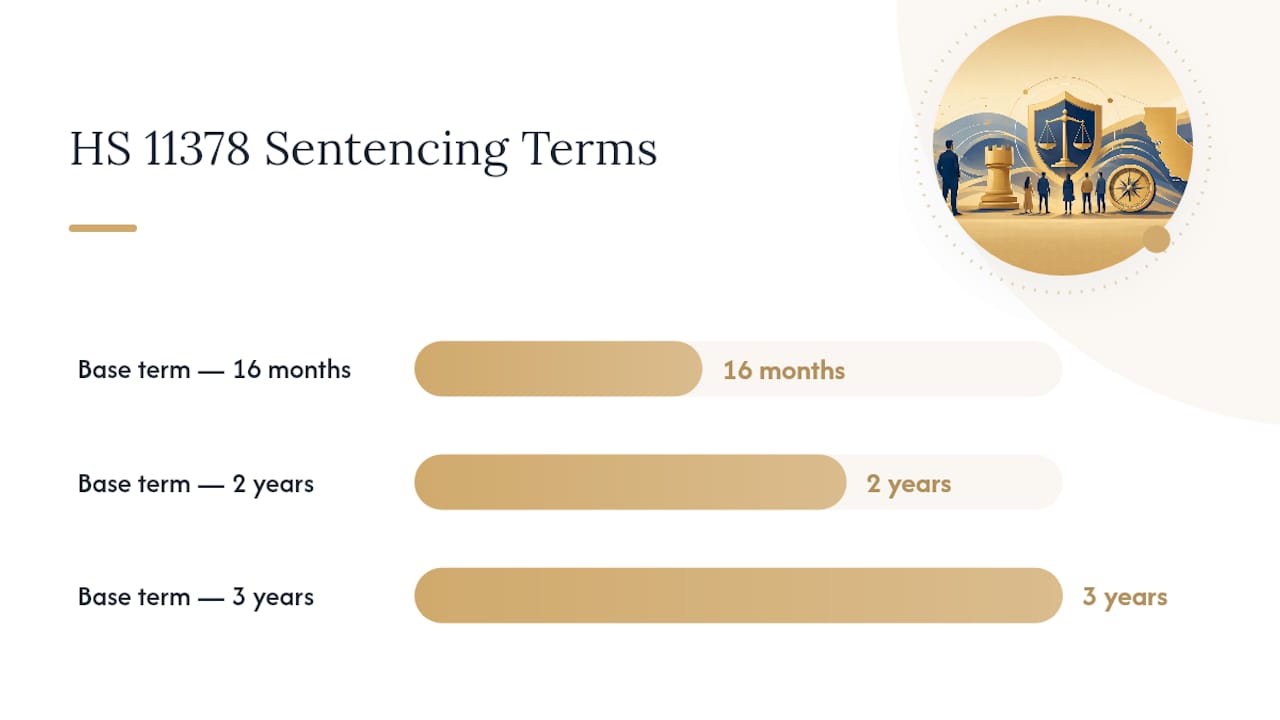
A conviction under HS 11378 is a straight felony, sentenced under Penal Code 1170(h) with a base term of 16 months, 2 years, or 3 years in county jail. Fines can reach $20,000 on top of custody time.
Fast facts on HS 11378 sentencing:
- Base term: 16 months, 2 years, or 3 years (county custody under California's realignment scheme)
- Fines: up to $20,000, separate from custody time
- Realignment under Penal Code 1170(h) usually means county jail rather than state prison, unless prior strikes, certain sex offense priors, or other exceptions apply
Pro Tip: Ask your attorney early whether your case qualifies for a split sentence, where part of the term is served on mandatory supervision instead of straight custody. Judges have more discretion here than most defendants realize.
Prior drug convictions, sales to minors, or quantities suggesting large-scale distribution can push sentencing toward the higher end of that range or trigger separate enhancement statutes. A conviction also follows you well past the custody date, showing up on background checks that affect employment, professional licensing, and housing applications for years.
How Do Prosecutors Prove Intent to Sell?
Intent to sell is rarely proven with a single smoking-gun item. It's built from a pattern of circumstantial evidence that, taken together, convinces a jury the drugs weren't for personal use.
Typical indicators prosecutors lean on include:
- Individually wrapped baggies or packaging materials inconsistent with personal consumption
- Digital or analog scales, especially with drug residue
- Large amounts of cash, particularly in small denominations
- Text messages, call logs, or apps suggesting sales negotiations
- Handwritten or digital ledgers tracking amounts owed or sold
- Quantity of the substance far exceeding what a typical user would possess
Joint possession cases complicate this picture considerably. If a substance is found in a car with three occupants, prosecutors have to connect the specific person to both knowledge and control, not just proximity. Law enforcement often builds these cases using confidential informants, controlled buys, and increasingly, digital forensics pulled from phones and cloud accounts.
Pro Tip: If your phone was seized, ask your attorney immediately about the scope of any search warrant covering digital data. Overbroad phone searches are one of the most common suppression arguments in HS 11378 cases today.
What Defenses Work Against HS 11378 Charges?
Every HS 11378 case turns on attacking either the search that produced the evidence or the inference of intent drawn from it. Effective defense strategies generally fall into a few categories:
- Challenge the search itself. If officers lacked a valid warrant, consent, or an applicable exception like exigent circumstances or plain view, evidence obtained from an unlawful search can potentially be suppressed, which often collapses the prosecution's case entirely.
- Argue personal use. Quantity and packaging cut both ways. A defense attorney can present context, purchasing history, or usage patterns that reasonably explain possession without a sales motive.
- Attack the forensic chain. Lab testing errors, broken chain of custody, or contamination during evidence handling can undermine the prosecution's core exhibit.
- Question witness credibility. Confidential informants and cooperating witnesses often have incentives to shade testimony in the prosecution's favor, and cross examination can expose that.
One thing families often assume incorrectly: that HS 11378 qualifies for the same diversion programs available to simple possession charges. It typically does not. As LegalClarity notes, HS 11378 is generally excluded from standard drug diversion programs precisely because it targets sales activity rather than personal use, and the charge also falls outside Proposition 47's reduction provisions.
Pro Tip: Don't assume a first offense automatically means probation or diversion. Ask your attorney directly which programs, if any, apply to your specific charge and criminal history.
What Will Your Lawyer Check About the Search That Led to Your Arrest?
Search and seizure issues decide more HS 11378 cases than any other single factor. Your attorney will scrutinize how officers obtained the evidence before ever discussing plea negotiations.
That review typically covers:
- Whether officers had a valid warrant, or whether an exception like consent, exigent circumstances, or plain view actually applied
- Whether a vehicle stop met the reasonable suspicion standard, or whether a probation or parole search condition justified the search
- Whether the lab that tested the substance followed proper protocols, since chain of custody gaps and testing errors have overturned convictions in cases citing precedent like People v. Leal
A search that fails any of these checks can lead to a motion to suppress, and a successful suppression motion often ends the case before trial.
What Should You Do Immediately After an HS 11378 Arrest?
The hours and days right after an arrest shape everything that follows. Here's the realistic sequence most defense attorneys follow:
- Invoke your right to counsel and stop talking. Anything said during booking or a follow-up interview can be used against you, even offhand comments that seem harmless.
- Preserve evidence on your end. Save texts, contact information for witnesses, and anything documenting where you were and why you had the substance.
- Let your attorney investigate the stop and search. This includes pulling body camera footage, dispatch records, and the warrant application if one exists.
- Expect motions before negotiations. Suppression motions, discovery requests, and independent testing of the substance usually come before any plea discussion.
- Understand the range of outcomes. Cases can end in dismissal, a negotiated plea to a lesser charge, a contested sentencing hearing, or trial. Diversion is possible in narrow circumstances, but it's the exception rather than the rule for HS 11378.
Why Early Defense Work Changes Everything in These Cases
Most people wait too long to bring in a lawyer, treating the first few days after arrest as a waiting period instead of the most critical window in the case. Search issues get harder to challenge the more time passes, and witness memory fades in ways that rarely favor the defense.
The practice focuses on drug charges where the search, the packaging evidence, and the intent inference are all still contestable if someone moves fast. Early intervention is treated as strategy, not formality.
If you're facing an HS 11378 charge, the difference between a felony record and a dismissed case often comes down to who reviewed the search warrant first.
— Jake
Getting Legal Help for an HS 11378 Charge in San Diego
Early representation on an HS 11378 case means someone is reviewing the search warrant, challenging the intent evidence, and preserving witness accounts while memories are still fresh, not months later when the case is already built against you.

The Law Offices of Logan Noblin handle drug crime defense across San Diego, including cases charged under HS 11378 involving methamphetamine and other controlled substances. That means scrutinizing every vehicle stop, every warrant application, and every claimed piece of intent evidence, from scales to text messages, for the weaknesses that can lead to suppression or a reduced charge. For cases specifically centered on possession-for-sale allegations, the firm's drug possession for sale practice page walks through how Logan approaches these charges from arraignment through trial.
If you or someone in your family was arrested on an HS 11378 charge, the first consultation is the moment to start building a defense, not after the preliminary hearing. Reach out to discuss your case and find out what your search, your evidence, and your options actually look like.
Primary Legal Texts and Support Resources
- HS 11378 statute text — California Legislative Information
- Justia copy of HSC § 11378
- FindLaw copy of HSC § 11378
- SAMHSA national helpline for treatment referrals
This article is general information, not a substitute for advice from a qualified lawyer. Consult a qualified legal professional about your own circumstances before acting on anything here.
Sources
- HS 11378 - California Legislative Information - CA.gov
- California Penal Code 11378: Penalties and Defenses - LegalClarity
- SAMHSA national helpline
FAQ
Is HS 11378 a felony or a misdemeanor?
HS 11378 is charged as a straight felony in California, not a misdemeanor or a wobbler. A conviction carries a base term of 16 months, 2 years, or 3 years in county custody under Penal Code 1170(h), plus fines up to $20,000.
What's the difference between HS 11378 and HS 11377?
HS 11377 covers simple possession for personal use and is often charged as a misdemeanor, while HS 11378 covers possession with intent to sell and is treated as a felony. That intent element is what separates the two charges, and it's also why HS 11378 is typically excluded from standard diversion programs that simple possession cases can access.
What does Schedule II or Class 2 controlled substance mean?
A Schedule II or Class 2 controlled substance is a drug the federal government and California both classify as having recognized medical uses alongside a high potential for abuse and dependence, methamphetamine and certain prescription opioids fall into this category. HS 11378 specifically targets possession for sale of substances the Health and Safety Code identifies under this and related schedules.
Is possession of a controlled substance always a felony in California?
No. Simple possession under HS 11377 is generally a misdemeanor for personal-use amounts, while possession for sale under HS 11378 is a felony because it involves distribution intent rather than personal consumption. The quantity, packaging, and other circumstantial evidence found alongside the substance usually determine which charge prosecutors file.
Can you get diversion or treatment instead of jail for HS 11378?
Diversion eligibility for HS 11378 is limited and shouldn't be assumed. Because the charge targets sales rather than personal use, it falls outside Proposition 47 reductions and most standard drug diversion programs, though narrow exceptions can exist depending on the specific facts of a case and a judge's discretion.