
Under California law, a hit and run means you were involved in a collision and failed to stop, identify yourself, or fulfill your legal duties at the scene. Two statutes govern this: California Vehicle Code §20001 (injury or death) and §20002 (property damage only). The single most important thing you can do right now is stop and exchange information.
If you are at the scene or believe you may be under investigation, act on these immediately:
- Stop your vehicle at the nearest safe location without impeding traffic.
- Exchange information: provide your name, address, driver's license number, registration, and insurance to the other party.
- Render reasonable aid if anyone is injured: call 911 and assist until emergency services arrive.
- Preserve evidence: photograph damage, skid marks, and the surrounding area before anything moves.
- Report to law enforcement when injuries, death, or significant property damage are involved.
- File a DMV SR-1 within 10 days if the accident caused injury, death, or property damage exceeding $1,000.
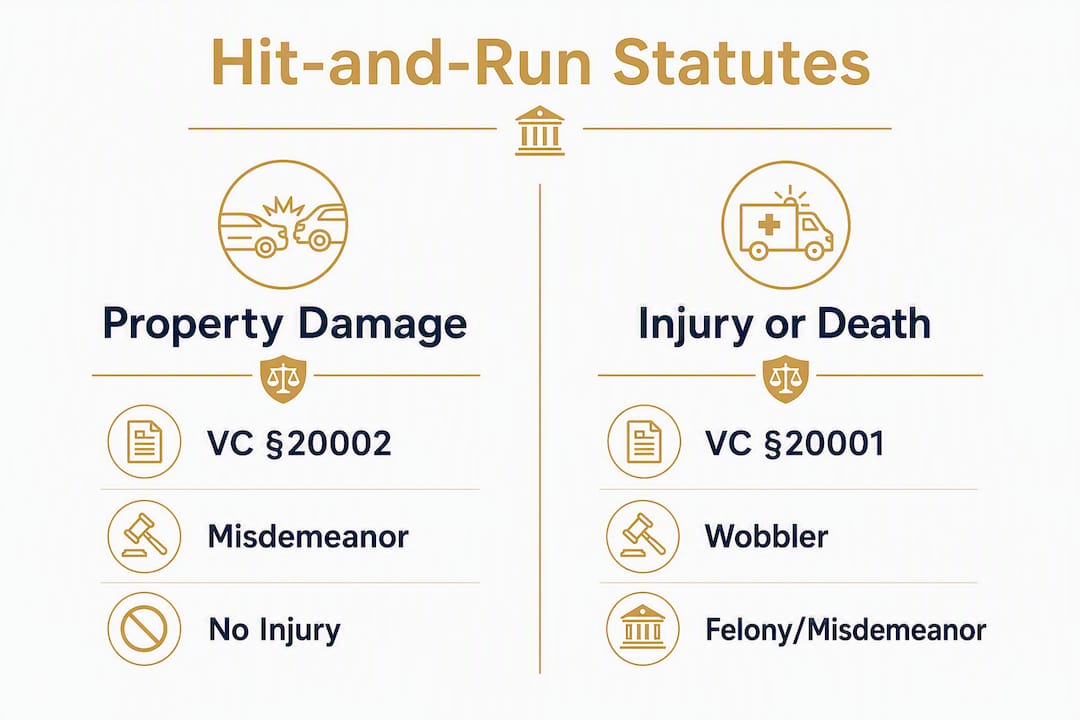
Quick statutory map: VC §20002 covers property-damage-only incidents and is a misdemeanor. VC §20001 covers accidents involving injury or death and is a "wobbler," meaning it can be charged as either a misdemeanor or a felony depending on the severity of harm and prosecutorial discretion.
Table of Contents
- What do California's hit-and-run statutes actually cover?
- Exactly what does the law require you to do at the scene?
- What does the prosecution have to prove?
- What are the penalties for a California hit-and-run conviction?
- What other charges often come with a hit-and-run?
- What defenses work in hit-and-run cases?
- How do civil liability and insurance work after a hit-and-run?
- What should you do right now if you're involved or under investigation?
- How does a hit-and-run case move from arrest to resolution?
- Why does specialized criminal-defense representation matter in these cases?
- Key Takeaways
- What these cases actually look like in practice
- Facing a hit-and-run charge in San Diego? Here's what to do next.
What do California's hit-and-run statutes actually cover?
California's two hit-and-run statutes divide the offense by the type of harm caused, and that distinction controls everything from the charging decision to the sentence range.
VC §20002: property damage only
Vehicle Code §20002 applies when a collision results only in damage to property, including other vehicles. The driver must immediately stop at the nearest location that does not impede traffic, then either locate the owner and provide contact and insurance information, or leave a written note with their name and address and report the incident to police or the California Highway Patrol without unnecessary delay. This is a straight misdemeanor.
VC §20001: injury or death (the wobbler)
VC §20001 applies when the accident causes injury or death. The statute requires the driver to stop and fulfill the duties spelled out in VC §20003 (exchange of information) and VC §20004 (notification when a person is killed). Because VC §20001 is a wobbler offense, prosecutors can charge it as a misdemeanor or a felony. That charging decision turns on factors like the severity of injury, the defendant's prior record, and whether the driver showed any effort to help.
Side-by-side comparison
| Feature | VC §20002 | VC §20001 |
|---|---|---|
| Trigger | Property damage only | Injury or death |
| Classification | Misdemeanor | Wobbler (misdemeanor or felony) |
| Max jail/prison | County jail time for misdemeanors | Up to 4 years state prison (felony) |
| Max fine | Up to $1,000 | Up to $1,000 (misdemeanor) |
| Statute of limitations | 1 year | 3 years (up to 6 years for death/permanent injury) |
| DMV SR-1 required | If damage exceeds $1,000 | Always |
Exactly what does the law require you to do at the scene?
California does not give drivers much discretion here. The duties are specific and sequential, and failing any one of them is what creates criminal exposure, regardless of who caused the crash.
- Call law enforcement — when there is injury, death, or significant property damage. For property-only incidents, you may still need to report to the CHP or local police if the owner cannot be located.
- File a DMV SR-1 — within 10 days if the accident involved injury, death, or property damage over $1,000.
Pro Tip: If you leave a note, photograph it before placing it on the vehicle and note the time and location. That photo can be critical evidence that you attempted to comply with VC §20002.
Panic is common after a collision, especially if you believe you may be at fault or if there are other circumstances (like a suspended license or prior DUI). The instinct to drive away can feel overwhelming in the moment, but leaving creates a separate criminal charge entirely. If you drove away and are now reconsidering, contact a criminal-defense attorney before speaking to anyone, including police.
What does the prosecution have to prove?
One of the most misunderstood aspects of hit-and-run law is that the state does not need to prove you caused the accident. The crime is the act of leaving, not the act of crashing. That said, prosecutors still carry a burden on specific elements.
Elements for VC §20002
- You were the driver of a vehicle involved in an accident.
- The accident resulted in damage to property.
- You knew or reasonably should have known that damage occurred.
- You willfully failed to stop and fulfill your duties (identify yourself, leave a note, or notify police).
Example: You back into a parked car in a parking lot, hear a thud, and drive away without checking. The prosecution does not need to prove you saw the damage. They need to show you were involved and that a reasonable person in your position would have known damage occurred.
Elements for VC §20001
- You were the driver of a vehicle involved in an accident.
- The accident caused injury or death to another person.
- You knew or reasonably should have known that injury or death occurred.
- You willfully failed to stop, provide information, or render reasonable aid.
Example: A driver strikes a pedestrian at a crosswalk, slows briefly, then accelerates away. The prosecution will argue the driver knew someone was hit based on the impact and the pedestrian's visible reaction. The "knowledge" element is often the central battleground in these cases.
The mental element, willfulness and knowledge, matters because it is where defenses most often gain traction. A driver who genuinely did not know a collision occurred, or who stopped and then left to get help and returned promptly, has a different legal position than one who saw an injured person and fled.
What are the penalties for a California hit-and-run conviction?
Penalties depend on which statute applies and, for VC §20001, whether the case is charged as a misdemeanor or felony.
VC §20002 (misdemeanor)
- Up to 6 months in county jail
- Fines up to $1,000
- Informal (summary) probation
- DMV points added to driving record
- Possible license suspension
VC §20001 (wobbler)
Misdemeanor: County jail time may be imposed for misdemeanor convictions, fines up to $1,000, and probation.
Felony (serious injury): State prison terms of 2, 3, or 4 years may be imposed for felonies involving serious injury or death, as well as fines and probation.
Felony (death or permanent serious injury): State prison terms of 2, 3, or 4 years and applicable fines may be imposed for serious felonies involving death or permanent injury.
Sentencing note: Courts can also order restitution, but under VC §20001, criminal restitution is limited to harms caused by the act of fleeing — for example, costs from delayed medical treatment — not the original crash injuries, unless the defendant is separately convicted of causing the collision.
Collateral consequences
Beyond jail and fines, a hit-and-run conviction carries consequences that can outlast the sentence itself:
- DMV points (typically 2 points) that can trigger a negligent operator hearing and license suspension.
- SR-22 requirement: insurers may require this high-risk certificate for years after conviction.
- Insurance premium increases or policy cancellation.
- Civil liability: a criminal conviction makes it significantly easier for the victim to win a civil judgment, since the conviction establishes key facts.
- Immigration consequences: a felony conviction under VC §20001 can trigger removal proceedings or affect naturalization eligibility for non-citizens.
Prior convictions matter. A prior hit-and-run or DUI on your record can push a wobbler charge toward felony filing and increase the likelihood of a state prison sentence rather than probation.
What other charges often come with a hit-and-run?
Prosecutors rarely file a hit-and-run charge in isolation when the underlying facts support additional counts. Each companion charge adds exposure and complicates plea negotiations.
- DUI causing injury (VC §23153): When alcohol or drugs are involved, this charge can stack on top of VC §20001. The combination is among the most aggressively prosecuted traffic-crime pairings in California. A DUI causing injury conviction carries its own felony sentencing range and mandatory license revocation.
- Vehicular manslaughter (PC §192(c)): Filed when a death results from an unlawful act or negligence while driving. Charged alongside VC §20001 in fatal accidents.
- Gross vehicular manslaughter while intoxicated (PC §191.5): A more serious charge when intoxication is a factor in a fatal crash. Carries up to 10 years in state prison.
- Reckless driving (VC §23103): Often added when the manner of driving before the collision was itself dangerous.
- Driving on a suspended license (VC §14601): Common when the driver fled partly because they had no valid license. Adds a separate misdemeanor count.
When multiple charges are filed together, the leverage shifts significantly. A skilled defense attorney can sometimes negotiate dismissal of companion counts in exchange for a plea on the primary charge, or argue that the facts do not independently support each count. That negotiation is far harder without counsel who understands how prosecutors build these cases.
What defenses work in hit-and-run cases?
The strength of a defense usually comes down to the mental elements: knowledge and willfulness. If the prosecution cannot prove you knew a collision occurred, or that you intentionally failed to fulfill your duties, the case weakens considerably.
- Emergency necessity: — You left the scene to seek immediate medical help for yourself or a passenger and returned as soon as possible. Courts look at whether you actually returned and whether the emergency was genuine.
Early investigation by defense counsel often uncovers exculpatory footage or witness statements that law enforcement never collected. Surveillance video from nearby businesses degrades or gets overwritten within days. Parking-lot camera exports, cell phone metadata, and vehicle telemetry data can make or break a defense, but only if someone requests preservation before the footage disappears.
How do civil liability and insurance work after a hit-and-run?
A criminal case and a civil claim run on separate tracks, and a resolution in one does not end the other.
Insurance coverage for hit-and-run victims
- Uninsured motorist (UM) bodily injury coverage typically covers injuries caused by a hit-and-run driver, since the at-fault driver is treated as uninsured for UM purposes.
- Collision coverage can cover vehicle damage when the at-fault driver is unknown.
- UM property damage coverage may apply depending on the policy terms.
Victims should notify their insurer promptly and file a police report, since most UM claims require a report to be on file.
For the driver accused of hit-and-run
- Report the accident to your insurer as required by your policy, but do not give a recorded statement without speaking to an attorney first.
- Do not admit fault in any communication with insurers, the other party, or law enforcement.
- Preserve all documentation: repair estimates, receipts, photos of your vehicle, and any communications.
- Understand the restitution distinction: criminal restitution under VC §20001 covers only losses caused by the act of fleeing, not the original crash. Civil damages, by contrast, can encompass the full scope of the victim's losses. A criminal conviction makes that civil recovery significantly easier for the plaintiff.
What should you do right now if you're involved or under investigation?
Whether you left the scene minutes ago or received a call from a detective weeks later, the steps you take in the next 24–72 hours can determine the outcome of your case.
- File the DMV SR-1 — within 10 days if the accident involved injury, death, or property damage over $1,000.
How does a hit-and-run case move from arrest to resolution?
Understanding the process helps you make better decisions at each stage.
- Investigation: Police collect physical evidence (paint transfer, debris, tire marks), review surveillance footage, canvass witnesses, and may subpoena repair shops for vehicles matching the damage profile. This phase can last weeks or months after the incident.
- Arrest or citation: Once law enforcement identifies a suspect, they may arrest or issue a citation. In some cases, a warrant is obtained before any contact.
- Arraignment: The defendant appears in court, hears the charges, and enters a plea. Bail is set or reviewed.
- Negotiation and pre-trial motions: Defense counsel reviews discovery, challenges evidence, and negotiates with the prosecutor. This is where wobbler reductions happen most often. Prosecutors may agree to reduce a felony VC §20001 to a misdemeanor when mitigating factors are strong, the defendant has no prior record, or the evidence of knowledge is thin.
- Diversion: Some defendants, particularly first-time offenders, may qualify for pretrial diversion programs that result in dismissal upon completion. Eligibility depends on the charge, the defendant's history, and the specific program.
- Plea or trial: Cases that do not resolve through negotiation proceed to a jury or bench trial.
- Sentencing: If convicted, the court imposes jail or prison time, fines, probation, restitution, and any applicable enhancements.
On timelines: misdemeanor hit-and-run charges must generally be filed within 1 year; felony charges within 3 years; cases involving death or permanent serious injury may allow up to 6 years under some circumstances. Investigative delays are common, which means you could receive a call from law enforcement long after the incident itself.
Why does specialized criminal-defense representation matter in these cases?
Hit-and-run cases move fast, and the decisions made in the first days after an incident often define what is possible later. An experienced California criminal-defense attorney does several things that are difficult or impossible to do on your own.
Investigation and evidence recovery. Defense counsel can issue preservation letters to businesses with surveillance systems, retain accident reconstruction experts, and subpoena records before they disappear. The prosecution's investigation is already underway; the defense needs to start immediately.
Negotiating wobbler reductions. Arguing for a reduction from felony to misdemeanor on a VC §20001 charge requires building a mitigation package: evidence of good character, prompt reporting, lack of prior record, and any facts that undercut the knowledge or willfulness elements. Prosecutors do not offer these reductions without a reason.
DMV representation. A hit-and-run conviction triggers DMV consequences separate from the criminal case. Counsel can represent you at a DMV hearing to contest license suspension or negotiate the terms of any restriction.
Immigration guidance. For non-citizens, a felony conviction under VC §20001 can have severe immigration consequences. Counsel experienced in the intersection of criminal and immigration law can structure a defense or plea to minimize that exposure.
Trial defense. When a case goes to trial, the prosecution must prove every element beyond a reasonable doubt. Challenging the identification evidence, the knowledge element, or the chain of custody for physical evidence are all viable trial strategies.
The Law Offices of Logan Noblin, APC specializes in San Diego hit-and-run defense and DUI representation, with a track record that includes not-guilty verdicts and successful case dismissals in traffic-related criminal matters. Logan Noblin, a former "Attorney of the Year," brings both the courtroom experience and the prosecutorial insight needed to navigate these cases from investigation through resolution.
Key Takeaways
California hit-and-run charges under VC §20001 are wobblers, meaning a skilled defense can often reduce a felony to a misdemeanor, and the difference between those outcomes is measured in years of freedom.
| Point | Details |
|---|---|
| Two statutes govern hit-and-run | VC §20002 covers property damage (misdemeanor); VC §20001 covers injury or death (wobbler, misdemeanor or felony). |
| Immediate duties are non-negotiable | Stop, exchange information, render aid, call 911, and file a DMV SR-1 within 10 days when required. |
| Felony penalties are severe | A VC §20001 felony conviction for death or permanent injury carries 2, 3, or 4 years in state prison. |
| Defenses focus on knowledge and willfulness | Lack of knowledge, mistaken identity, and emergency necessity are the most defensible positions. |
| Logancriminaldefense handles these cases in San Diego | The Law Offices of Logan Noblin, APC defends hit-and-run and DUI charges, including wobbler reduction negotiations and DMV hearings. |
What these cases actually look like in practice
Most hit-and-run cases I see at the Law Offices of Logan Noblin, APC fall into two broad categories: the parking-lot brush where someone panicked and drove off without realizing the full legal weight of that decision, and the serious-injury case where the facts are more complex and the stakes are far higher.
The parking-lot cases are often resolvable. The driver had no intent to harm anyone, the damage was minor, and the failure to stop was a moment of poor judgment rather than a calculated decision. In those situations, early mitigation, voluntary reporting, and a clean record can move a prosecutor toward a reduced charge or even a diversion outcome.
The serious-injury cases demand a different approach. Evidence preservation is the first priority, because the prosecution's investigation is already running. The knowledge element is almost always contested, and the difference between a misdemeanor and a felony conviction can hinge on a single piece of surveillance footage or a witness statement collected in the first 48 hours. Waiting to hire counsel in those cases is the single most costly mistake defendants make.
What clients consistently underestimate is how quickly the evidence window closes. Surveillance footage overwrites. Witnesses' memories fade. Repair shops complete work on damaged vehicles. The earlier a defense attorney is involved, the more tools remain available. An early consultation costs nothing compared to the options it preserves.
Facing a hit-and-run charge in San Diego? Here's what to do next.
When the charge is a California hit-and-run, the difference between a felony record and a misdemeanor, or between conviction and dismissal, often comes down to who is working your case and when they started.

The Law Offices of Logan Noblin, APC handles hit-and-run defense across San Diego, from first-offense property-damage cases to serious-injury felony charges. The firm's approach combines aggressive evidence investigation with targeted negotiation: building the mitigation package that gives prosecutors a reason to reduce a wobbler, challenging identification and knowledge evidence at the pre-trial stage, and taking cases to trial when that is the right call.
Services include full criminal defense representation, DMV hearing advocacy, SR-22 guidance, and, where eligible, diversion program navigation. All consultations are confidential. To speak with Logan Noblin directly about your situation, visit logancriminaldefense.com/san-diego-criminal-defense or call the firm to schedule a consultation. The sooner you reach out, the more options remain on the table.
Authoritative sources and primary references
- California Vehicle Code §20001 and §20002 (leginfo.legislature.ca.gov)
- California Vehicle Code §20002 full text (leginfo.legislature.ca.gov)
- California DMV SR-1 reporting guidance (dmv.ca.gov)
- California Highway Patrol (chp.ca.gov)
- California Courts — CALCRIM jury instructions (courts.ca.gov)
- Law Offices of Logan Noblin, APC — San Diego hit-and-run defense
This article provides general legal information about California hit-and-run law and is not legal advice. Laws change, and your specific facts matter. Consult a qualified California criminal-defense attorney and verify current statutes at leginfo.legislature.ca.gov before making any legal decisions.