
Under California Penal Code § 487, grand theft applies when the value of property or services taken exceeds a specific statutory threshold in most cases, or when the property falls into a special category such as an automobile or firearm regardless of value. This is a wobbler offense, meaning prosecutors can charge it as either a felony or a misdemeanor depending on the facts and your prior record. If you are facing a grand theft PC 487 charge, the single most important step you can take right now is to preserve any evidence and contact a criminal defense attorney before speaking with investigators.
Table of Contents
- What does Penal Code § 487 actually say?
- What must prosecutors prove to convict under PC 487?
- Common scenarios that lead to PC 487 charges
- How the aggregation rule can turn small thefts into a felony
- What are the penalties for grand theft under PC 487?
- What defenses work in PC 487 cases?
- How prosecutors build a grand theft case
- How does PC 487 differ from PC 484, PC 488, and burglary?
- What should you do immediately after a PC 487 arrest?
- Key Takeaways
- Why the aggregation rule deserves more attention than it gets
- Facing a PC 487 charge in San Diego? Here is how Logancriminaldefense can help
- Useful sources for PC 487 research
What does Penal Code § 487 actually say?
The full text of § 487 reads, in relevant part:
Here is what each subdivision means in plain English:
- Subdivision (a): The general rule. Any theft of money, labor, or property exceeding the applicable statutory threshold qualifies as grand theft.
- Subdivision (b): Special lower thresholds apply to certain agricultural products, domestic fowl, and aquaculture products. A lower threshold applies to these items, so stealing farm produce or commercial fish above that amount can be charged as grand theft.
- Subdivision (d): Automobiles and firearms are grand theft automatically, regardless of their value. A $400 used handgun stolen from a car is still grand theft under this subdivision.
- Subdivision (e): The aggregation rule. When a defendant takes property through a series of acts driven by a single intention, general impulse, and plan, the values of those acts may be combined to reach the $950 threshold.
The annotated version on Justia reproduces the full statutory text with commentary on each subdivision and is a reliable reference for the current language.
What must prosecutors prove to convict under PC 487?
Grand theft is not just "taking something valuable." Prosecutors must establish each of the following elements beyond a reasonable doubt:
-
The defendant took property belonging to someone else. Taking means physically moving the property, even a short distance. Example: sliding merchandise into a bag inside a store counts, even if the defendant never left the building.
-
The owner did not consent. If the owner gave permission, even informally, that consent is a complete defense. Example: a contractor who keeps leftover materials the homeowner said he could have has not committed theft.
-
The defendant intended to permanently deprive the owner of the property. This is the intent element, and it is where many cases break down. Borrowing without permission is not grand theft unless the intent to keep the property can be proven. Example: taking a coworker's laptop intending to return it after a weekend is legally different from taking it to sell.
-
The property meets the value threshold or falls into a special category. For ordinary property, the fair market value at the time of the theft must exceed $950. For automobiles, firearms, and certain agricultural products, the threshold rules differ as described above.
The burden of proof rests entirely on the prosecution. A defendant does not have to prove innocence; the state must prove guilt on every element.
Common scenarios that lead to PC 487 charges
Retail shoplifting of a high-value item. This is the most common scenario. A person conceals a $1,200 handbag or a $1,100 piece of electronics and walks out of a store. The retail price typically serves as the starting point for valuation, though defense counsel can challenge whether fair market value actually exceeded $950 at the time of the taking.

Employee theft. An employee skims cash from a register over several weeks, or diverts company funds through falsified expense reports. These cases often involve the aggregation rule: each individual transaction may be small, but prosecutors combine them into a single grand theft count. Employment records, transaction logs, and surveillance footage are the usual evidence.
Vehicle theft. Taking someone's car, truck, or motorcycle triggers subdivision (d) automatically. Value is irrelevant. A 20-year-old beater worth $300 is still grand theft if taken without consent.
Theft of services. A contractor bills a client for $15,000 in work, collects a deposit, and never performs the job. Or a tenant receives months of free housing through deception. Services count as "labor" under subdivision (a), so the $950 threshold applies the same way it does to physical property.
Special categories worth noting: theft of domestic fowl, avocados, olives, citrus, nuts, or aquaculture products valued above $250 qualifies as grand theft under subdivision (b), a threshold that catches many defendants off guard in agricultural regions.
How the aggregation rule can turn small thefts into a felony
The aggregation rule in § 487(e) is the provision most defendants never see coming. It allows prosecutors to combine the value of multiple separate thefts into a single grand theft charge when those acts were motivated by one intention, one general impulse, and one plan.
What that looks like in practice:
- A retail employee takes $50 from the register on Monday, $75 on Wednesday, and $100 the following week. Each act alone is petty theft. Combined, they exceed $950 and prosecutors charge one count of grand theft.
- Evidence that acts occurred within a certain time window supports the argument that they reflect a single scheme.
- For employee theft specifically, California courts have applied an extended aggregation period in some cases, allowing prosecutors to reach back further when the employment relationship provides the common thread.
Challenging aggregation is one of the most effective defense strategies available. The key is attacking the "single plan" element:
- Show the thefts targeted different victims or different property types.
- Demonstrate significant timing gaps that suggest separate, independent decisions rather than one ongoing scheme.
- Argue that different methods (cash skimming vs. inventory theft vs. fraudulent returns) reflect separate impulses, not one plan.
- Challenge the evidentiary basis: prosecutors often rely on circumstantial evidence to establish a common scheme, and that evidence can be contested.
Pro Tip: If you are charged with multiple petty theft counts that prosecutors are trying to aggregate into grand theft, ask your attorney immediately whether the acts involved different victims, different methods, or significant time gaps. Any one of those factors can undercut the aggregation argument.
What are the penalties for grand theft under PC 487?
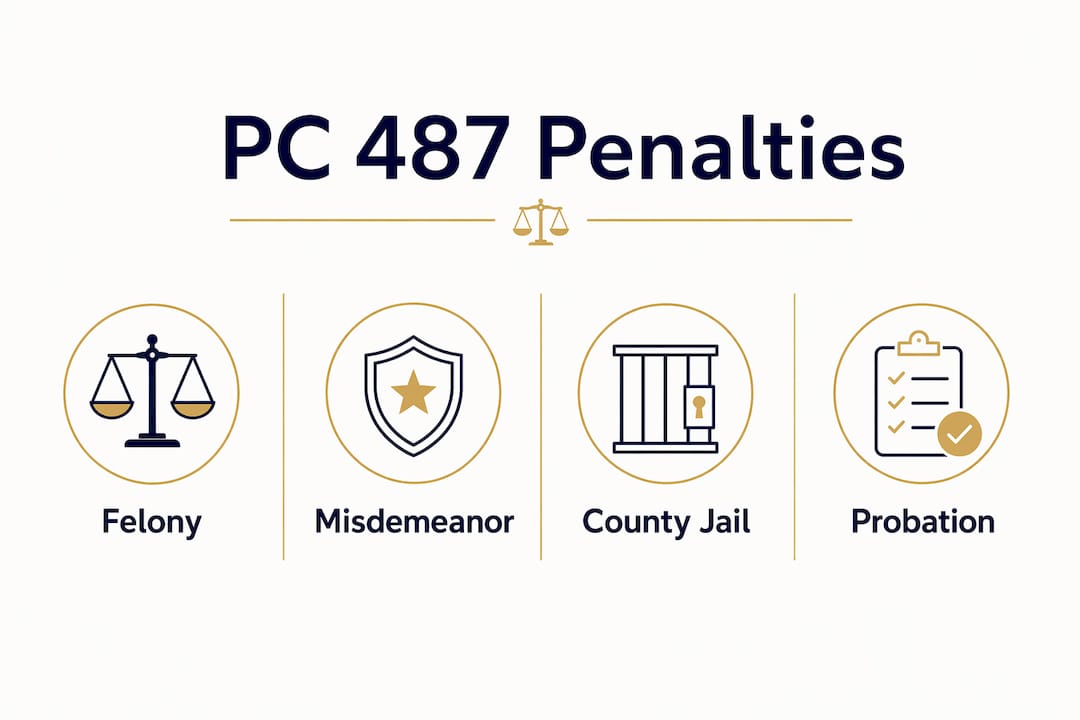
Grand theft is a wobbler under California law, meaning the prosecutor decides whether to charge it as a felony or misdemeanor based on specific facts, property value, and criminal history.
Misdemeanor grand theft
A misdemeanor conviction may involve county jail time and fines. Probation is common for first-time offenders without aggravating factors.
Felony grand theft
A felony conviction may lead to state prison time and fines. When the property taken was a firearm, the charge is a straight felony with no misdemeanor option.
Factors that push a case toward felony treatment
- Prior theft convictions, especially prior felony theft convictions
- Property value significantly above $950
- Taking from a person directly (as opposed to a store or employer)
- Use of deception or breach of trust
- Involvement of a firearm or vehicle
Collateral consequences
A conviction, even a misdemeanor, can cost you a professional license, disqualify you from certain jobs, affect immigration status, and appear on background checks for housing and employment. Restitution to the victim is nearly always ordered, separate from any fine.
| Property / Threshold | Classification | Notes |
|---|---|---|
| Value over $950 (general) | Wobbler (felony or misdemeanor) | Fair market value at time of theft controls |
| Value $250–$950 (farm/aquaculture products) | Grand theft | Special lower threshold under § 487(b) |
| Automobile (any value) | Wobbler | Subdivision (d)(1); value irrelevant |
| Firearm (any value) | Straight felony | Subdivision (d)(2); no misdemeanor option |
| Value under $950 (general property) | Petty theft (PC 488) | Misdemeanor |
What defenses work in PC 487 cases?
A skilled defense attorney will evaluate every element of the prosecution's case. The most effective defenses in grand theft cases include:
-
Lack of intent to permanently deprive. If the defendant intended to return the property, the specific intent element fails. This defense works best when there is objective evidence of intent to return, such as messages, partial payments, or prior conduct.
-
Claim of right / ownership dispute. A defendant who genuinely believed the property was theirs, or that they had a legal right to it, lacks the criminal intent required for theft. This is not a defense to taking someone else's property knowingly, but it is a complete defense when the belief is sincere and reasonable.
-
Consent. If the owner gave permission, there is no theft. Consent can be express or implied, and even informal consent can defeat the charge.
-
Value dispute. The property's fair market value at the time of the theft, not its original purchase price, determines whether the $950 threshold is met. A depreciated vehicle, used electronics, or secondhand goods may fall below $950 in actual market value even if the original retail price was higher. Independent appraisals are a standard defense tool.
-
Insufficient evidence / identity. Eyewitness identifications are unreliable, surveillance footage is often unclear, and circumstantial evidence can be consistent with innocence. Challenging the sufficiency of the prosecution's proof is always on the table.
-
Abandonment. If the defendant voluntarily returned the property before completing the taking, the theft may be incomplete.
Pretrial diversion
California offers pretrial diversion programs for eligible defendants. Diversion typically requires no prior theft convictions, a relatively low-value theft, and a willingness to complete community service, counseling, or restitution. Successful completion results in dismissal of the charge with no conviction on record.
Plea negotiations
When the evidence is strong, negotiating a plea to a lesser offense, such as petty theft under PC 488 or a civil compromise, can avoid a felony record. Restitution agreements often play a central role: prosecutors are more willing to reduce charges when the victim is made whole.
How prosecutors build a grand theft case
Prosecutors in PC 487 cases rely on a fairly predictable set of evidence types. Understanding what they typically present, and where those presentations are vulnerable, is the foundation of any defense.
Surveillance video is the most common evidence in retail theft cases. It can show the act of concealment or taking, but it rarely shows intent. Video quality, camera angles, and chain-of-custody documentation are all contestable.

Transactional records and receipts matter most in employee theft and services cases. Bank records, point-of-sale logs, and expense reports establish a pattern, but they require expert interpretation and can be challenged on completeness or accuracy.
Eyewitness identification from store employees or victims is frequently the weakest link. Memory is fallible, and cross-racial identifications are particularly unreliable. Defense counsel should request any identification procedures used (lineups, photo arrays) and challenge suggestive methods.
Valuation evidence is where many cases turn. Prosecutors often use retail price or replacement cost, but the legal standard is fair market value at the time of theft. An independent appraiser can often bring that number below $950, which drops the charge to petty theft.
Defendant statements are often the most damaging evidence. Anything said to police, store security, or investigators before counsel is retained can be used against the defendant. This is why the first rule after any arrest is to say nothing beyond identifying yourself.
Defense counsel should request surveillance footage, dispatch logs, loss prevention reports, and any valuation documentation in the first round of discovery. Evidence disappears quickly, and early requests preserve options.
How does PC 487 differ from PC 484, PC 488, and burglary?
These statutes overlap in ways that confuse defendants, and prosecutors sometimes charge multiple counts from the same act.
PC 484 is the general theft statute. It defines theft broadly and covers everything from shoplifting to embezzlement to obtaining property by false pretenses. PC 487 and PC 488 are both subsets of PC 484: they specify the degree of theft based on value or property type.
PC 488 is petty theft: any theft that does not meet the grand theft thresholds. It is a misdemeanor carrying up to six months in county jail. The key distinction between PC 488 and PC 487 is the $950 value threshold and the special property categories.
Embezzlement (PC 503) involves the fraudulent appropriation of property by someone to whom it was entrusted. An employee who steals from a cash register is committing both theft and embezzlement. Prosecutors sometimes charge both to maximize leverage in plea negotiations.
Burglary (PC 459) is a different animal entirely. Burglary is entering a structure with the intent to commit a theft or felony inside. You can be charged with burglary even if you never actually steal anything, because the crime is complete at the moment of entry with criminal intent. A shoplifter who walks into a store intending to steal can technically be charged with commercial burglary under PC 459 in addition to theft under PC 487. Prosecutors use this pairing strategically when they want felony exposure on a case that might otherwise resolve as a misdemeanor. For defendants facing both charges, a San Diego burglary lawyer can often negotiate the burglary count down or dismissed in exchange for a plea on the theft.
What should you do immediately after a PC 487 arrest?
The decisions made in the first 48 hours after an arrest often determine the outcome of the case. Here is what to do, in order:
-
Say nothing to police or investigators. Invoke your right to remain silent clearly and politely. Do not explain, justify, or provide context. Every statement you make can be used against you, and none of it will help you at this stage.
-
Contact a criminal defense attorney before your arraignment. The arraignment is your first court appearance, where you enter a plea. Having counsel before that hearing preserves your options and prevents you from making uninformed decisions under pressure.
-
Preserve all evidence. Save text messages, emails, receipts, photos, and any documentation related to the property or the circumstances of the alleged theft. Do not delete anything.
-
Write down your account of events while memory is fresh. Include dates, times, locations, and the names of any witnesses. Give this only to your attorney, not to police.
-
Collect witness contact information. Anyone who can speak to your whereabouts, your intent, or the value of the property is potentially useful. Get names and phone numbers now.
-
Understand the court timeline. After arraignment comes the preliminary hearing (in felony cases), then discovery and pretrial motions, then either a plea resolution or trial. Your attorney will file motions to suppress evidence, challenge valuations, or seek diversion at the appropriate stages.
-
Ask your attorney about bail reduction. If you are in custody, a motion for bail reduction can be filed at or shortly after arraignment. Conditions of release can often be negotiated.
The statute of limitations for grand theft under PC 487 is generally three years from the date of the offense for felony charges. For misdemeanor charges, it is typically one year. If you were not arrested immediately, charges can still be filed within that window.
Key Takeaways
Grand theft under California Penal Code § 487 is a wobbler offense triggered by the $950 value threshold, special property categories, or the aggregation of multiple smaller thefts into one charge, and the outcome depends heavily on early legal intervention.
| Point | Details |
|---|---|
| The $950 threshold | Property or services must exceed $950 in fair market value at the time of theft; original purchase price does not control. |
| Special categories | Automobiles and firearms are grand theft regardless of value; farm and aquaculture products have a $250 threshold. |
| Aggregation risk | Multiple small thefts can be combined into one grand theft count if prosecutors show a single plan, impulse, and intention. |
| Wobbler status | Grand theft can be filed as a felony or misdemeanor; prior record, property type, and value all influence that decision. |
| Logancriminaldefense | The firm handles PC 487 defense in San Diego, including valuation challenges, aggregation defenses, and pretrial diversion advocacy. |
Why the aggregation rule deserves more attention than it gets
Most people charged with grand theft understand the $950 threshold. What catches defendants off guard, consistently, is the aggregation rule. A single act of shoplifting a $1,200 item is obvious grand theft. But a series of $200 transactions spread over two months? Many defendants genuinely believe those are separate petty theft incidents. They are not, if prosecutors can show a common plan.
The fair market value nuance is equally underappreciated. Defense attorneys who know what they are doing will hire an independent appraiser before trial. A used laptop that retails for $1,100 new might have a fair market value of $700 on the day it was stolen. That single fact drops the charge from grand theft to petty theft. Prosecutors know this, which is why they often use retail price in charging documents rather than actual market value. Challenging that number is not a technicality; it is the law.
The collateral consequences of a grand theft conviction also tend to get minimized in early conversations. A felony theft conviction can end a career in healthcare, finance, education, or any licensed profession. It can affect professional licenses, security clearances, and housing applications for years. The stakes are high enough that even a case with strong prosecution evidence is worth fighting, because the difference between a felony and a misdemeanor, or between a conviction and a diversion dismissal, is not just time served. It is the shape of the next decade of someone's life.
Facing a PC 487 charge in San Diego? Here is how Logancriminaldefense can help

A grand theft charge carries real consequences, and the defense strategy that works depends on facts that need to be evaluated early. Logancriminaldefense, the Law Offices of Logan Noblin, APC, handles PC 487 grand theft defense in San Diego with a direct focus on the issues that actually move these cases: independent valuation challenges, aggregation defense, pretrial diversion advocacy, and plea negotiations that protect your record. Logan Noblin is a former Attorney of the Year with multiple not-guilty verdicts and case dismissals across theft and fraud matters.
The firm's approach to theft cases includes:
- Retaining independent appraisers to challenge prosecution valuation evidence
- Filing early discovery requests for surveillance, loss prevention reports, and transaction records
- Identifying diversion eligibility and advocating for program admission
- Negotiating charge reductions when the evidence warrants a practical resolution
Outcomes are never guaranteed, but early intervention consistently produces better options. Schedule a consultation with Logancriminaldefense to discuss your case before your arraignment.
This article is general legal information, not legal advice. For guidance specific to your situation, consult a qualified California criminal defense attorney.
Useful sources for PC 487 research
| Source | What it offers |
|---|---|
| California Penal Code § 487 (CA.gov) | The official, current statutory text including all subdivisions and the aggregation language. Start here. |
| § 487 Annotated (Justia) | Annotated version with commentary on each subdivision; useful for understanding how courts have interpreted the thresholds. |
| § 487 Text (FindLaw) | Clean statutory text with a short explanatory overview; good for quick reference on special-category treatment. |
If you are charged under PC 487, these sources can help you understand the statute, but they are not a substitute for counsel who knows how San Diego prosecutors and judges handle these cases in practice.