
Under California Penal Code § 487, grand theft is the unlawful taking of money, labor, real property, or personal property valued over $950. Certain property types trigger grand theft charges regardless of dollar value, including automobiles and firearms. This is a felony offense in California, and a conviction carries serious consequences: state prison time, fines, probation, and a permanent criminal record that can affect future job applications and housing searches.
Key elements that define grand theft under PC 487:
- Value threshold: Property worth more than $950 (most cases)
- Firearms and automobiles: Grand theft regardless of value
- Theft from a person: Grand theft regardless of value
- Employee theft: Aggregated theft of $950 or more from an employer within any 12-month period
- Farm crops and aquacultural products: Grand theft when value exceeds $250
- Aggregated acts: Multiple related thefts across victims or counties may be combined to reach the $950 felony threshold
What types of conduct qualify as grand theft in California?
California law recognizes several distinct methods of committing theft, and each can support a grand theft charge when the value or property type qualifies.
- Grand theft by larceny: The most familiar form. You physically take someone else's property without consent and carry it away, intending to keep it permanently.
- Grand theft by false pretenses: You obtain property by knowingly making a false statement of fact, and the victim transfers ownership based on that lie. A contractor who takes a deposit and never performs the work is a textbook example.
- Grand theft by trick: Similar to false pretenses, but the victim only transfers possession, not ownership. The distinction matters legally, though both are charged as theft.
- Embezzlement: A servant, agent, or employee fraudulently takes property entrusted to them by their employer. Under PC 487(b)(3), employee theft that aggregates $950 or more over any 12 consecutive months qualifies as grand theft.
- Farm crop theft: Avocados, citrus fruits, vegetables, nuts, artichokes, and similar crops stolen at a value exceeding $250 constitute grand theft under PC 487(b)(1).
- Aquacultural product theft: Fish, shellfish, mollusks, crustaceans, kelp, and algae taken from a commercial or research operation at a value over $250 also qualify under PC 487(b)(2).
- Auto theft: Stealing any automobile is grand theft under PC 487(d)(1), no matter what the car is worth.
- Firearm theft: Taking any firearm is grand theft under PC 487(d)(2), period.
How does grand theft differ from petty theft in California?
The $950 line is where California theft law splits into two very different legal worlds. Petty theft covers property valued at $950 or less and is typically charged as a misdemeanor, carrying up to six months in county jail and a fine up to $1,000. Grand theft, by contrast, is a wobbler or straight felony depending on the property involved, with prison exposure measured in years rather than months.
That gap in consequences is wider than most people expect. A petty theft conviction is embarrassing; a grand theft felony conviction can cost you a professional license, a security clearance, or a career in finance or healthcare. The offense classification also determines whether you face a jury trial or a bench trial, and whether the DA's office assigns a senior prosecutor to your case.
One wrinkle worth knowing: petty theft can be elevated to a felony if you have prior convictions for certain serious offenses listed under Penal Code § 667(e)(2)(C)(iv), or if you are required to register as a sex offender under PC 290. For most people, though, the dividing line stays at $950.
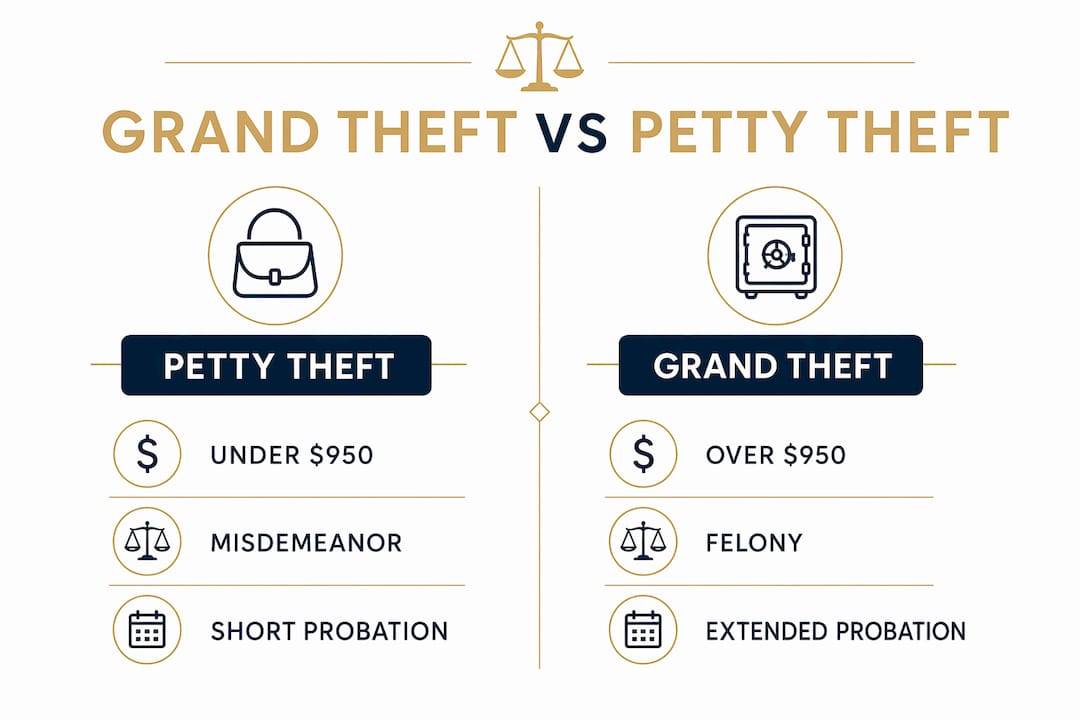
Pro Tip: If the value of stolen property is close to the $950 threshold, how that value is calculated matters enormously. Prosecutors use fair market value, not replacement cost or sentimental value. A skilled defense attorney can challenge the valuation and potentially reduce a grand theft charge to petty theft.

What are the penalties for a grand theft conviction in California?
Sentencing depends heavily on what was stolen and your prior record.
- Firearm theft (PC 487(d)(2)): Straight felony, punishable by 16 months, 2, or 3 years in state prison.
- All other grand theft (PC 487(c)(1)): Wobbler. The court may sentence you to up to one year in county jail (misdemeanor treatment) or to state prison under PC 1170(h) (felony treatment).
- Fines: Up to $10,000 for felony grand theft convictions in most categories.
- Probation: Formal felony probation, typically three to five years, with conditions including community service, restitution payments, and regular check-ins with a probation officer.
- Enhanced sentences: Large-scale resale operations, property damage exceeding $50,000 during a felony, and organized retail theft all carry mandatory sentencing enhancements under 2025 legislation.
- Prior convictions: A prior strike or serious felony conviction can double the base prison term under California's Three Strikes law.
The practical reality is that most first-time grand theft defendants who stole non-firearm property have a real shot at probation rather than prison, especially with strong legal representation. Repeat offenders, or anyone caught up in an organized theft ring, face a much harder road.
What defenses work against grand theft charges in California?
Grand theft requires proof that you intended to permanently deprive the owner of their property. That single element opens several credible defense paths.
- Lack of intent: You genuinely believed the property was yours, or you intended to return it. Borrowing without permission is not grand theft if you had no plan to keep the item.
- Claim of right: You had a good-faith belief you owned or had a legal right to the property, even if that belief turned out to be wrong. This defense does not require the belief to be reasonable, only sincere.
- Consent: The owner gave you permission to take the property. Disputes over whether consent was given or revoked are more common than people think.
- Insufficient value: The property did not actually meet the statutory threshold. Challenging the prosecution's valuation is a legitimate and often effective tactic.
- Unlawful search and seizure: Evidence obtained without a valid warrant or proper legal basis can be suppressed under the Fourth Amendment, sometimes gutting the prosecution's case entirely.
- Mistaken identity: Eyewitness misidentification is a documented problem in theft cases, particularly in retail settings with poor camera angles or brief contact.
The theft intent requirement is the prosecution's biggest burden, and it is also your biggest opportunity. A defense attorney who can raise reasonable doubt about intent can win even when the facts look bad on the surface.
What changed in California's grand theft laws in 2026?

California's 2025 property crime legislation represents the most significant overhaul of theft law in the state in decades. Several changes directly affect how grand theft is charged and prosecuted.
Aggregation across counties and victims: Under AB 2943, prosecutors can now combine theft values from different victims or different counties into a single felony grand theft charge, as long as the acts share one intention, one general impulse, and one plan. Evidence of a common plan can include acts involving the same defendant, substantially similar conduct, or acts occurring within a 90-day window.
Extended probation for petty theft and shoplifting: Probation terms for petty theft and shoplifting offenses doubled from one year to two years under the 2025 reforms, giving courts longer supervision windows for repeat offenders.
Retail theft restraining orders: AB 3209 authorizes courts to issue retail theft restraining orders barring convicted individuals from entering specific retail establishments for up to two years.
New crime: possession of stolen goods with intent to sell: Possessing more than $950 in stolen goods with intent to sell, exchange, or return them is now a standalone crime punishable by up to three years. Critically, prosecutors no longer need to prove the defendant knew the goods were stolen.
California's 2025 retail theft reforms give law enforcement and prosecutors new tools to tackle organized theft and protect local businesses, closing loopholes that previously allowed repeat offenders to avoid felony charges.
Does grand theft law apply differently across California counties?
The statute is uniform statewide, but how aggressively it gets enforced varies by county. Los Angeles, San Francisco, and San Diego each have their own district attorney priorities, charging policies, and diversion program thresholds. A DA's office in a rural county may handle a $1,200 theft very differently from one in a major urban jurisdiction where organized retail crime is a stated enforcement priority.
San Diego County, for example, has seen increased prosecution of organized retail theft rings operating across county lines, a pattern that the 2025 aggregation rules were specifically designed to address. AB 1779 now permits consolidation of theft charges from different counties into a single criminal case, which means a defendant who stole from stores in San Diego, Orange, and Riverside counties can face one unified prosecution rather than three separate ones.
Bail practices also differ. Some counties still release low-level theft suspects on their own recognizance; others have moved toward stricter pretrial detention for repeat offenders, particularly after the 2025 reforms extended the law preventing organized retail theft suspects from being released on a signed promise to appear.
How does a grand theft prosecution actually unfold?
Most grand theft cases move through a predictable sequence, though the timeline varies.
Arrest and booking come first, followed by arraignment, where you enter a plea and bail is set. For felony grand theft, the next major step is a preliminary hearing, where a judge decides whether the prosecution has enough evidence to proceed to trial. If the case survives that hearing, it moves to superior court for trial.
Plea negotiations happen at every stage. The majority of grand theft cases resolve through a plea deal rather than trial, often to a reduced charge or with an agreed-upon sentence. Whether to accept a plea or fight the charge at trial is one of the most consequential decisions you will make, and it depends on the strength of the evidence, your prior record, and what the prosecution is offering.
A San Diego theft defense attorney who knows the local courts, the judges, and the prosecutors can assess those factors accurately. Generic advice from the internet cannot.
How does a grand theft charge affect your future?
A felony grand theft conviction does not stay in the courtroom. It follows you.
Background checks for employment flag felony convictions, and many employers in finance, healthcare, education, and government will not hire someone with a theft-related felony. Professional licensing boards for nurses, real estate agents, contractors, and attorneys treat theft convictions as grounds for denial or revocation. Landlords routinely reject rental applications from felony convicts, and federal housing assistance programs have their own exclusion rules.
Immigration consequences are serious for non-citizens. Theft offenses classified as crimes involving moral turpitude can trigger deportation proceedings or bar someone from adjusting their immigration status. The stakes are not abstract.
California does allow expungement of certain theft convictions after probation is completed successfully, but expungement does not erase the record for all purposes. It helps with private employment but does not restore professional licenses or eliminate immigration consequences.
How does intent shape the charges and penalties you face?
Intent is the engine of every theft prosecution. Without proof that you meant to permanently deprive the owner of their property, the charge fails. That is why the same act can lead to very different outcomes depending on what the evidence shows about your state of mind.
Taking a car for a joyride with the intent to return it, for instance, is not grand theft auto under PC 487(d)(1). It is more likely charged under Vehicle Code § 10851 as unlawful taking of a vehicle, which carries its own penalties but is treated differently. The distinction turns entirely on whether you intended to keep the car.
Intent also affects sentencing after conviction. Judges weigh whether the theft was opportunistic or planned, whether it targeted a vulnerable victim, and whether it was part of a larger scheme. Organized, premeditated theft draws harsher sentences than impulsive, one-time conduct, even when the dollar amounts are similar.
How does restitution work in a California grand theft case?
California courts are required to order restitution to crime victims in virtually every criminal case, including grand theft. Restitution covers the victim's actual economic losses: the fair market value of stolen property, repair costs, lost income, and related expenses. It is separate from any fine paid to the court.
Restitution orders survive bankruptcy and cannot be discharged. If you are placed on probation, paying restitution is almost always a condition of that probation. Failure to pay can result in probation revocation and a return to custody.
Victims can also pursue civil remedies independently of the criminal case. A grand theft conviction makes a civil judgment much easier to obtain, since the criminal standard of proof is higher than the civil one. Settling restitution early and demonstrating a commitment to making the victim whole can influence both the plea negotiation and the judge's sentencing decision.
Facing grand theft charges in San Diego? Get real help.

Grand theft charges in California carry consequences that extend far beyond the courtroom. A felony conviction can close doors in your career, housing, and personal life for years. Logancriminaldefense, the Law Offices of Logan Noblin, APC, has built a track record of not-guilty verdicts and case dismissals for clients facing exactly these charges in San Diego.
Logan Noblin, a former "Attorney of the Year," brings aggressive advocacy and deep local knowledge to every grand theft defense case. If you are facing a theft charge, the time to act is before the preliminary hearing, not after.
Contact Logancriminaldefense for a consultation today.
Key Takeaways
Grand theft under California Penal Code § 487 is a felony triggered by property valued over $950, or by the theft of firearms, automobiles, or property taken directly from a person, regardless of value.
| Point | Details |
|---|---|
| Core value threshold | Property worth more than $950 qualifies as grand theft; firearms and autos qualify regardless of value. |
| 2025 aggregation rule | Prosecutors can now combine theft values across multiple victims or counties to reach the $950 felony threshold. |
| Firearm theft sentencing | Stealing a firearm carries 16 months, 2, or 3 years in state prison as a straight felony. |
| Probation doubled | Petty theft and shoplifting probation terms increased from one year to two years under 2025 reforms. |
| Intent is the key element | Proving permanent deprivation intent is required for conviction; lack of intent is the strongest defense available. |