
A federal target letter tells you the government considers you a likely defendant. Retain experienced federal criminal defense counsel today — not tomorrow, not after you make a few calls. Today.

In the first 24 hours, do not call the prosecutor's office, do not contact anyone named in the letter, and do not delete a single file, email, or text message. Those three mistakes alone can turn a difficult situation into an unwinnable one.
Pro Tip: Do not read the letter and assume you have time to think it over. Federal investigations move on their own schedule, and your options narrow the longer you wait to get counsel involved.
Table of Contents
- What a federal target letter actually is
- Who sends a federal target letter and why
- A target letter is not an indictment — but here is what comes next
- What to do in the first 24 hours and first week
- Grand-jury subpoenas, the Fifth Amendment, and your rights
- Common mistakes that make a bad situation worse
- How to read the DOJ sample target letter
- How an experienced federal defense attorney responds to a target letter
- Key Takeaways
- The window before indictment is where cases are won or lost
- Facing a federal investigation? Here is how Logancriminaldefense can help
- Useful sources and official resources
What a federal target letter actually is
The DOJ Criminal Resource Manual defines a "target" as a person for whom a prosecutor or grand jury has substantial evidence linking them to a crime. A target letter is the formal written notice that you hold that status. It is not a charge, not an arrest warrant, and not an indictment — but it is the clearest signal the government will give you before one of those things happens.
DOJ policy requires issuing a target letter when a person subpoenaed to testify before a grand jury is considered a target, specifically to promote fairness and ensure the recipient understands the risks. The letter typically serves several purposes at once:
- Notifying you of your status as a target of the investigation
- Advising you of your right to refuse to answer questions that may incriminate you
- Inviting you to testify before the grand jury (which you are not required to do)
- Warning you to preserve documents, devices, and records
- Providing contact information for the assigned prosecutor
Prosecutors also use these letters strategically. Experts note that while letters are intended to promote fairness, they also preserve the admissibility of grand-jury testimony and create an opening for cooperation discussions.
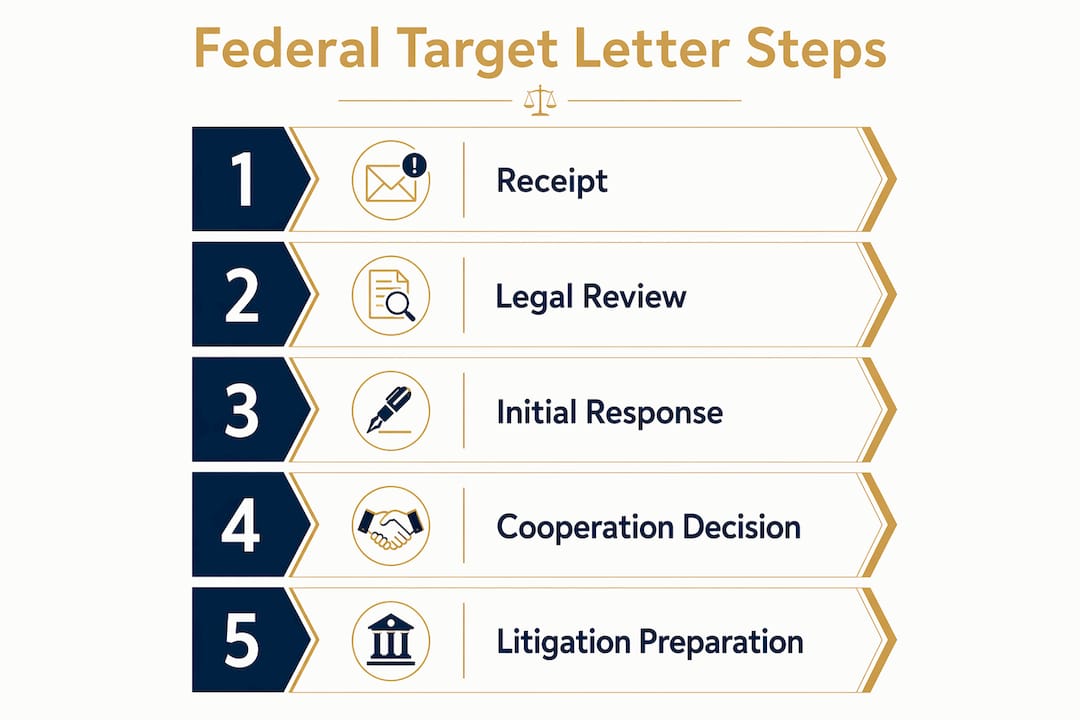
Who sends a federal target letter and why
Several federal entities can issue a target letter, and knowing which one sent yours affects how your attorney will respond.

U.S. Attorney's Office — The most common source. Assistant U.S. Attorneys (AUSAs) handle federal prosecutions district by district. When an AUSA sends a target letter, it signals the investigation has reached the stage where charges are being seriously considered. The specific U.S. Attorney's Office that sends the letter determines which federal district has jurisdiction over your case.
Department of Justice Main Justice — For high-profile or nationally significant investigations, DOJ divisions (the Criminal Division, the National Security Division, or specialized units) may issue letters directly rather than through a local U.S. Attorney's Office.
FBI and other federal agencies — The FBI, IRS Criminal Investigation, DEA, HSI, and other agencies conduct the underlying investigations. They do not issue target letters themselves, but their findings drive the AUSA's decision to send one. An FBI agent delivering or mailing a letter is acting on behalf of the U.S. Attorney's Office.
Grand jury channels — When a grand jury is actively investigating and you are called as a witness, the AUSA supervising the grand jury will issue a target letter before your testimony if you are considered a target. This is a DOJ policy requirement, not a courtesy.
The timing matters too. Letters typically arrive after subpoenas have already gone out to others, after records have been obtained, and after the investigation is well into its final phase. By the time you receive one, the government has likely been building its case for months.
A target letter is not an indictment — but here is what comes next
A target letter carries no legal force by itself. It does not charge you with a crime, it does not restrict your movement, and it does not trigger any mandatory court appearance. Under Federal Rule of Criminal Procedure 7, an indictment requires a grand jury vote — a separate, formal step that has not happened yet.
What the letter does signal is that the government believes it has substantial evidence. That distinction matters practically, not just legally, because the period between a target letter and a potential indictment is the window where your attorney can do the most work.
There is no fixed statutory timeline for indictment after a target letter. Some cases move in weeks; others take months or longer depending on case complexity, the number of targets, and whether cooperation discussions are underway. Federal statutes of limitations set outer bounds, but within those limits the government controls the pace.
The realistic outcomes after receiving a letter fall into three categories:
- Declination — The government decides not to charge you. This can happen when evidence is insufficient, when a cooperating witness becomes unavailable, or when your attorney successfully argues against prosecution before charges are filed.
- Plea or cooperation agreement — You and your attorney negotiate terms before indictment. This is often the most favorable path when the evidence is strong, and it typically results in reduced charges or sentencing recommendations.
- Indictment and prosecution — The grand jury votes to charge you and the case proceeds to trial or further negotiation.
Pro Tip: Your leverage is highest before indictment. Once charges are filed, cooperation credit diminishes and the government's posture hardens. Treat the letter as a deadline, not a warning.
What to do in the first 24 hours and first week
Speed and discipline in the days after receiving a target letter can materially change your outcome. Follow this sequence.
First 24 hours:
- Retain federal criminal defense counsel. Former prosecutors and defense attorneys are clear: targets do not have a right to appointed counsel at the investigative stage, so you must hire your own. Call a federal defense attorney before you do anything else.
- Do not speak to any federal agent, prosecutor, or AUSA. Not to explain yourself, not to "clear things up," not even to say you will call back later. Anything you say can and will be used against you.
- Do not contact anyone else named in or connected to the investigation. Reaching out to co-targets or potential witnesses can be characterized as obstruction or witness tampering.
- Stop using work email and messaging apps for anything related to the matter. Assume those communications are already being monitored.
First week — preservation checklist:
- Preserve all personal devices (phones, laptops, tablets) exactly as they are. Do not factory reset, delete apps, or clear browser histories.
- Back up cloud accounts (Google Drive, iCloud, Dropbox) without deleting anything.
- Preserve work devices if you have access; inform your attorney immediately if your employer controls those devices.
- Tell family members not to delete any communications, photos, or files that could be related to the investigation.
- Collect and organize paper documents, financial records, and correspondence in a secure location for your attorney's review.
When you call an attorney, keep it simple: Say you received a federal target letter, give the name of the issuing office if it appears on the letter, and ask for an urgent consultation. Do not describe the facts of the investigation on that first call — save the details for a privileged meeting.
Pro Tip: Destroying or altering materials after receipt of a target letter can result in obstruction charges that may be easier for prosecutors to prove than the underlying offense. Preservation is not optional.
Grand-jury subpoenas, the Fifth Amendment, and your rights
If your target letter includes an invitation or subpoena to testify before a grand jury, the stakes just went up. Grand-jury proceedings are secret by design — only specific persons may attend, witnesses cannot bring an attorney into the room, and everything said is sealed. That asymmetry is exactly why targets should never testify without thorough preparation and legal guidance.
Sample target-letter language used by U.S. Attorney's Offices states explicitly that anything you say may be used against you and that you have the right to consult counsel and refuse to answer incriminating questions. Read that language carefully — it is not boilerplate.
Do/don't list for grand-jury testimony:
- Do consult your attorney before responding to any subpoena or invitation to testify.
- Do understand that you may step outside the grand-jury room to consult counsel between questions.
- Don't testify as a target without counsel's explicit guidance — almost every experienced federal defense attorney will advise against it.
- Don't assume that "just telling the truth" protects you. Prosecutors can use your testimony to build a stronger case, and any inconsistency becomes a potential perjury exposure.
Invoking the Fifth Amendment means asserting your constitutional right not to answer questions that could incriminate you. You can invoke it in front of the grand jury. Doing so cannot be used as evidence of guilt in a subsequent criminal trial.
Proffer agreements are negotiated arrangements where you agree to provide information to prosecutors in exchange for limited use protections. A well-handled proffer can preserve cooperation options, but an unprepared or informal proffer can be used against you. Your attorney negotiates the terms and scope before you say a word.
Immunity — either use immunity or transactional immunity — is granted rarely and only at the government's discretion. Do not assume it will be offered.
Common mistakes that make a bad situation worse
Most of the damage targets do to their own cases happens in the first few days, before counsel is involved.
- Calling the prosecutor or agent directly. People do this thinking they can explain their way out. What actually happens: the call is recorded, anything you say is admissible, and you have just handed the government a statement made without counsel.
- Deleting emails, texts, or files. This is the fastest path to an obstruction charge. Prosecutors often find deletion activity in metadata, and obstruction can be easier to prove than the underlying crime.
- Contacting co-targets or witnesses. Even a "just checking in" text can be characterized as an attempt to coordinate stories or intimidate a witness. Let your attorney handle all such contact.
- Posting on social media. Anything you post publicly — or even in private messages on platforms subject to subpoena — can be obtained by investigators. Go quiet.
- Trying to resolve the matter without an attorney. Some people believe that hiring a lawyer "looks guilty." In federal investigations, going unrepresented looks far worse and produces far worse outcomes.
- Ignoring the letter. A target letter is not a summons with a mandatory response deadline, but ignoring it means losing the cooperation window and any chance to influence the government's charging decision.
The practical alternative to each of these mistakes is the same: route everything through your attorney. That is not a cliché — it is the structural protection that keeps your statements privileged and your options open.
How to read the DOJ sample target letter
The DOJ Criminal Resource Manual publishes a sample target letter that shows the standard language U.S. Attorney's Offices use. Reading that sample alongside your own letter helps you understand what each element means and what it requires of you.
When you first open your letter, read in this order:
- Who sent it — Which U.S. Attorney's Office or DOJ division, and which AUSA is listed as the contact.
- Any deadlines — A response date, a grand-jury appearance date, or a document production deadline.
- Subpoena language — Whether you are being compelled to produce documents or testify, or merely invited.
- Your rights language — The explicit statement of your right to counsel and your right to refuse incriminating answers.
- Preservation warnings — Any instruction not to destroy documents or records.
- Contact instructions — How and whether you (or your attorney) should respond.
| Letter element | What it signals | Immediate action |
|---|---|---|
| Issuing office and AUSA name | Jurisdiction and who controls the case | Share with counsel immediately |
| Grand-jury appearance date | Compelled testimony is being sought | Do not appear without an attorney |
| Document subpoena | Records are being demanded under legal compulsion | Preserve everything; counsel reviews scope |
| Rights/Fifth Amendment language | Government acknowledges your exposure | Do not waive these rights without counsel |
| Preservation warning | Destruction of evidence now carries obstruction risk | Implement a litigation hold immediately |
| Invitation to cooperate | Prosecution may be negotiable | Counsel evaluates cooperation strategy |
How an experienced federal defense attorney responds to a target letter
The attorney's job starts the moment you call. Here is what a methodical federal defense response looks like in practice.
- Immediate case intake and conflict check — Counsel reviews the letter, confirms no conflicts, and establishes the attorney-client relationship so all subsequent communications are privileged.
- Preservation notice — A formal litigation hold goes out to you (and sometimes to employers or third parties) directing that all potentially relevant materials be preserved. This creates a documented record that you acted in good faith.
- Privilege review — Counsel identifies which documents are protected by attorney-client privilege or work-product doctrine before any production is made.
- Evidence mapping — Counsel reconstructs what the government likely has based on the letter's language, the issuing office's known practices, and any prior subpoenas or search warrants you are aware of.
- Proffer strategy — If cooperation is worth considering, counsel evaluates whether a proffer agreement is appropriate, negotiates its terms, and prepares you thoroughly before any meeting with prosecutors.
- Plea and negotiation evaluation — Counsel assesses the strength of the government's case and whether pre-indictment resolution serves your interests better than contesting charges.
- Litigation readiness — If the case is heading toward trial, counsel begins building the defense narrative, identifying witnesses, and preparing for grand-jury proceedings.
Federal practice differs from state court in ways that matter. Federal sentencing guidelines, mandatory minimums, and the resources available to federal prosecutors make these cases categorically more complex than most state matters. An attorney with federal felony defense experience knows how U.S. Attorney's Offices operate, how grand juries are managed, and where the leverage points are in pre-indictment negotiations.
Key Takeaways
A federal target letter is a formal signal that the government has substantial evidence against you — retaining experienced federal counsel immediately is the single most consequential step you can take.
| Point | Details |
|---|---|
| Not an indictment | A target letter carries no charges; it is a pre-indictment notice under DOJ policy. |
| Retain counsel immediately | Targets have no right to appointed counsel at this stage — hire your own before doing anything else. |
| Preserve everything | Destroying documents after receipt creates a separate obstruction exposure that may be easier to prove than the underlying offense. |
| Stay silent | Do not speak to agents, prosecutors, or co-targets; route all contact through your attorney. |
| Logancriminaldefense | The Law Offices of Logan Noblin, APC handles federal defense in San Diego, including grand-jury preparation and pre-indictment strategy. |
The window before indictment is where cases are won or lost
Most people who receive a target letter focus on the wrong question. They want to know whether they will be charged. The better question is: what can be done right now, before that decision is made?
Pre-indictment representation is where experienced federal defense counsel earns its keep. The government has been building its case for months, sometimes years. By the time a target letter arrives, the investigation is not starting — it is concluding. That means the window to influence the outcome is narrow, and it closes the moment an indictment is returned.
What actually changes outcomes at this stage is not dramatic courtroom advocacy. It is methodical, unglamorous work: a well-timed proffer, a carefully negotiated cooperation agreement, a privilege review that keeps key documents out of the government's hands, a persuasive pre-indictment memorandum to the AUSA arguing against charges. None of that happens without counsel who has done it before in federal court.
The conventional wisdom says "get a lawyer." That is true but incomplete. Get a lawyer who has sat across the table from AUSAs, who understands how federal grand juries are managed, and who can assess within the first consultation whether cooperation, litigation, or a hybrid strategy fits your specific facts. The letter in your hand is not the end of the story. It is the moment where the story can still be shaped.
Facing a federal investigation? Here is how Logancriminaldefense can help
Logancriminaldefense — the Law Offices of Logan Noblin, APC — offers something most general criminal defense firms cannot: a San Diego attorney with a documented record of not-guilty verdicts and case dismissals in federal matters, available for an urgent consultation the same day you call.

When you contact the firm after receiving a target letter, the first consultation covers the letter's language, your immediate preservation obligations, and a frank assessment of where the investigation likely stands. There is no obligation to retain after that call, but there is every reason to make it. The firm handles federal criminal defense across a range of matters — from grand-jury preparation and proffer negotiation to full pre-indictment strategy and trial representation. All consultations are confidential. Call or reach out through the website to speak with Logan Noblin directly.
Useful sources and official resources
These primary sources let you verify the facts in this article and read the official language yourself:
- DOJ Criminal Resource Manual — Sample Target Letter (justice.gov) — The official DOJ sample showing standard target-letter language and policy basis.
- U.S. Attorneys | Charging | DOJ (justice.gov) — Explains the grand-jury process, indictment requirements, and how federal charges are brought.
- Federal Rules of Criminal Procedure, Rule 7 — LII / Cornell Law — The rule governing indictments and the formal charging process.
- National Law Review — "I Received a Federal Target Letter — Now What?" — Practitioner commentary on preservation, timeline, and immediate steps.
- The Conversation — "What Is a Target Letter?" — Academic and policy analysis of DOJ target-letter practice.
Procedures vary by federal district. Confirm district-specific rules and deadlines with qualified federal defense counsel in your jurisdiction. This article provides general legal information, not legal advice — consult a licensed attorney about your specific situation.