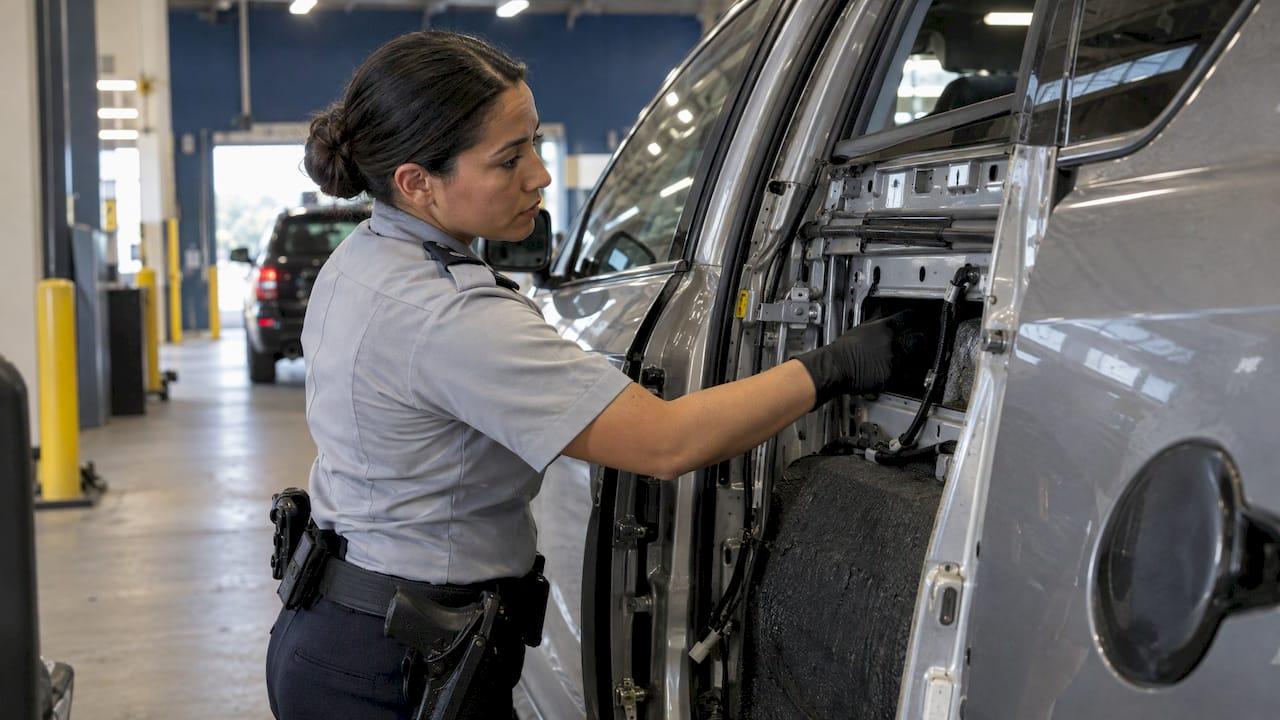
A federal drug courier charge means prosecutors say you moved drugs from one place to another, by car, by air or on your body. The label "courier" is not a separate crime. You are charged under the same federal trafficking and importation statutes as anyone else, and what you carried, how much, and what you knew decide the exposure. The good news is that your role and your knowledge are also where a defense is built. Early work by a federal defense attorney can change how the case ends, and we handle these cases for people arrested in San Diego and at the border through our federal and border defense practice.
TL;DR
- "Courier" describes your role, not a charge. Charges usually come from importation, possession with intent to distribute, or distribution statutes.
- Some federal drug offenses carry a mandatory minimum of 10 years up to life, depending on drug and quantity.
- Prosecutors must prove you acted knowingly. "I didn't know what was in the car" is the most contested issue in border cases.
- Since November 1, 2025, the sentencing guidelines say a low-level courier role generally warrants a mitigating-role reduction.
- Act before charges are final: the earliest decisions about statements, bail and cooperation shape everything after.
Table of Contents
- What counts as a drug courier under federal law
- What penalties a courier can face
- Being a courier does not guarantee a reduction
- What prosecutors must prove: knowledge
- What happens after arrest
- A pending bill that could change the minimums
- How we approach courier cases
- Talk to a federal defense attorney in San Diego
- FAQ
- Sources
What counts as a drug courier under federal law
The U.S. Sentencing Commission, the agency that writes the federal sentencing guidelines, separates two kinds of transporters in its report to Congress on mandatory minimums. A "courier" carries drugs with the help of a vehicle or other equipment. A "mule" carries them internally or on the person, often by air or across a border, including in baggage or clothing.
Neither word appears as a crime in the statute. In practice the government charges what the act looks like:
- Importation or exportation. Bringing a controlled substance into the country, or having it on a vessel, aircraft or vehicle, is covered by 21 U.S.C. § 960. This is the usual charge at ports of entry.
- Possession with intent to distribute. Carrying a quantity too large for personal use, even when you were never going to sell it yourself.
- Distribution. Handing the drugs to someone, including through the mail. Using the postal system makes it a federal matter, whatever the amount.
- Conspiracy. An agreement with others to move the drugs, which can be charged even if the delivery never happened. See our page on federal drug conspiracy defense.
In San Diego, most courier cases begin at a border crossing or checkpoint. Our pages on federal drug importation and drug smuggling describe how those cases start.
What penalties a courier can face
The penalty follows the drug and the quantity, not the job title. Under § 960, specified violations involving threshold amounts of listed drugs carry not less than 10 years and up to life. If death or serious bodily injury results, the range is 20 years to life. Fines can reach the greater of the Title 18 amount or $10 million for an individual.
A prior conviction raises the floor. A prior serious drug felony or serious violent felony lifts the minimum to 15 years under the same statute. Since the First Step Act of 2018, only those more serious priors count, rather than any prior felony drug offense, as the Sentencing Commission's summary of the changes explains.

Those numbers are the statutory ceiling and floor, not a prediction. Many people charged as couriers are sentenced well below them, through two doors: the safety valve and a reduction for minor role.
The safety valve
The safety valve in 18 U.S.C. § 3553(f) lets a court sentence below a mandatory minimum when you meet certain conditions. The First Step Act widened it. Eligibility now turns on criminal history: no more than 4 points (not counting 1-point offenses), no prior 3-point offense and no prior 2-point violent offense, per the Commission's amendment summary. The same summary notes that what you disclose under the safety valve generally cannot be used to raise your sentence unless it relates to a violent offense, and that qualifying defendants get a 2-level reduction in the drug guideline.
The safety valve has other requirements, and the way you meet them matters. This is a conversation to have with your attorney before you say anything to agents or prosecutors.
The minor-role reduction
The guidelines let a judge lower the offense level for a defendant who played a minor part. Section 3B1.2 treats a primary function of courier, errand runner or lookout as among the lowest-level drug functions for which an adjustment is generally warranted.
A 2025 change strengthened this. Amendment 833, effective November 1, 2025, added a special instruction to § 2D1.1: the adjustment applies whether or not other participants were involved and whether or not you were substantially less culpable than the average participant. The judge first asks whether § 3B1.2 applies by its own terms. The size of the reduction then depends on the totality of the circumstances.
Being a courier does not guarantee a reduction
This is where cases are won or lost on detail. The Commission's 2026 primer on role adjustments notes that courts have consistently held courier or mule status alone does not automatically earn a minor-role reduction. The Eighth Circuit, in United States v. Beridon (2022), said being "merely a mule" is relevant but did not entitle a defendant to the reduction, even with low cognitive functioning, no prior involvement and limited pay.
Other courts have gone the other way on facts that were well presented. The same primer describes an Eighth Circuit case in which a courier inside a larger distribution network could receive the adjustment even on a possession-with-intent conviction.
The First Circuit's 2025 decision in United States v. Flores-Álvarez shows how the comparison works. A courier moved 8 kilograms of cocaine through a Puerto Rico airport. The court vacated his sentence because the judge looked only at his own steps. The correct method has four parts:
- Identify the universe of participants, including those who procured the drugs and the recipient.
- Order them on a culpability continuum.
- Identify the average participant.
- Compare your role to that average.
The primer lists the facts courts weigh for couriers: the amount and market value of the drugs, what you were paid, whether you held any equity interest in the drugs, your role in planning, and your role in distribution. Each is evidence your lawyer can gather and present before sentencing.
A worked example
Imagine a driver stopped at a port of entry with a quantity of methamphetamine in a hidden compartment. He was offered a few thousand dollars for the trip, never met the supplier, and had no say in the route or the buyer. Those facts point to a low-level function. A defense team would document the payment, the lack of decision-making authority and the people above him. The Flores-Álvarez method then asks where he sits among everyone involved, not just among the people in the car. The same facts, left undeveloped, can leave a judge seeing only a person who carried a large quantity.
What prosecutors must prove: knowledge
For a possession charge, the government must prove beyond a reasonable doubt that you knowingly possessed the drug with intent to distribute it. For importation, it must show you played a role in bringing it into the country. The Fifth Circuit laid out those elements in United States v. Layne, and also upheld an inference of knowledge from a same-day round trip to Mexico for $1,000 to $5,000, a warning that drugs were involved, and repeated lies about the trip.
That case shows what prosecutors lean on: unusual pay, a short trip, inconsistent stories. The classic defense is that you were deceived. In United States v. Maloney, a driver found with 321 pounds of marijuana in his truck cab said he thought he was hauling bleach. That is a typical border case where knowledge is the only contested element.

Expert testimony about couriers
In 2024 the Supreme Court decided Diaz v. United States. It held that an expert may testify that most couriers know what they are carrying, because that statement is about a group and not about the defendant, so it does not violate Federal Rule of Evidence 704(b). Diaz had been convicted of importing over 54 pounds of methamphetamine. Expect the government to use this kind of testimony, and expect a prepared defense to challenge how the expert's opinion fits your facts.
What happens after arrest
A typical sequence, as in Flores-Álvarez, where agents interdicted a courier at an airport: arrest, initial appearance before a magistrate judge, indictment, then either a plea or trial. That courier pleaded guilty and sought a mitigating-role adjustment at sentencing.
Three moments deserve attention:
- The first questioning. Anything you say about who gave you the drugs, what you were paid and what you suspected can become evidence of knowledge. You have the right to ask for a lawyer before answering.
- Charging and bail. The charge chosen, and the quantity alleged, sets whether a mandatory minimum is in play.
- Pre-sentencing. Your role, your history and your cooperation, if any, are presented in the presentence report. In one First Circuit case, the report found no evidence of any involvement beyond acting as a courier and recommended a two-level minor-role reduction. How that record is built matters.
A pending bill that could change the minimums
The Smarter Sentencing Act of 2026 (S.3959) is a proposal, not law. As written, it would define "courier" as a defendant whose role was limited to transporting or storing drugs or money, and would lower several mandatory minimums in 21 U.S.C. § 841(b)(1). The Senate Judiciary Committee's section-by-section summary says the lower importation minimums would apply only to couriers. Until it passes, the current statutes and guidelines control your case. Ask your attorney whether its status affects timing.
How we approach courier cases
We start from a simple view: a courier case is a story about a person, and the story is usually not the one in the complaint. Prosecutors see a quantity and a vehicle. A judge deserves to see who asked you, what you were told, what you were paid and who was above you.
Our work is to build that account early. We write for judges and juries, we try cases, and we have won not guilty verdicts and dismissals. We also bring pre-charge intervention to the table, because the best time to shape a federal case is before it hardens.
If you were stopped at the border, arrested at an airport or contacted by agents, call before you give a statement. The role you played is the part of the case that we can still define.
Logan Noblin
Talk to a federal defense attorney in San Diego
We represent people facing federal drug importation, smuggling, transportation and trafficking charges. If you or a family member is accused of carrying drugs for someone else, start with our federal and border defense page, or read about drug transportation defense and drug trafficking defense.

Our Federal Drug Trafficking Charges guide explains why acting early matters.
FAQ
What is a drug courier?
A courier is someone who transports drugs, usually by vehicle, for another person. The Sentencing Commission distinguishes this from a mule, who carries drugs on or inside the body. Both are charged under ordinary federal drug statutes.
How many years can a federal drug courier face?
It depends on the drug, the quantity and your record. Certain importation violations carry 10 years to life, and 15 with a prior serious drug felony. Actual sentences can be lower through the safety valve or a minor-role reduction.
Can I be convicted if I did not know there were drugs?
The government must prove you acted knowingly. It can use circumstances, such as unusual payment, a quick trip or inconsistent statements, to argue you knew. Whether your account is believable is the central question in many border cases.
Does being a courier automatically reduce my sentence?
No. Courts have held that courier status alone does not guarantee a minor-role reduction. Since November 2025, though, the guidelines say the adjustment is generally warranted for a primary low-level function like couriering, and the judge weighs the facts of your case.
Is mailing drugs a federal crime?
Yes. Sending controlled substances through the U.S. mail brings federal charges, and the amount does not need to be large.
Sources
- USSC Report to Congress, Appendix H
- 21 U.S.C. § 960
- USSC 2023 reader-friendly amendments
- 2026 Guidelines Manual, Chapter 2 Part D
- USSC Amendment 833
- USSC Primer on Aggravating and Mitigating Role
- United States v. Beridon (8th Cir. 2022)
- United States v. Flores-Álvarez (1st Cir. 2025)
- United States v. Layne (5th Cir. 2014)
- United States v. Maloney (9th Cir. 2014)
- Diaz v. United States (2024)
- United States v. Reid (1st Cir. 2018)
- S.3959, Smarter Sentencing Act of 2026
- Senate Judiciary Committee section-by-section summary