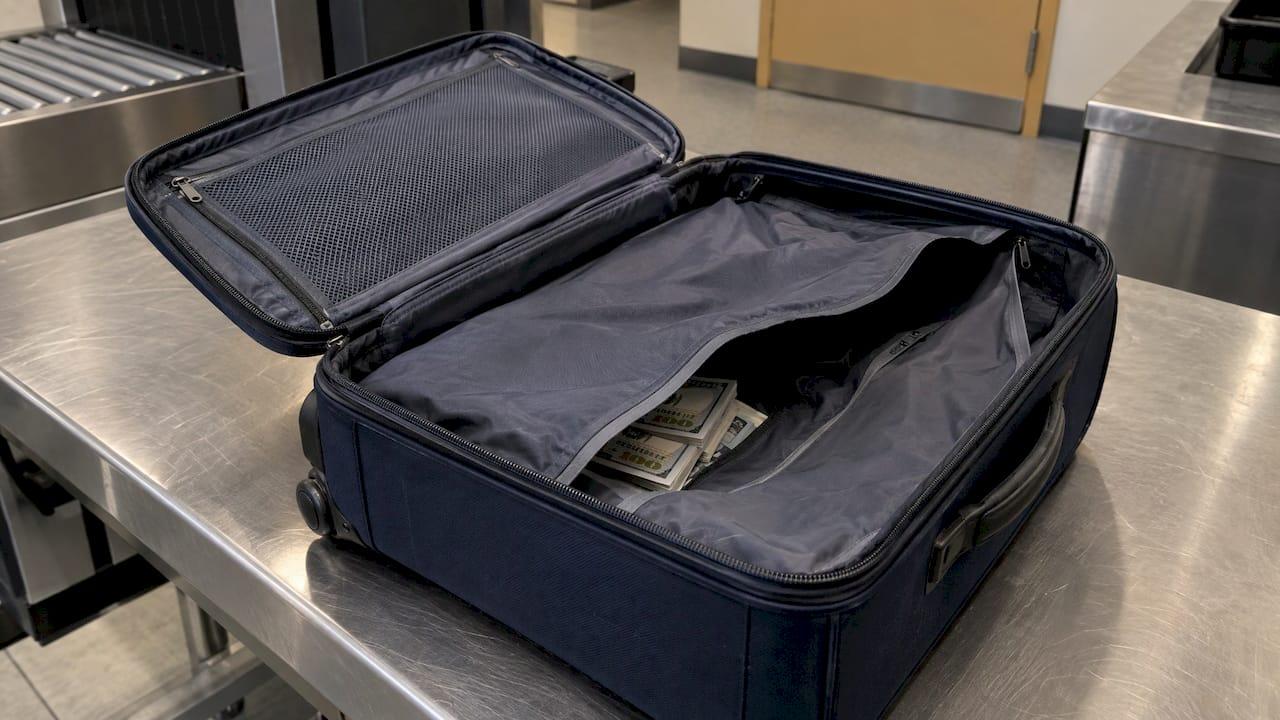
31 U.S.C. § 5332 makes it a federal crime to knowingly conceal more than $10,000 in currency or monetary instruments and move it into or out of the United States, with the intent to evade the currency reporting requirement. A conviction can bring up to 5 years in prison and forfeiture of the cash. Carrying cash across the border is not the offense by itself. Concealment plus intent to evade the report is what turns it into a felony case.
This guide explains the statute in plain terms: the elements, the penalties, how seizures and forfeiture work, and what matters in a defense. We write it from San Diego, where border crossings make this a real issue for travelers, families and businesses.
TL;DR
- Section 5332 targets knowingly concealing more than $10,000 in currency or monetary instruments while moving it across the U.S. border, with intent to evade the reporting requirement.
- The maximum prison term is 5 years, and the court must order forfeiture of property involved in the offense and property traceable to it.
- The cash can be seized at the border or airport, and the criminal charge may follow later.
- Prosecutors must prove knowledge and intent. Those elements are often argued from circumstantial evidence, so the facts around the cash matter.
- If cash was seized or agents contacted you, speak with a federal defense attorney before you give any statement.
Table of Contents
- What 31 U.S.C. § 5332 actually prohibits
- Reporting versus smuggling: where the line sits
- What prosecutors must prove
- Penalties: prison and forfeiture
- Seizure comes first, and often the charge comes later
- What to do in the first hours and days
- How a defense is built
- Our perspective
- Talk to a San Diego federal and border defense team
- Common mistakes people make
- FAQ
- Sources
What 31 U.S.C. § 5332 actually prohibits
The statute is titled "Bulk cash smuggling into or out of the United States." Under § 5332(a)(1) as published by the Office of the Law Revision Counsel, a person commits the offense when, with intent to evade a currency reporting requirement under 31 U.S.C. § 5316, he or she:
- knowingly conceals more than $10,000 in currency or other monetary instruments on the person or in a conveyance, article of luggage, merchandise or other container, and
- transports or transfers, or tries to transport or transfer, that cash from inside the United States to outside it, or from outside to inside.
Several parts of that sentence deserve attention.
"More than $10,000." The threshold is an amount above $10,000, and it applies to currency and other monetary instruments, not only to paper bills.
"Conceals." The statute is aimed at hidden cash: money in a bag, a vehicle, a package or on the body. Cash openly declared on the required form is a different situation.
"Attempts." You do not have to complete the crossing. An attempt to move the cash is covered.
"Intent to evade." The mental state is tied to the reporting requirement. That is why the law is usually described as a Bank Secrecy Act offense, and not as a ban on carrying cash. ICE's bulk cash smuggling FAQ frames it this way, linking criminal liability to evasion of the report.
What counts as a monetary instrument
Many people assume this is only about U.S. dollars in a suitcase. ICE explains that the term is defined for FinCEN Form 105 purposes. Under ICE's FAQ, it includes coin and currency, traveler's checks, certain negotiable instruments, incomplete instruments, and certain bearer securities or stock. It excludes certain instruments made payable to a named person with restrictive endorsements, as well as warehouse receipts and bills of lading.

The practical point is that a mix of cash and checks can be added up. A traveler who thinks "I only had $6,000 in bills" may be counting wrongly if cashier's checks or similar items were also in the bag.
Reporting versus smuggling: where the line sits
The most common misunderstanding is that moving more than $10,000 is illegal. It is not what § 5332 punishes. The reporting requirement (the § 5316 report, filed on FinCEN Form 105) is about disclosure. Section 5332 adds a separate, heavier offense for concealment combined with intent to evade that disclosure.
In practice, prosecutors sometimes charge both. A federal judgment in the Varanese case, for example, reflects guilty findings on a § 5332(a)(1) bulk cash smuggling count, a willful failure to file a currency report count under §§ 5316(a)(1)(A) and 5322(a), and a false statement count under 18 U.S.C. § 1001(a)(2). The false statement count is a reminder of how much a conversation with agents at the border can matter.
| Issue | Failure to report | Bulk cash smuggling (§ 5332) |
|---|---|---|
| Core conduct | Not filing the required report | Concealing the cash and moving it across the border |
| Amount | More than $10,000 | More than $10,000 |
| Key mental state | Willfulness regarding the report | Intent to evade the reporting requirement |
| Forfeiture | Possible under separate provisions | Mandatory on conviction, plus civil forfeiture |
This table is a simplified comparison. Which charges are brought in a given case depends on the facts and on what the prosecutor can prove.
What prosecutors must prove
Courts describe the elements in similar terms. In United States v. Camacho-Ontiveros, a 2019 Fifth Circuit case, the government had to prove that the defendant:
- knowingly concealed more than $10,000 in U.S. currency in the vehicle,
- attempted to transport it from inside the U.S. to outside,
- knew a report had to be filed with the Secretary of the Treasury, and
- intended to evade filing that report.
The Second Circuit stated the same core requirements in United States v. Varanese in 2011. That court also noted that mental-state elements can be proved by circumstantial evidence and reasonable inferences.
That last point shapes how these cases are fought. Nobody confesses to "intent to evade" in a neat sentence. The government points to how the money was packed, where it was hidden, what the person said, and what they knew about the rules. The defense looks at the same facts and asks whether they truly show knowledge and intent.
The elements most often contested
- Knowledge that the cash was there. In Varanese, the court looked at evidence on whether the defendant knew the cash was in the truck. A driver, passenger or borrower of a vehicle may genuinely not know what is inside it.
- Knowledge of the reporting requirement. The government must connect the person to awareness that a report was required.
- Concealment. Whether the money was truly hidden, or simply in a bag or wallet, can be a real dispute.
- Amount. The total must exceed $10,000. How the amount was counted, and which items were included, can matter.
- Crossing or attempt. Where the person was and what they were doing when stopped bears on whether there was a transport or attempt.
In a trial setting these issues are not abstract. In United States v. Del Toro-Barboza, a Ninth Circuit case from 2012, defendants were convicted after a four-day jury trial under § 5332 and § 5324 following the discovery of a bag holding $500,000. On appeal they argued, among other things, that the evidence was insufficient. California is in the Ninth Circuit, so its decisions carry particular weight for San Diego cases.
Penalties: prison and forfeiture
The penalty provisions of § 5332(b) have two main parts.
Prison. A person convicted under § 5332(a), or of conspiracy to commit it, may be imprisoned for up to 5 years. ICE describes the same maximum.
Forfeiture. On conviction, the court shall order forfeiture to the United States of any property, real or personal, involved in the offense, and any property traceable to it. If that property is unavailable and the defendant lacks enough substitute property subject to forfeiture under 21 U.S.C. § 853(p), the statute provides for a personal money judgment.
In short, the cash is not the only exposure. The statute reaches property traceable to the cash too, and a money judgment can follow the defendant.
Actual sentences depend on the federal sentencing process, the person's history and the other counts. The Varanese judgment mentioned above, for example, shows 24 months of imprisonment running concurrently on its first three counts. That is one case and not a prediction for any other.
Seizure comes first, and often the charge comes later

The statute also provides for civil forfeiture. Property involved in a violation or conspiracy, and any traceable property, may be seized and forfeited. This is separate from any criminal case. It means that the government can take the money at the border even if no one is charged that day, and possibly even if no one is ever charged.
CBP press releases show how encounters tend to unfold:
- In 2013 at Detroit Metro Airport, CBP seized $271,463 from a lawful permanent resident and his daughter after they failed to report the currency. They were arrested and turned over to ICE Homeland Security Investigations, and CBP stated that they were charged with bulk cash smuggling and conspiracy.
- In 2017 at the Port of Douglas, in an outbound inspection, CBP seized $70,000 in unreported currency and $50,000 in unendorsed cashier's checks, along with the vehicle. The subject was arrested and turned over to HSI.
Two things follow from those examples. First, a vehicle can be seized along with the money. Second, the agency that investigates is usually HSI, which means that a federal prosecutor, not a county DA, will decide what happens next.
What to do in the first hours and days
The period right after a seizure shapes everything else. These are practical steps for anyone in that spot.
- Do not argue the facts with agents. You are not required to explain where the money came from or why it was packed the way it was. Statements are a common source of extra charges, as the false statement count in the Varanese judgment illustrates.
- Ask for a lawyer. Say clearly that you want to speak with an attorney before answering questions.
- Keep every document you receive. Seizure notices, receipts for the cash, and property forms all carry deadlines and details that matter.
- Gather proof of the money's source. Bank records, sale documents, business ledgers, pay records and family transfer records help show what the money was for. Do not alter or create documents after the fact.
- Write down what happened while it is fresh. Who spoke to you, what was asked, what you said, what was searched and taken.
- Do not discuss the case with others by phone or text. Conversations can become evidence.
- Do not try to move or recover other funds in a way that looks like hiding assets. Talk to counsel first.
Because the charge may come weeks or months after the encounter, waiting to see what happens can cost you the chance to shape the outcome. An attorney can often communicate with prosecutors before charges are filed, and can address the civil forfeiture side at the same time as the criminal exposure.
How a defense is built
Every case is different, but the work tends to follow the elements.
Knowledge. If someone else packed the bag, owned the vehicle, or asked a favor, the question is what the person truly knew. Circumstantial evidence cuts both ways, and the defense can offer innocent explanations for the same facts.
Intent to evade. The report requirement is the target of the intent. Evidence that the person was unaware of it, or planned to report, or openly told officers about the money, goes directly to this element.
The search and the statements. How agents handled the stop, what questions were asked, and whether statements were voluntary can be examined. Federal border authority is broad, but the details of an encounter still matter.
The source and purpose of the money. Legitimate funds, such as business proceeds, savings, a property sale or family support, change the story a jury hears. They also matter for the forfeiture side, where the government's claim and the owner's claim are weighed.
Resolution paths. Some matters end without charges. Others resolve by negotiation, and some go to trial, as the Del Toro-Barboza case did. The right path depends on the evidence, and a lawyer should explain the options before you choose.
Our perspective
Bulk cash cases are won or lost on story and on proof of state of mind. The government has the money on a table. What it often lacks is a clear picture of why it was there, and whether the person truly knew about the report and meant to dodge it.
That is where we put our effort. Our approach is to build a client-centered narrative that judges, prosecutors and juries can understand, backed by documents, timelines and a close reading of what the agents did. Because these cases can start with a seizure and no charge, we also look for pre-charge intervention, so that the facts reach the decision-makers before a complaint is filed.
We handle federal and border matters in San Diego, and we know the way border encounters unfold here. If you are a traveler, a family sending money, or a business owner who was stopped, you do not have to sort this out alone, and you should not do it by talking to agents without counsel.
Logan Noblin
Talk to a San Diego federal and border defense team
If cash was seized, agents have contacted you, or you have been told a bulk cash charge may be coming, we can review what happened and explain your options. Our federal and border defense practice handles these matters in San Diego.

For a broader view of how we approach other border cases, see our pages on illegal smuggling defense and federal drug smuggling defense. You can also start at our main site to reach us about your situation.
Common mistakes people make
- Assuming that declaring is optional. The reporting requirement exists. The statute's focus is on concealing and evading it.
- Counting only bills. Monetary instruments can include several kinds of items, so the total may be higher than expected.
- Giving a casual explanation. A loose answer at the booth can become an element of the government's case, or a separate false statement charge.
- Waiting for the other shoe to drop. Because the criminal charge may come later than the seizure, delay can mean missed chances to talk to prosecutors early.
- Ignoring the forfeiture track. Civil forfeiture runs apart from the criminal case and has its own deadlines.
FAQ
Is it illegal to carry more than $10,000 across the border?
No, carrying it is not itself the § 5332 offense. The law punishes knowingly concealing more than $10,000 and moving it across the border with intent to evade the reporting requirement. The separate duty to file the report applies to amounts over that threshold, which is why failing to report can lead to its own charge.
What is the maximum penalty under 31 U.S.C. § 5332?
A conviction can carry up to 5 years in prison. The court must also order forfeiture of property involved in the offense and property traceable to it. If that property is unavailable, a personal money judgment may apply. The sentence in a real case depends on the facts and the federal sentencing process.
Can the government keep my cash even if I am not charged?
The statute authorizes civil forfeiture of property involved in a violation and traceable property, separate from any criminal case. Cash can therefore be seized at the border or airport before any charge is filed. An attorney can look at both the forfeiture claim and the potential criminal exposure together.
What do prosecutors have to prove?
Courts describe four core points: knowing concealment of more than $10,000, an attempt to transport it across the border, knowledge that a report was required, and intent to evade that report. Knowledge and intent can be shown through circumstantial evidence, so the surrounding facts are central to the defense.
Should I talk to agents if my money was seized?
Speak with a lawyer first. Statements made during a border encounter can be used later, and false or inaccurate statements can create their own federal charge. You can state that you want an attorney and decline to answer questions until you have one.
Sources
- 31 U.S.C. § 5332, Office of the Law Revision Counsel
- FAQ: Bulk Cash Smuggling, ICE
- United States v. Camacho-Ontiveros (5th Cir. 2019)
- United States v. Varanese (2d Cir. 2011)
- Judgment in United States v. Varanese (N.D.N.Y. 2009)
- United States v. Del Toro-Barboza (9th Cir. 2012)
- CBP: Detroit Metro Airport seizure of $271,463
- CBP: Douglas seizure of cash and cashier's checks